
How to Measure and Isolate W220 Parasitic Battery Draw
Measure W220 key-off battery current safely, allow modules to sleep, apply the 50 mA limit and isolate the circuit without resetting the fault.
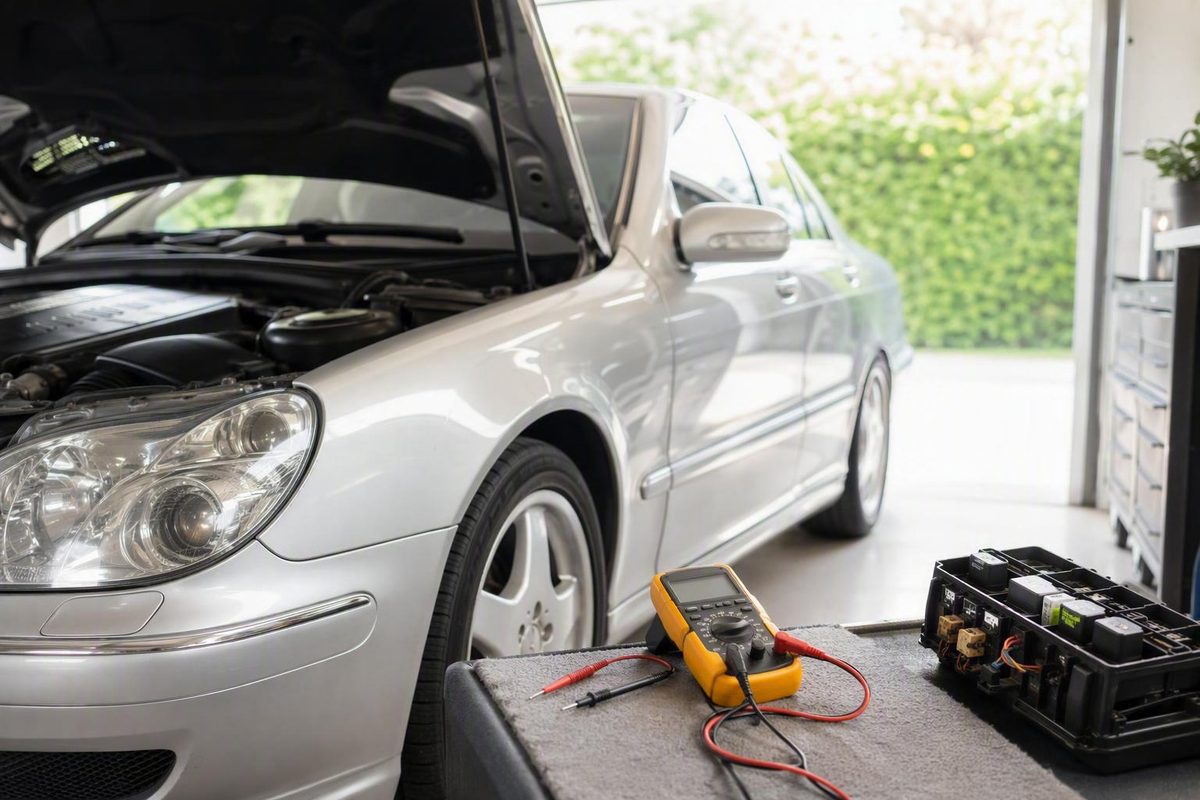
For a Mercedes-Benz W220 S-Class, measure parasitic draw at the trunk battery only after the car has entered sleep mode. The engine and transmission fitted do not change this basic test, but the model year changes which fuse panels are present.
A sleeping W220 should draw no more than 0.050 A (50 mA) at the battery after it has been locked for at least 20 minutes, according to a W220 procedure based on Mercedes WIS/Xentry information. That same procedure warns that operating the locks can momentarily exceed 20 A—well beyond the usual 10 A multimeter input (W220 S-Class Encyclopedia). Do not connect a handheld meter and then lock, unlock or start the car through it.
Before measuring current
First charge and test the battery, then verify that the charging system works. A weak battery or inadequate charging can produce the same repeated no-start complaint without an abnormal key-off load. Mercedes-focused diagnostic guidance likewise says to verify both the battery and charging system before pursuing quiescent draw (Automotive Tech Info).
Use:
- A digital multimeter with a fused 10 A DC-current input
- Sound test leads rated for that input
- A purpose-made battery disconnect/bypass switch or current-loop tool rated to carry the car’s wake-up current
- The fuse chart supplied with the specific car
A DC clamp probe is safer for initial monitoring because it does not open the battery circuit. The direct multimeter method below is appropriate only when the sleeping current is safely within the meter’s rating.
Connect the multimeter without waking the W220
- Switch off COMAND, lamps, climate REST mode and every accessory. Remove the key. Unplug aftermarket chargers, dashcams and diagnostic equipment unless one is the suspected load.
- Expose the battery and all fuse panels that may need testing. Arrange access without leaving courtesy lamps on. If manually closing a door or trunk latch with the panel open, attach a conspicuous reminder so nobody slams the panel against the closed latch.
- Set the meter to DC amps. Put the black lead in COM and the red lead in the fused 10 A jack. Start on the highest current range; do not begin in the milliamp jack. Fluke also directs users to start at the 10 A input, connect the meter in series at the negative battery terminal and never crank or operate high-current devices while measuring (Fluke).
- Install the rated bypass tool between the negative battery post and disconnected negative cable so the car remains powered. Connect the meter across the same two points: red lead to the battery post, black lead to the removed cable.
- With the bypass still carrying the current, put the car in its normal parked state and lock it. Do not touch a handle, remote, seat switch or other control afterward.
- Wait at least 20 minutes. Waiting 30–60 minutes is a sensible check if the reading is still declining; Mercedes systems use delayed switch-off, and testing before they sleep is not meaningful (Automotive Tech Info).
- Without disturbing the car, open the bypass switch so current transfers through the meter. Stop immediately if the display overloads, the meter fuse opens, a lead becomes warm or the draw approaches the meter’s continuous-current/time limit.
Never start the engine, switch on the headlamps, operate a seat or run the central-locking pump while the meter is the only battery path.
Read the result
Use the settled reading, not the initial wake-up current:
- 0.050 A or less: within the cited W220 sleep-current limit
- More than 0.050 A and stable: excessive draw is present during this test
- Reading falls in stages: modules are still shutting down; keep waiting
- Normal now, but battery sometimes dies: the fault may be intermittent and require overnight current logging rather than parts replacement
Check the units carefully. 0.05 A is 50 mA, while 0.50 A is 500 mA. For scale, a continuous 50 mA consumes 1.2 Ah per day; 250 mA consumes 6 Ah per day.
Isolate the circuit without erasing the evidence
Keep the meter monitoring total battery current. The preferred first pass is to measure millivolt drop across the two exposed test points on each installed fuse. Current flowing through a fuse creates a small voltage drop; this avoids pulling the fuse and resetting the module that may be holding the network awake. Mercedes diagnostic guidance specifically warns that pulling a fuse can reset the circuit and eliminate the draw, and recommends measuring voltage across installed fuses instead (Automotive Tech Info). Use a fuse voltage-drop chart that matches the fuse type and rating if converting millivolts to current.
If the fault is constant and voltage-drop testing is inconclusive, remove one fuse at a time while watching total current. A substantial drop identifies a circuit to investigate, not a failed component. Record its position and refit it. Once a fuse is reinstalled, the affected module may wake; allow the W220 to sleep again before trusting the next reading.
W220 fuse layout depends on build period. Cars from the facelift change dated September 30, 2002 have four listed fuse-box areas—two in the engine compartment, one under the rear seat and one at the side of the dashboard—whereas earlier cars omit the dashboard-side box (W220 fuse reference). Use the fuse card belonging to the car rather than a generic online diagram.
After identifying the branch, use the correct wiring diagram to separate every consumer on it. Check added equipment and recent repairs before condemning a Mercedes module. If no ordinary fuse changes the draw, the fault may be on a prefused or unfused path; diagnose those high-current branches with the wiring diagram and a suitably rated clamp probe rather than bridging them with a handheld meter.
Finally, repeat the complete sleep test after repair. The proof is a stable battery-terminal reading at or below 50 mA under the same locked, undisturbed conditions—not merely a new battery or a disconnected module.