
Why Your 2000 S500 Should Skip Unleaded 88
A 2000 S500 is outside EPA’s E15 category. See how Mercedes’ E10 limit, octane needs, mileage loss, and accidental fills affect your choice.
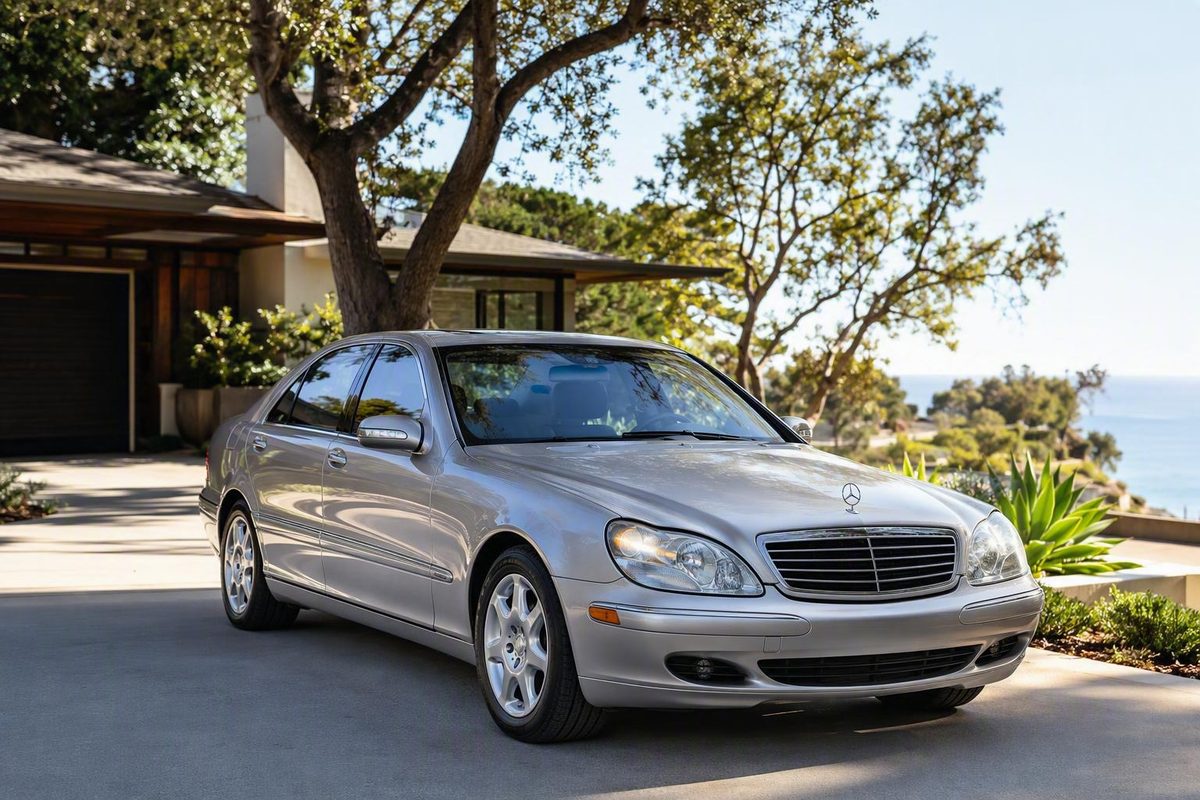
No. A model-year 2000 Mercedes-Benz S500 should not use E15 gas, including fuel marketed as Unleaded 88. The EPA permits E15 only in conventional light-duty vehicles from model year 2001 onward, while the available Mercedes compatibility guidance limits non-flex-fuel models to E10. Choose E10 or less, then verify that the grade meets the car’s separate octane requirement.
The model year controls the federal decision even if the car was sold or first registered later. A model-year 2000 S500 remains outside the E15 category under current U.S. Department of Energy guidance.
Select your W220, enter local fuel prices, and check whether E15 is legal, approved, or actually cheaper per mile.
W220 E15 Pump-Decision Checker
Model year determines EPA eligibility. Engine and mileage identify your car but do not override the cutoff or Mercedes’ E10 limit for a conventional non-flex-fuel W220.
2000 S500 verdict: Do not use E15.
Expected E15 fuel-economy penalty: approximately 4%–5% versus ethanol-free gasoline.
No mileage entered. Mileage does not alter the EPA model-year cutoff.
| W220 Model Year | EPA E15 Category | Mercedes Limit | Decision |
|---|---|---|---|
| 1999 | No | E10 maximum | Do not use E15 |
| 2000 | No | E10 maximum | Do not use E15 |
| 2001 | Yes | E10 maximum | Legal is not approved |
| 2002 | Yes | E10 maximum | Legal is not approved |
| 2003 | Yes | E10 maximum | Legal is not approved |
| 2004 | Yes | E10 maximum | Legal is not approved |
| 2005 | Yes | E10 maximum | Legal is not approved |
| 2006 | Yes | E10 maximum | Legal is not approved |
Sources: U.S. Department of Energy and EPA model-year guidance; FuelEconomy.gov 4%–5% E15 mileage estimate; available Mercedes compatibility reporting. The mileage estimate compares E15 with ethanol-free gasoline, not a measured local E10 blend.
The calculator’s 4%–5% fuel-economy range comes from federal consumer guidance comparing E15 with ethanol-free gasoline. It is a useful pump-price benchmark, not a precise measurement of the difference between E15 and a particular local E10 blend.
A 2000 S500 Fails The Federal E15 Test
EPA’s E15 authorization was established through two partial Clean Air Act waiver decisions. The first covered model-year 2007 and newer light-duty vehicles. EPA later extended the category to model-year 2001–2006 light-duty vehicles under specified conditions.
The second decision was published on January 26, 2011, as 76 FR 4662. The Federal Register page cautions that its displayed XML is an unofficial informational rendition and directs legal researchers to the official PDF on govinfo.gov (EPA’s partial-waiver notice).
For a driver at the pump, the federal categories are straightforward:
| Vehicle Category | Federal E15 Status |
|---|---|
| Conventional 2000 or older | Not permitted |
| Conventional 2001 or newer | Within EPA category |
| Flexible-fuel vehicle | Separate higher-ethanol category |
A vehicle’s current age, mileage, maintenance history, registration date, replacement fuel-system parts, or condition cannot move it across that model-year cutoff. A station’s authority to sell E15 also does not make every car at the station eligible to use it.
Federal eligibility should not be mistaken for manufacturer approval. Model year 2001 begins the EPA category, but an automaker may specify a lower ethanol limit. That distinction matters for 2001–2006 W220s: they fall within the federal category, but the available Mercedes guidance does not approve more than E10 for non-flex-fuel models.
For the model-year 2000 S500, the manufacturer distinction does not alter the answer. The car already fails the federal test.
E15 And Octane Are Separate Specifications
The number after the “E” describes ethanol concentration by volume, not octane. E10 contains up to 10% ethanol. EPA defines E15 as gasoline containing more than 10% and no more than 15% ethanol; retail descriptions commonly place it between 10.5% and 15%.
A suitable fuel must pass separate checks:
- Its ethanol concentration must be permitted for the vehicle.
- Its octane must meet the engine’s minimum requirement.
- It must comply with any additional manufacturer restrictions.
A high octane number cannot cancel an ethanol restriction. E15 is commonly sold as Unleaded 88, but E15 may be offered at other octane ratings. A premium-rated E15 product is still E15 and remains unsuitable for a model-year 2000 conventional vehicle.
The reverse assumption is also unsafe: do not decide that every product displaying 88 is E15 without reading the ethanol label. Identify the blend first, then evaluate its octane.
The supplied evidence does not include the official U.S.-specification 2000 S500 owner’s manual or a VIN-specific Mercedes document establishing the exact minimum octane. No octane figure should be inferred from the W220 chassis, a different S-Class model year, or another Mercedes engine.
Verify the octane requirement using, in order:
- The original manual for the correct model year and market
- Legible fuel information on or near the fuel door
- VIN-specific Mercedes-Benz documentation
- A qualified Mercedes-Benz service department
The missing octane figure is not a reason to try E15. It means the owner must choose among E10-or-lower fuels after confirming the required grade.
Mercedes Guidance Stops At E10 For Non-Flex-Fuel Models
Federal consumer guidance says automakers approve gasoline containing up to 10% ethanol in their gasoline vehicles. It also directs owners to consult the applicable manual for manufacturer recommendations.
A third-party review reports that Mercedes-Benz limits models not approved for E85 to no more than 10% ethanol and warns about prolonged use in incompatible fuel systems (The Autopian’s E15 compatibility discussion). That report supports the E10 ceiling for a conventional W220, although it is not a substitute for factory documentation specific to a U.S.-market 2000 S500.
Higher ethanol concentrations can create material-compatibility concerns in systems not designed or approved for them. Depending on the system, prolonged exposure may affect incompatible lines, seals, or related components. The available evidence does not establish that a particular S500 component will fail after one fill, nor does it provide a damage timeline, repair cost, or probability of failure.
That leaves a narrow, supportable verdict:
- A model-year 2000 S500 is outside the federal E15 category.
- Available Mercedes compatibility guidance stops at E10 for non-flex-fuel models.
- The evidence does not support predicting a particular failure from one accidental fill.
E15’s Lower Price May Not Reduce Fuel Cost
Ethanol contains less energy per unit volume than gasoline. Federal consumer guidance estimates that vehicles typically travel about 4% to 5% fewer miles per gallon on E15 than on ethanol-free gasoline (FuelEconomy.gov ethanol guidance).
That means E15 must be discounted enough to offset the expected mileage loss before it reduces fuel cost per mile. Using that 4%–5% benchmark, the break-even discount is approximately 4%–5% of the comparison fuel’s price. The exact dollar amount depends on the local pump price.
The comparison has limits. Most regular gasoline already contains some ethanol, so the published E15-versus-ethanol-free estimate does not establish the exact mileage difference between E15 and a local E10 product. Vehicle condition, route, weather, and driving style can also change observed consumption.
For a 2000 S500, this calculation is secondary because E15 is already excluded. It is more useful for showing why a lower pump price does not automatically mean lower operating cost—and why even a 2001–2006 W220 that clears the EPA cutoff still lacks Mercedes approval for more than E10.
Choose E10 Or Less, Then Check The Grade
For a model-year 2000 S500, choose gasoline labeled E10, “contains up to 10% ethanol,” or a lower-ethanol designation. The selected fuel must also meet the octane and other requirements in the car’s official documentation.
| Fuel | Ethanol Content | 2000 S500 Decision |
|---|---|---|
| E10 | Up to 10% | Check required octane |
| E15 | More than 10%, up to 15% | Do not use |
| E85 | High-ethanol flex fuel | Not for a conventional S500 |
Ethanol-free gasoline may be an option where available if it meets the required octane and every other manufacturer specification. The supplied evidence does not establish that ethanol-free fuel is required or mechanically superior for this S500.
Do not confuse premium with ethanol-free. Premium identifies an octane grade, while ethanol-free identifies composition. Premium fuel may contain ethanol, and E10 can be sold in more than one octane grade.
At the pump, use this order:
- Read the ethanol-content label.
- Reject E15 for a model-year 2000 S500.
- Limit the choices to E10 or less.
- Select a grade meeting the documented octane requirement.
- Follow any additional restrictions in the correct manual or VIN-specific documentation.
The Pump Label Matters More Than The Brand Name
The federally required E15 warning label is usually placed near the hose or nozzle. It identifies the product as containing up to 15% ethanol and limits use to model-year 2001 and newer passenger vehicles and flexible-fuel vehicles. The warning says use in other vehicles and gasoline-powered equipment may cause damage and is prohibited by federal law.
E15 is often marketed under names including Unleaded 88, Regular 88, Clean 88, eBlend, and Unleaded15. Retail branding varies, so do not rely only on the product name, button color, price, retailer, or prominently displayed octane number.
For this S500, the pump-side rule is: read the ethanol designation first and the octane rating second.
If a label is unclear, ask the station operator or use another pump. A lower price, adequate-looking octane number, major retailer, or advertisement saying the fuel suits “most” vehicles does not change the car’s model year or supply Mercedes approval.
An Accidental Fill Requires Situation-Specific Advice
One accidental E15 fill does not prove the car has been damaged, but the supplied evidence does not support declaring it harmless. There is also no authoritative, model-specific remediation procedure here for a 2000 S500.
Do not automatically drive the tank empty, dilute the fuel, siphon it, or arrange a drain based on a universal internet rule. The appropriate response depends on how much E15 was added, what was already in the tank, and whether the engine has operated.
Contact qualified Mercedes-Benz service or an experienced technician and provide:
- Approximately how much E15 was added
- Approximately how much fuel was already present
- What fuel was believed to be in the tank
- Whether the engine was started
- How far the car was driven
- Whether any warning lights appeared
- Whether starting, idle, acceleration, or general drivability changed
- Whether this was one mistake or repeated use
A small addition to a tank containing substantial approved fuel produces a different final mixture from filling an almost empty tank with E15. That fact helps a technician assess the incident; it is not an automatic dilution instruction or permission to keep driving.
Consumer Reports says one accidental tank is unlikely to destroy an older car immediately, while warning that continued exposure may have effects over time (Consumer Reports on accidental E15 use). That is general guidance, not a Mercedes-Benz guarantee or a model-specific remedy.
If symptoms appear, record when they began and tell the technician exactly what fuel was added. Avoid speculative parts replacement until the fuel event and other possible causes have been evaluated.
Wider E15 Sales Do Not Make It Compatible
EPA seasonal or emergency actions can affect when retailers may sell E15, but they do not change the model-year eligibility rule or a manufacturer’s fuel specification.
EPA extended a summer E15 waiver and ended the summer-blend restriction early for September 1 through September 15, 2026, as part of an effort to address gasoline prices (Agri-Pulse coverage of the EPA action). The House had passed permanent year-round E15 legislation on May 13, 2026, and another Senate farm-bill vote containing E15 provisions was planned for mid-September 2026 (reporting on the year-round E15 proposal).
Those developments concern market access. They do not move a model-year 2000 S500 into the 2001-and-newer federal category, change Mercedes’ E10 ceiling for non-flex-fuel vehicles, or establish the car’s octane requirement.
A station may lawfully offer E15 while some vehicles arriving there cannot lawfully use it. For a 2000 Mercedes-Benz S500, the decision remains unchanged: skip E15 and Unleaded 88, choose E10 or less, and confirm the required octane from vehicle-specific Mercedes documentation.