
Why Your W220 Is Not a Leading Converter Target
The W220 is absent from current theft rankings. Compare it with leading targets, assess local exposure, and plan for likelier exhaust trouble.
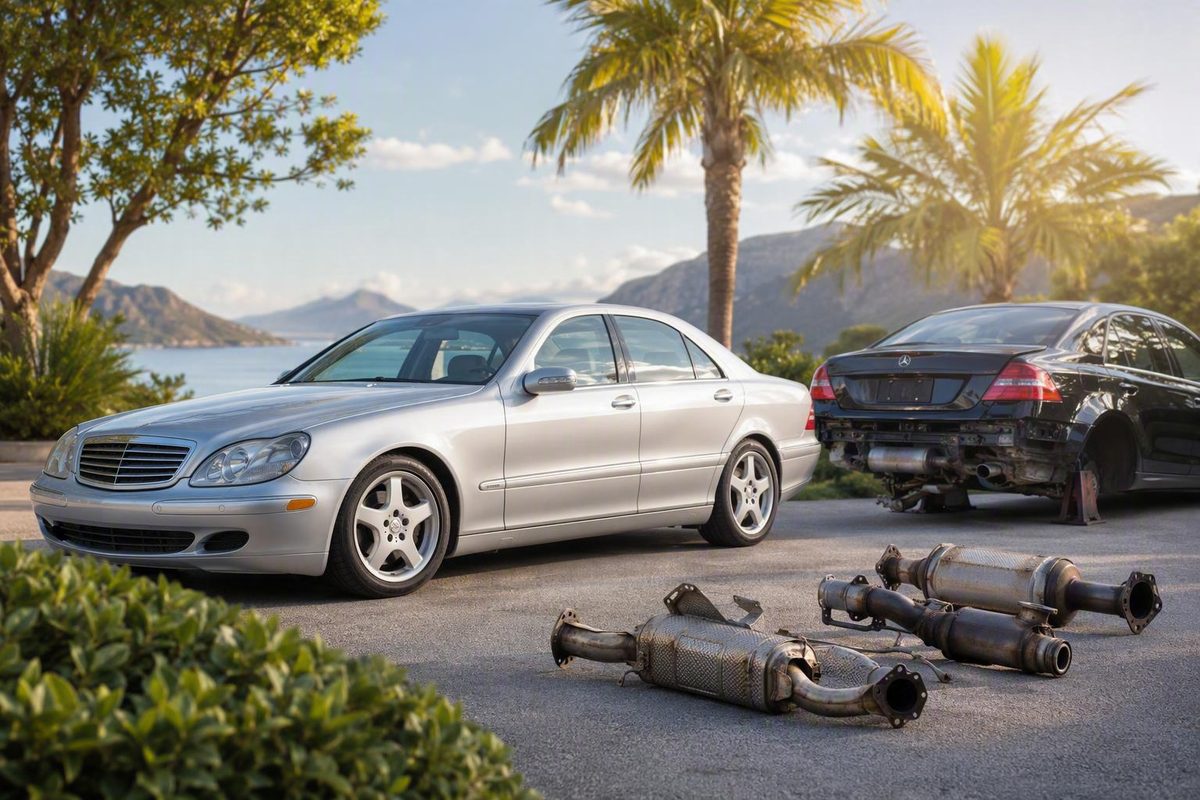
The Mercedes W220 S-Class is a possible catalytic-converter theft target, but it is not a documented favorite: no Mercedes-Benz model appears in the cited 2025 top 10 despite more than 137,000 catalytic converters stolen that year. The list is led by common trucks and crossovers, while no supplied source gives the W220 a theft rate or shows that its valuable converters overcome the practical disadvantages of a low sedan (CARFAX).
That verdict needs limits. Absence from a top-10 list is reassuring, not immunity. Local theft activity, parking exposure, and access to the exhaust on the exact car still matter. For most W220 owners, those facts support proportionate precautions rather than treating the car like a Ford F-150 or Ram 2500.
The Case For Treating The S-Class As A Target
The received wisdom is understandable. Catalytic converters contain recyclable platinum, palladium, and rhodium. The S-Class is an expensive car, and many W220 variants have substantial combustion engines and costly exhaust hardware. A thief can cut out a converter without stealing the vehicle; Edmunds describes the use of reciprocating saws and other portable cutting tools (Edmunds).
The broader theft problem is also real. CARFAX reports more than 137,000 converters stolen in 2025. Its earlier analysis estimated as many as 153,000 U.S. thefts in 2022 after examining millions of service records and accounting for other reasons converters might be replaced (archived 2022 analysis).
Some hybrids deserve special concern because their converters may have unusually dense precious-metal loading. The cited 2026 coverage separately flags the Toyota Prius and RAV4 Hybrid as high-value outliers. Material value can therefore outweigh the usual pattern in particular designs (AutoGuide).
So the consensus is right on three points: an S-Class with a combustion engine has stealable emissions equipment; theft can cause an expensive repair; and no badge, alarm, or low body guarantees safety. What the evidence does not support is the next leap—that a W220 is a leading target merely because it is an expensive German V8 sedan.
Actual Rankings Favor Common, Accessible Vehicles
CARFAX’s 2025 nationwide ranking contains the Ford F-150, Hyundai Tucson, Ford Explorer, Ram 2500, Chevrolet Silverado, Chevrolet Traverse, Ram 3500, Ford EcoSport, Ford Expedition, and Chevrolet Trax. Neither the S-Class nor any other Mercedes-Benz appears in its national or supplied regional rankings.
The historical result is similar. CARFAX’s 2022 nationwide list included the Ford F-Series, Honda Accord, Toyota Prius, Honda CR-V, Ford Explorer, Ford Econoline, Chevrolet Equinox, Chevrolet Silverado, Toyota Tacoma, and Chevrolet Cruze. Again, there was no S-Class.
AutoGuide’s 2026 editorial list also omits every Mercedes sedan. Its supplied material does not explain the ranking methodology, so that omission is supporting context rather than a model-specific risk study. The stronger observation is that repeated lists favor mass-market pickups, SUVs, crossovers, and selected hybrids—not luxury sedans.
Choose a W220 or a ranked vehicle, then set its access and parking conditions; the result identifies which side wins for your inputs.
Compare your car with the vehicles that actually appear in CARFAX’s 2025 national top 10. Because no source supplies report counts by model, the tool uses documented list position—not invented rates.
This does not mean immune. Check current local theft reports and have the exact exhaust layout inspected.
| 2025 Position | Vehicle | Broad Body/Access Context | What The Source Establishes |
|---|---|---|---|
| Not top 10 | Mercedes W220 S-Class | Low sedan | No Mercedes appears nationally or regionally |
| 1 | Ford F-150 | Pickup / higher clearance | Ranked national target |
| 2 | Hyundai Tucson | Crossover | Ranked national target |
| 3 | Ford Explorer | SUV / higher clearance | Ranked national target |
| 4 | Ram 2500 | Pickup / higher clearance | Ranked national target |
| 5 | Chevrolet Silverado | Pickup / higher clearance | Ranked national target |
| 6 | Chevrolet Traverse | Crossover | Ranked national target |
| 7 | Ram 3500 | Pickup / higher clearance | Ranked national target |
| 8 | Ford EcoSport | Crossover | Ranked national target |
| 9 | Ford Expedition | SUV / higher clearance | Ranked national target |
| 10 | Chevrolet Trax | Crossover | Ranked national target |
Source: CARFAX 2025 nationwide ranking cited in the article; more than 137,000 converters were reported stolen in 2025. Model-level report volumes, W220 theft rates, and verified clearance measurements are —.
The pattern has a practical explanation, although the sources do not prove why the S-Class is absent. High-clearance trucks and SUVs can leave enough working room to reach exhaust components without first raising the vehicle. Large fleets also provide more examples to encounter and layouts that thieves can learn. A common model can generate many raw reports without every individual example having a high probability of attack.
That is why metal content alone is a poor shortcut. The W220 may carry expensive exhaust components, but a thief also values quick access, a familiar layout, concealment, and a ready supply of targets. The lower sedan body works against at least one of those factors. It does not make the converter inaccessible.
Kelley Blue Book cautions that no reliable model-by-model count completely determines which vehicles will be targeted (Kelley Blue Book). Different rankings can use service histories, insurance claims, police reports, reported-theft databases, or replacement activity. Those are not interchangeable measures.
None of the supplied evidence provides an S-Class or W220 theft rate, a model-year breakdown, a regional incidence figure, a powertrain comparison, or a verified converter-accessibility measurement. There is therefore no defensible numerical probability or universal low-, medium-, or high-risk label for an individual W220.
Your Parking Conditions Can Override The National Pattern
A W220 absent from national rankings can still be the easiest available car in a particular parking lot. Assess opportunity separately from model popularity.
A locked private garage is materially different from repeated overnight parking on a public street or open apartment lot. Lighting is useful when it makes someone working beside or beneath the car conspicuous; a bright lamp above a concealed parking bay is less useful. Cameras should cover the ground beside the vehicle and capture usable images, not merely show that the car is present.
Current local activity matters more than an old national ranking when a theft crew is working nearby. Check recent police alerts or crime dashboards, building-management notices, verified neighbor reports, nearby exhaust shops, parking-facility security, and your insurer. Ask about converter theft generally rather than Mercedes theft alone.
The other unknown is physical access. Have a Mercedes technician or exhaust specialist inspect the car at its normal parked height and identify:
- converter locations on that engine and market specification;
- pipes, sensors, wiring, brackets, and heat shields reachable from the sides or center;
- whether meaningful access exists without lifting the car;
- whether the underbody panels are present and secure; and
- whether a barrier can preserve heat management, suspension movement, inspection access, drains, and service points.
Do not assume AIRMATIC raises or lowers theft risk merely because it changes ride height. The supplied evidence contains no verified comparison. Evaluate the actual parked car.
Powertrain also sets the scope. A gasoline, diesel, or hybrid S-Class has combustion-related emissions equipment; a fully electric vehicle has no exhaust and therefore no catalytic converter. Hybrid status can deserve attention because some hybrid designs use valuable converters, but it does not establish the loading, accessibility, or theft rate of a particular S-Class hybrid.
W220 Exhaust Corrosion Is The More Grounded Planning Issue
For a W220 owner deciding where to direct maintenance attention, age-related exhaust deterioration is the routine issue to inspect. The draft evidence does not provide a W220 corrosion rate, repair price, or failure interval, so none can be assigned responsibly. The practical distinction is that corrosion can be found during an underbody inspection, while a model-specific theft probability is unavailable.
Ask the technician to inspect exhaust flanges and joints for corrosion while locating the converters. Also check pipes, brackets, heat shields, sensors, and wiring. A noisy exhaust, visible deterioration, or a leaking flange should be diagnosed rather than attributed automatically to attempted theft.
This does not prove corrosion will affect every W220, nor does it erase theft risk. It puts the planning priorities in order: inspect the old exhaust that is actually on the car, then choose theft precautions according to access, local incidents, and parking exposure. Do not buy an elaborate barrier solely because the Mercedes converters seem valuable.
Deterrent Spending Should Match The Exposure
Start with parking because it changes the opportunity around the whole vehicle. Use a locked garage when available. Otherwise favor a monitored position with clear sightlines, motion-sensitive lighting, and visible camera coverage. Avoid a space where walls, hedges, or unused vehicles conceal someone beside the rocker panel.
Identification is a second layer. VIN or identifying-number etching and visible high-heat marking may complicate resale or assist identification, but neither prevents cutting nor guarantees recovery. Photograph and retain any marks with the vehicle records, and confirm that the marking method suits a hot exhaust component.
A motion or tilt alarm may attract attention to activity around the car. It works as one layer, not as proof against theft.
A shield, plate, or cage may add time and difficulty, but fitment cannot be inferred from a broad “S-Class compatible” label. A technician should check the exact chassis, model year, engine, converter and sensor positions, heat shielding, suspension travel, ground clearance, drains, inspection access, and fastener locations. A product made for another S-Class generation should not be presumed suitable for the W220. Consumer Reports likewise presents secure parking, alarms, identification, and professionally selected barriers as precautions rather than guarantees (Consumer Reports).
For a garaged W220 with no known local incidents and no easy access found during inspection, basic monitoring may be proportionate. Repeated street parking, recent nearby thefts, weak surveillance, or accessible exhaust components support stronger layers. This is a decision based on exposure, not a formal probability score.
Repair And Insurance Numbers Are Not W220 Quotes
The downside is large enough to verify coverage. AutoGuide says catalytic-converter replacement may cost $3,000 or more, depending on the vehicle, and that parts availability can delay repairs. Consumer Reports cites a general RepairPal range of $2,177 to $2,506 and says some replacements exceed $3,300. None of those figures is a W220 estimate.
A real quotation depends on the model year and engine, the number and type of damaged components, parts availability, labor rates, sensors and wiring, cut pipes, brackets, heat shields, other underbody damage, and applicable emissions or inspection requirements. The converter is not necessarily the entire loss.
Comprehensive insurance may cover converter theft and related damage, subject to policy language, exclusions, the deductible, parts provisions, and claim requirements. Liability or collision coverage alone should not be assumed to cover it. Confirm the policy before a loss, including required documentation and treatment of attached exhaust components.
Compare the verified deductible and possible uncovered costs with the installed price of a suitable deterrent. The draft provides no deterrent price, W220 repair quotation, or model-specific loss probability, so a precise financial break-even point cannot be calculated.
The W220 Verdict Stays Narrow
A W220 can lose a catalytic converter, and an exposed car in an active theft area deserves layered protection. But the available 2025 and 2026 rankings do not identify the S-Class—or any Mercedes-Benz—as a leading target. Common, accessible trucks and crossovers dominate, while particular hybrids are the documented metal-content outliers.
For this chassis, inspect converter access and age-related exhaust flange corrosion at the same visit. Base theft spending on the exact exhaust layout, overnight parking, current local reports, and insurance deductible. The Mercedes badge and the assumed value of its converters are not enough to move the W220 into the documented high-target group.