
The Massachusetts Court Fight Does Not Threaten W220 Diagnostics
A W220 can still be scanned through its physical diagnostic connector. The pending cases concern wireless data from connected vehicles instead.
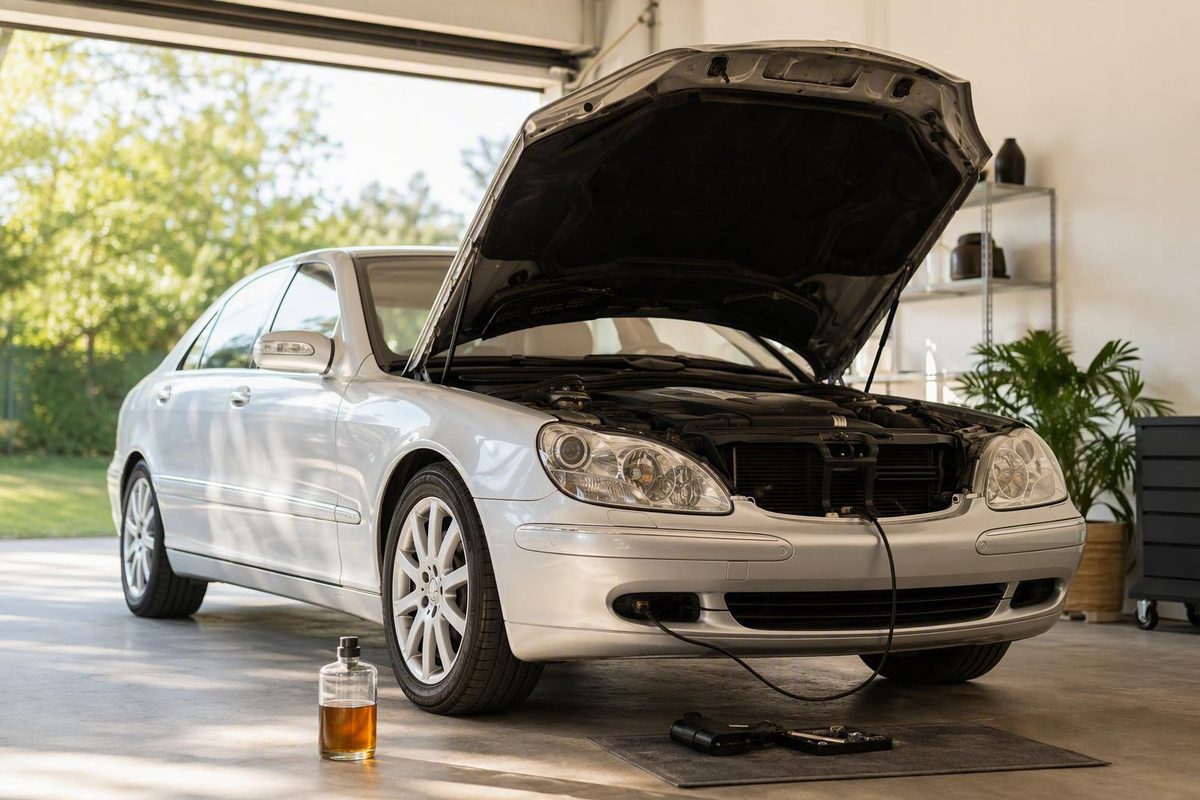
A Mercedes W220, built from 1998–2005, is not affected by the pending Massachusetts telematics case: the disputed law applies specifically to vehicles “that utilize a telematics system,” while the W220 has no such wireless, real-time data platform. Whatever the First Circuit decides, it does not take away the W220’s established physical diagnostic access.
Why The Headlines Sound More Sweeping Than The Case
The concern is understandable. A pending appellate ruling described simply as a “right to repair” case sounds as though it could determine whether an independent Mercedes specialist may diagnose a car without dealer permission.
That concern reflects a real distinction in repair capability. Reading fault codes does not guarantee access to every wiring diagram, programming function, firmware file, security credential, specialty tool, or discontinued part. Nor does legal access guarantee that a general-purpose scanner can perform every function of Mercedes equipment.
The consensus view is therefore right in one limited respect: right-to-repair rules can affect what an independent shop can obtain, and coverage varies by jurisdiction, model year, original sale location, installed equipment, and the resource requested. Security and immobilizer functions may also follow controlled-access procedures.
But that is not what the current Massachusetts appeal is deciding. The 2020 Data Access Law requires open access specifically for vehicles sold in Massachusetts that use telematics—a connected platform carrying vehicle data wirelessly. The First Circuit dispute is about that wireless data, not whether a W220 owner may connect diagnostic equipment to the car (Nelson Mullins).
The W220 Falls Outside The Telematics Dispute
The W220 was built from 1998 through 2005 and has no telematics system of the kind governed by the disputed Massachusetts platform requirement. A statute cannot make a car transmit a live wireless data stream that its hardware does not provide.
For a W220, the ordinary workshop route is a physical diagnostic connection. That access predates the 2020 Massachusetts ballot measure and remains a different technical and legal category from remote telematics access.
This distinction holds whichever party wins the appeal:
| Access Type | W220 Position | Court Dispute |
|---|---|---|
| Physical diagnostics | Available at the car | Not at issue |
| Wireless telematics data | No qualifying system | Central issue |
| Coding and programming | Tool/function dependent | Not decided generally |
| Keys and immobilizer | Security-controlled | Not ordinary telematics |
The verdict is narrow, not a claim that every Mercedes resource is open. A scan-tool connection does not promise free Mercedes software, dealer credentials, all bidirectional tests, online module programming, key authorization, or continued production of old parts.
Choose the model year and factory connectivity; the checker separates physical diagnostic access from the wireless data now in court.
Select the car's model year and whether it has a factory system that sends vehicle data wirelessly. The default 2005 W220 result shows why the pending telematics case does not control its scan-port access.
| Access Or Rule | For These Inputs | What It Means | Court Fight? |
|---|---|---|---|
| Physical onboard diagnostics | Available | Connect compatible diagnostic equipment at the vehicle; tool coverage varies. | No |
| Federal emissions information | Reported coverage | Industry source reports dealer-equivalent emissions-service information for vehicles built after 1994. | No |
| Massachusetts wireless platform | Not applicable | No qualifying telematics system means no wireless data stream under dispute. | No |
| Maine model-year provision | Possible if sold in Maine | Model years 2002–2017 have dealer-equivalent covered diagnostic and repair-information access if the vehicle was sold in Maine. | No |
| Keys and immobilizer | Controlled access | Credentials, ownership proof, payment, compatible tools, or secure release may apply. | No |
| Free software, tools, or parts | Not guaranteed | Access may be paid; discontinued parts and shop capability are separate issues. | No |
- Always Separate A telematics ruling does not remove a physical diagnostic connector.
- For a specific legal claim, verify original sale state, exact resource requested, current law, and current docket status.
Sources: Maine Title 29-A, §1810; NCSL legislative summary; Nelson Mullins update published August 24, 2026; Shop Press automotive primer. “—” means the supplied evidence does not establish a result.
What The First Circuit Is Actually Reviewing
Massachusetts enacted an automotive repair measure in 2012, then voters approved a telematics expansion in 2020 (National Conference of State Legislatures). The later Data Access Law concerns vehicles sold in Massachusetts that utilize a telematics system. It calls for an interoperable, standardized, open-access platform through which owners and independent repair facilities can obtain vehicle data for repairs.
An industry group challenged that law on federal-preemption grounds. The federal district court dismissed the remaining counts on February 11, 2025. The First Circuit heard oral argument in February 2026 and suggested mediation; the Massachusetts Attorney General’s office declined mediation on February 25, 2026. A decision remained pending as of the legal update published August 24, 2026 (Nelson Mullins).
On August 14, 2026, Auto Innovators also filed a parallel federal challenge to Maine’s similar telematics law. That filing keeps the wireless-data issue active, but it does not convert either case into a challenge to the physical connector on an older Mercedes.
The supplied evidence goes no later than August 24, 2026. It contains no later decision, so current docket status should be checked before relying on the case procedurally.
Physical Diagnostics And Wireless Data Are Different Access Paths
Onboard diagnostics can include trouble codes, live data, module identification, actuator tests, and diagnostic procedures reached through a physical connection. Telematics concerns data generated by a connected vehicle and communicated beyond that conventional connector.
That difference matters on the workshop floor. A W220 may communicate with a basic scanner for some functions while requiring Mercedes-capable equipment for others. Connector access alone does not make every control unit or command available to every tool.
The transmission, AIRMATIC, body electronics, climate control, and other non-emissions systems also should not be folded into a claim about federal emissions access. An industry account reports that Clean Air Act amendments required manufacturers to provide independent repairers the same emissions-service information supplied to franchised dealers for vehicles built after 1994 (Shop Press). That supports a narrower emissions-information route for a W220, not universal access to every Mercedes function.
The draft evidence uses “built after 1994”; it does not provide a different model-year cutoff. Cars near that boundary require a check of the applicable federal text and EPA requirements.
What A Court Loss Would Not Remove From A W220
An appellate loss for Massachusetts would concern the state’s demanded wireless platform and the related federal-preemption arguments. It would not erase the physical diagnostic architecture already installed in a W220.
It also would not repeal narrower federal emissions-information requirements. Nor would it, by itself, decide access to ordinary workshop documents, paid subscriptions, replacement components, or Mercedes security systems.
The practical W220 questions remain the same:
- Does the scan tool support the chassis and specific control module?
- Is the needed operation reading, testing, coding, programming, or security authorization?
- Does it require a paid information or software subscription?
- Is compatible hardware still available?
- Has a part or supporting online service been discontinued?
Those are real limits, but they are not consequences of the pending telematics appeal.
Where State Law Can Still Matter To An Older Mercedes
The fact that the W220 is outside the wireless dispute does not mean all right-to-repair law is irrelevant to it. State automotive statutes can separately govern conventional diagnostic tools and repair information.
Maine provides the clearest model-year example in the supplied evidence. Its statute concerns motor vehicles sold in Maine and uses these categories (Maine Title 29-A, §1810):
| Model Year | Maine Provision |
|---|---|
| 2002 | Specified resources on fair terms |
| 2002–2017 | Dealer-equivalent covered access |
| 2018 and later | Added interface/data provisions |
A 2005 W220 sold in Maine falls within the 2002–2017 category. For covered onboard diagnostics and repair information, owners and independent facilities must receive the same access available to new-vehicle dealers. This can involve payment and does not mean a shop already owns equivalent hardware, credentials, or expertise.
The evidence does not establish the same comprehensive Maine dealer-equivalent protection for a pre-2002 W220. That is not proof of no rights; it means another legal, regulatory, or contractual basis would be needed. Current Maine registration alone is also insufficient because the statute’s central condition concerns vehicles sold in Maine.
For 2018-and-later vehicles, Maine addresses nonproprietary interfaces, suitable off-the-shelf computers, and standardized onboard-diagnostic access. Its standardized owner-authorized access platform has an implementation deadline of September 1, 2027. The supplied evidence does not fully map which demands depend on that platform or later standards (Nelson Mullins).
That newer platform schedule has no practical bearing on a W220’s existing physical diagnostics.
Massachusetts Still Has A Separate Diagnostic Framework
Massachusetts automotive law is broader than the single 2020 telematics provision. Its framework includes standardized access to onboard diagnostic systems without manufacturer authorization. The appeal should not be mistaken for a ruling on every part of that earlier framework.
Whether a particular older Mercedes can invoke a Massachusetts legal remedy still requires checking its original sale location, the applicable statutory version and effective date, the precise resource requested, and current enforcement status. The evidence does not resolve every retroactivity question for every older model.
Before a Massachusetts private action, a legal survey reports that owners and independent facilities must submit a National Automotive Service Task Force service-information request, provide written notice, and allow the manufacturer an opportunity to cure (Crowell & Moring). A technical limitation, quoted subscription, or credential requirement is not automatically an unlawful refusal.
Free Tools, Parts, And Security Access Are Not Guaranteed
Right to repair does not generally mean a free repair or free factory software. Depending on the governing rule, manufacturers may charge for subscriptions, tools, components, or credentials, sometimes under a fair-and-reasonable-terms standard.
Information access and repair capability are separate. A shop may obtain a procedure but lack the interface, adapter, account, or experience needed to perform it. A platform may not support an old module. A server can fail. A replacement part may have been discontinued. None of those facts alone proves that the manufacturer unlawfully withheld covered information.
Keys, immobilizers, and theft-prevention functions receive separate treatment. Maine permits security and immobilizer information to be withheld from ordinary access while requiring a secure-release route (Maine Title 29-A, §1810). An industry account reports that Mercedes may require NASTF credentials and payment for certain security-related parts and systems (Shop Press).
A controlled route is not necessarily a denial. The issue is whether the applicable framework permits the restriction and whether a compliant route is actually available.
The federal REPAIR Act also cannot be treated as a current nationwide entitlement. It remained proposed legislation as of August 2026. In May 2026, a House committee advanced an amended version concerning diagnostic and repair information while removing proposed telematics and wireless-data provisions (Nelson Mullins).
Voluntary industry arrangements are not statutes either. The reported 2014 automotive memorandum applied beginning with the 2018 automotive year, so it should not automatically be extended to a 1999, 2002, or 2005 W220. A later commitment describes opportunities for independent facilities to buy diagnostic and repair information available to dealers, but the supplied evidence does not establish identical statutory rights or remedies (Shop Press).
Magnuson-Moss restricts certain warranty conditions involving specified replacement parts; it is not a general right to every Mercedes scan function, technical record, part, or security credential (Crowell & Moring).
Document The Exact Failure Before Calling It A Denial
For a W220 access problem, record the VIN, model year, chassis, original sale state, present repair location, relevant option codes, and the module involved. Then name the resource precisely: a wiring diagram, diagnostic test, coding function, firmware file, subscription, adapter, component, or key authorization.
Preserve screenshots, error messages, emails, support case numbers, quoted prices, subscription durations, compatibility lists, credential requirements, and the written reason for refusal. Distinguish an outright refusal from a paid offer, unsupported module, incompatible tool, security route, discontinued component, or temporary account failure.
Where dealer-equivalent access matters, document what the dealer receives and how the independent offer differs. A fee can be relevant under a fair-and-reasonable standard, but it is not the same event as a refusal.
For Massachusetts, verify the latest appellate status and any required NASTF request, notice, and cure process. For Maine, establish that the car was sold there, identify the model-year category, and separate present diagnostic obligations from the platform due September 1, 2027.
The central workshop answer remains simple: the pending Massachusetts case is about wireless telematics on connected cars. It does not threaten the physical scan-tool access used to diagnose a W220.