
What Your Transmission Fluid’s Appearance Can—and Cannot—Tell You
The specified fluid may be green, blue, yellow, nearly clear or light brown. Milky fluid, burnt-smelling opaque fluid or visible metal warrants prompt diagnosis.
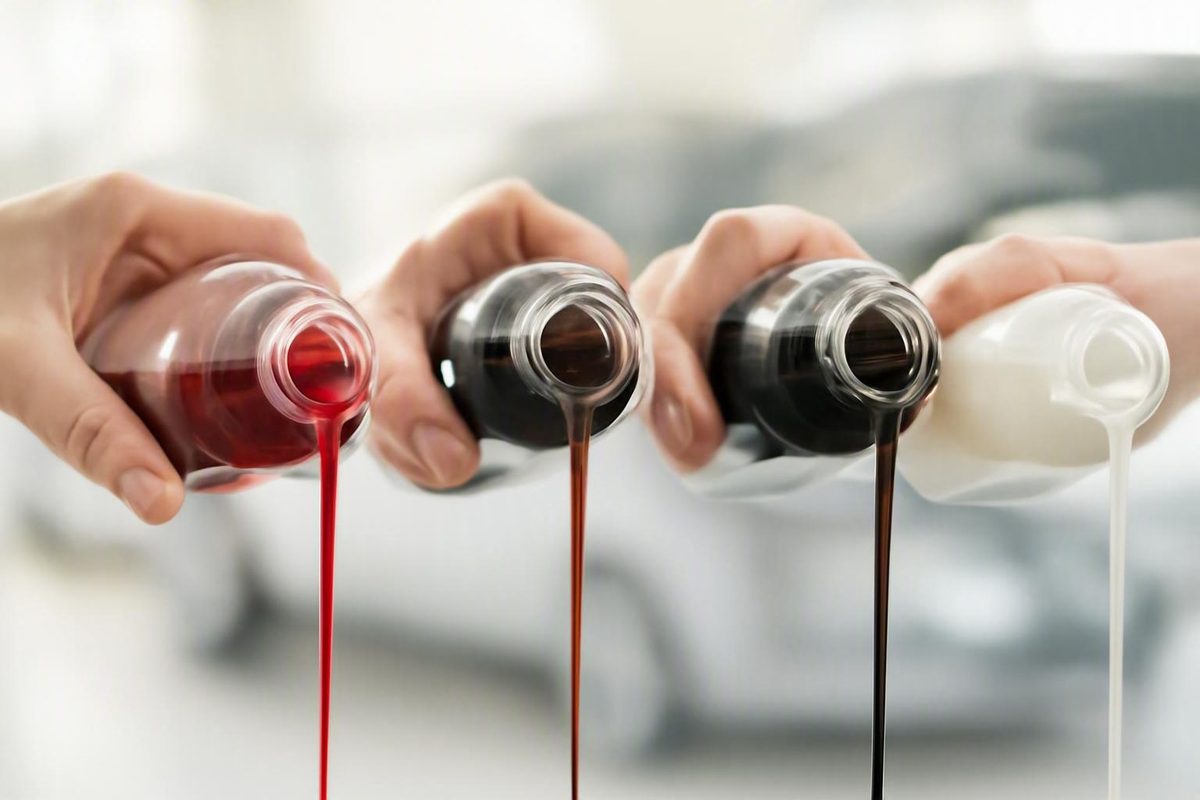
The quick answer: normal transmission fluid is not always red
Fresh conventional automatic transmission fluid is commonly translucent red or pinkish-red. Dye makes the fluid easier to identify and can help reveal leaks, but red is not a universal technical standard. Depending on the product and transmission type, specified fluid may instead appear green, blue, purple, yellow, nearly clear, or light brown. Normal appearance varies with formulation, brand, and age (AutoZone’s transmission-fluid color guide).
Before deciding whether a sample looks healthy or abnormal, identify:
- The transmission type
- The exact required fluid specification
- The appearance of that specified fluid when new
- The vehicle-specific level-check procedure
- The maintenance and repair history
- Any leaks or operating symptoms
“Transmission fluid” is not one interchangeable product. Conventional automatic transmissions, continuously variable transmissions (CVTs), manual gearboxes, and dual-clutch systems may require different formulations. Manual fluid is often clear, slightly blue, or very light brown, while automatic fluid is commonly red or green. CVT fluid also differs from conventional ATF, and automatic and manual products should not be assumed interchangeable (AutoZone’s fluid-type and checking guidance).
The central rule is simple: color is a screening clue, not a diagnosis. It cannot by itself prove that fluid is healthy, measure its remaining life, identify a failed component, or establish that a transmission needs replacement. Interpret appearance together with transparency, odor, particles, level, leaks, operating symptoms, service history, and the manufacturer’s specification.
Transmission fluid color guide: appearance, context, and next step
This table is a decision aid rather than a universal color chart. Compare the sample with the correct fluid when new, and give more weight to combinations of evidence than to a subjective shade name.
| Appearance | Possible meaning | Companion signs to check | Urgency | Safest next step |
|---|---|---|---|---|
| Translucent red or pinkish-red | Common appearance of fresh or relatively clean conventional ATF | Correct level, no abnormal odor or debris, normal engagement and shifting | Usually low if it matches the specified product | Continue the manufacturer’s maintenance schedule and monitor for changes |
| Translucent dark red, orange, or light brown | May reflect ordinary aging or heat exposure | Service history, transparency, odor, level, leaks, shift quality | Usually not an emergency by color alone | Review the vehicle-specific schedule and other condition indicators |
| Opaque brown or dark brown | May suggest oxidation, prolonged heat exposure, debris, or contamination | Muddy appearance, burnt odor, rough shifting, overheating | Moderate to high depending on accompanying signs | Arrange inspection or obtain transmission-specific service guidance |
| Nearly black | May indicate severe heat exposure, heavy wear, or extended service | Burnt smell, grit, slipping, delayed engagement, overheating | High when paired with odor or operating symptoms | Seek prompt diagnosis; do not conclude from color alone that replacement is required |
| Clear pink | May simply be the product’s normal dye | Known new-fluid appearance, correct specification and level | Usually low if everything else is normal | Continue monitoring under the manufacturer’s schedule |
| Milky pink, creamy, frothy, or milkshake-like | May indicate water or coolant contamination | Cloudiness, foam, overheating, cooling-system concerns | High | Minimize further driving and arrange prompt professional evaluation (guidance on pink and frothy fluid) |
| Cloudy or muddy | May indicate moisture, suspended debris, mixed fluid, or degradation | Grit, burnt odor, unusual shifting, unknown service history | Moderate to high | Verify what fluid has been used and arrange a condition check |
| Glittery, gritty, or flaky | Visible metal or substantial debris may point to internal wear even if the fluid remains red | Noise, slipping, grinding, debris in the pan | High | Obtain professional assessment rather than assuming a fluid change will solve it (appearance and particle guidance) |
Fresh-looking red fluid is reassuring only when the rest of the evidence is also reassuring. Bright fluid containing metallic glitter or flakes deserves more concern than uniformly dark but transparent fluid with no burnt odor, debris, leak, or operating symptoms.
Pink requires particular care because two very different appearances can share that label. Clear, translucent pink may be exactly how the specified fluid should look. Pink fluid that is opaque, creamy, frothy, or milkshake-like may indicate water or coolant contamination. That appearance warrants prompt investigation, but it cannot identify where the fluids mixed or prove that a particular cooling-system component caused the breach.
Nearly black fluid also needs context. It is more concerning than ordinary translucent browning, especially if it smells scorched, contains debris, or accompanies slipping or overheating. It does not automatically prove that the transmission has failed, must be rebuilt, or is safe or unsafe under every operating condition.
Normal darkening versus burnt or contaminated fluid
Transmission fluid commonly darkens as it ages and experiences heat. A darker shade alone therefore does not establish a fault. An older sample may be dark red, orange, or light brown while remaining transparent and free from burnt odor or visible debris.
**** A uniform sample through which light still passes can be consistent with aging. An opaque, muddy, streaked, or unusually cloudy sample is more suspicious because its appearance may reflect moisture, oxidation, debris, or incompatible products.
Odor changes the interpretation. A sharp, scorched, or burnt smell associated with very dark fluid is more concerning than color alone because it can accompany excessive heat and fluid breakdown. Dark fluid paired with slipping or delayed engagement may also indicate a problem beyond routine maintenance (qualified color-and-symptom guidance).
Escalate concern when dark, cloudy, or abnormal-looking fluid accompanies:
- Delayed engagement after selecting Drive or Reverse
- Engine-speed flare or slipping under load
- Rough, abrupt, or inconsistent shifts
- Grinding, whining, or another unusual noise
- Overheating
- A warning message or reduced-function mode
- A falling fluid level or active leak
Particles are a separate condition indicator. Fluid can remain bright red yet contain metallic glitter, flakes, or grit. That combination should not be called healthy merely because the dye remains vivid. Conversely, uniformly dark fluid does not disclose how much wear exists or which component, if any, is damaged.
Use this interpretation sequence:
- Confirm the original color. Identify the exact required fluid and determine how that product looks when new.
- Assess transparency. View a thin sample against clean white material under neutral light.
- Check the odor cautiously. Do not put your face directly over hot fluid or deliberately touch it.
- Look for particles. Note glitter, flakes, grit, muddy sediment, fibers, or foreign material.
- Check the level correctly. Follow the specified fluid temperature, engine state, selector position, and measuring procedure.
- Review operation. Consider engagement, shift quality, slipping, noise, warning messages, and heat.
- Review history. Account for previous services, added products, leaks, repairs, towing, or other demanding use.
Avoid universal conclusions such as “every brown sample is unusable” or “black fluid proves failure.” Shade names are subjective, lighting varies, and different formulations do not begin with the same color. The overall pattern matters more than the label.
How to inspect transmission fluid color accurately and safely
Start with the owner’s manual or model-specific service information. Level-check procedures vary. One vehicle may be checked warm and idling in Park; another may require a different selector position or a temperature-dependent measuring procedure. Applying a generic method can produce an inaccurate reading.
For a dipstick-equipped vehicle:
- Park on a level surface.
- Follow the specified instructions for fluid temperature, engine operation, parking-brake use, and selector position.
- Do not proceed if you cannot complete the required check without unsafe exposure to hot fluid or moving engine-bay components.
- Remove the dipstick and wipe it with clean, lint-free material.
- Reinsert it fully, then withdraw it to read the level as directed.
- Transfer a small drop to clean white paper or a white lint-free towel.
- Record the level, color, transparency, odor, cloudiness, foam, and visible debris.
- Reinstall the dipstick securely.
Use daylight or neutral white lighting where possible. Colored shop lights, amber bulbs, dirty rags, stained dipsticks, and dark containers can distort the result. A transmission vendor’s inspection guide likewise recommends viewing drops on clean white paper instead of judging only the dipstick surface (sample-inspection method).
Do not reduce the inspection to a single color word. A useful record might say:
Translucent medium brown; no foam; no visible particles; no scorched odor; level at the specified mark; no shift symptoms; service history unknown.
That description is more useful than “the fluid looks bad.”
Fluid level and fluid condition are separate questions. Normal-looking fluid does not rule out a low level, and dark fluid is not necessarily low. If the level is below specification, investigate the cause rather than repeatedly topping it up without checking for leakage.
If the vehicle has no conventional dipstick, do not improvise by opening an unfamiliar fill, check, or drain point. Some transmissions use a temperature-dependent procedure or require dedicated equipment. When the correct method is unclear, have the level and condition checked by a qualified technician.
Do not add fluid until the exact specification is confirmed. A product with a similar color can still be incompatible, and using the wrong transmission fluid can cause shifting problems or damage (fluid-compatibility and service guidance).
When abnormal color becomes urgent
Urgency should be based on combinations of evidence, not one shade.
A generally reassuring combination is:
- The sample is translucent and consistent with the specified fluid
- The level is correct under the specified checking conditions
- There is no burnt or scorched odor
- No grit, glitter, flakes, foam, or milkiness is visible
- No active leak is present
- Engagement and shifting are normal
- There is no unusual noise or overheating
Continue monitoring in that situation and follow the manufacturer’s maintenance schedule.
Arrange a service review when the fluid is becoming noticeably darker or cloudier, the maintenance history is unknown, or a small leak appears without severe operating symptoms. The purpose is to verify the level and specification, locate leakage, and determine whether maintenance or further testing is appropriate.
Seek prompt professional evaluation when opaque dark-brown or nearly black fluid has a strong burnt odor, particularly if the transmission also slips, delays engagement, shifts roughly, makes unusual noises, or overheats. Burnt odor, discoloration, slipping, delayed engagement, overheating, and unusual noises are recognized warning signs, although none identifies an exact fault by itself (warning-sign overview).
Minimize further driving and obtain prompt help when any of these combinations appears:
- Milky, creamy, or persistently frothy fluid
- Metallic glitter, flakes, or substantial grit
- A large or active leak that is lowering the fluid level
- Grinding or severe slipping
- Substantially delayed engagement or difficulty moving
- Overheating
- A warning or reduced-function mode accompanied by abnormal operation
These signs may indicate a condition beyond ordinary fluid maintenance. A fluid change cannot be promised to reverse mechanical wear, repair a leak, remove the cause of overheating, or restore damaged internal components.
Likewise, black fluid does not automatically require transmission replacement. Inspection may reveal overdue maintenance, heat exposure, contamination, wear, or several issues together. The appropriate response is diagnosis, not an irreversible conclusion based solely on color.
Is the red or brown puddle under the car transmission fluid?
A red or reddish-brown oily puddle may be transmission fluid, particularly if it appears around the front-middle area of the vehicle. Transmission fluid is commonly described as oily or slick and petroleum-like in odor; degraded fluid may smell burnt (supporting leak-identification clues).
A red puddle is not definitive. Consider:
- Specified fluid color: Some automatic transmission fluids are green, while aged red fluid may appear brown.
- Texture: Transmission fluid is commonly slick, but texture does not reliably distinguish it from every other automotive fluid.
- Odor: A petroleum-like or burnt odor can support identification but is not proof.
- Location: The place where fluid reaches the ground may not be directly below its source.
- Level: A falling transmission-fluid level strengthens the case for a transmission leak.
- Symptoms: Delayed engagement, slipping, noise, or overheating increases urgency.
If it can be done safely, place clean cardboard under the parked vehicle and note the puddle’s position and approximate quantity. Check the transmission-fluid level only through the correct procedure, and never crawl beneath an unsupported vehicle. An active or substantial leak deserves prompt assessment because topping up does not repair the source and adding an unsuitable product can make the problem worse.
Mercedes-Benz W220 and 722.6 note: Independent site W220 Repair instructs owners to inspect the 722.6 transmission’s electrical connector plug for red ATF residue, which may reveal leakage at that location (W220 Repair’s 722.6 guidance). This is a model-specific inspection clue, not official Mercedes-Benz documentation and not proof that every W220 leak will be red or originate at the connector.
Document visible residue before cleaning the area, or ask the technician to inspect it first. The residue pattern may help with tracing the source.
Should discolored fluid be changed, flushed, or diagnosed first?
A conventional fluid change and a flush or equipment-assisted exchange are not the same procedure.
A conventional change, often called a drain-and-fill, removes the fluid that drains through a plug or during pan removal and replaces it. Some old fluid ordinarily remains elsewhere in the system.
A flush or fluid exchange uses specialized equipment to exchange fluid through more of the transmission and related fluid circuit. The broader exchange does not automatically make a flush the better choice. The appropriate method depends on the transmission design, manufacturer procedure, required fluid, condition, service history, and operating symptoms.
Use a symptom-based decision:
- Merely aged fluid with normal operation: Review the manufacturer’s maintenance schedule, previous service records, and specified procedure. Do not choose a flush solely because the fluid is somewhat darker than new.
- Unknown history without severe symptoms: Have the level, fluid condition, leaks, and operation assessed before selecting a service.
- Milky or frothy fluid: Prioritize diagnosis of the possible contamination. The transmission and cooling systems may need investigation, but appearance alone cannot identify where a breach occurred.
- Visible metal or substantial grit: Diagnose before assuming fresh fluid is the cure. Model-specific inspection may be appropriate.
- Strong burnt odor with slipping, delayed engagement, grinding, or overheating: Investigate the operating problem before treating replacement fluid as a repair.
- Incorrect or mixed fluid suspected: Confirm what was added and obtain transmission-specific advice. Color cannot establish compatibility.
Do not rely on a universal mileage interval. Maintenance timing varies by vehicle, transmission, fluid specification, use, and manufacturer guidance. No fluid service should be promised to reverse internal wear or cure an existing shift problem.
Whether the appropriate response is a drain-and-fill, pan and filter service, equipment-assisted exchange, contamination investigation, leak repair, or mechanical diagnosis, the exact manufacturer specification remains controlling. Conventional automatic, manual, CVT, and dual-clutch fluids should not be selected by color or assumed interchangeable.
A final color-plus-symptom checklist
Use this checklist before deciding what to do next.
Identify the system
- [ ] Confirm whether the vehicle has a conventional automatic, CVT, dual-clutch, or manual transmission.
- [ ] Identify the transmission model where possible.
- [ ] Confirm the exact required fluid specification.
- [ ] Determine the specified fluid’s appearance when new.
- [ ] Find the correct level-check procedure and maintenance schedule.
Inspect the fluid
- [ ] Check the level under the required temperature and operating conditions.
- [ ] View a thin sample against clean white material.
- [ ] Record the color instead of relying on memory.
- [ ] Decide whether the sample is translucent, cloudy, muddy, or opaque.
- [ ] Note any burnt or scorched odor.
- [ ] Look for foam, milkiness, grit, flakes, or metallic glitter.
- [ ] Consider whether different fluids or additives may have been mixed.
Review vehicle behavior
- [ ] Does Drive or Reverse engage promptly?
- [ ] Is there slipping or engine-speed flare?
- [ ] Are shifts rough, delayed, or inconsistent?
- [ ] Is there grinding, whining, or another unusual noise?
- [ ] Has the transmission overheated?
- [ ] Is a warning or reduced-function mode active?
Look for leakage
- [ ] Check for wet areas and puddles.
- [ ] Record the approximate location, color, texture, and quantity.
- [ ] Determine whether the level is falling.
- [ ] Remember that fluid can travel before it drips.
- [ ] Do not identify a leak solely from color.
Choose the response
- Monitor: Appropriate when appearance matches the specified fluid or plausible normal aging, the level is correct, and there are no warning symptoms, debris, burnt odor, or significant leaks.
- Arrange service guidance: Appropriate for questionable darkening, unknown maintenance history, developing cloudiness, or minor leakage without severe symptoms.
- Seek prompt diagnosis: Appropriate for milky or frothy fluid, burnt-smelling opaque fluid, visible metal, substantial leakage, overheating, slipping, delayed engagement, grinding, or pronounced shift problems.
The practical decision rule is: identify the specified fluid first, then judge its appearance together with transparency, odor, particles, level, leaks, symptoms, and service history. Translucent darkening without other warning signs may reflect normal aging. Milky fluid, burnt-smelling opaque fluid, visible metal, substantial leakage, overheating, slipping, delayed engagement, or grinding calls for prompt professional diagnosis.
Vehicle-specific service information—not a universal color chart—should determine the correct fluid, inspection procedure, maintenance timing, and service method.
Can healthy transmission fluid be brown?
Yes. Some specified fluids can be light brown when new, and red or pink fluid may become translucent brown as it ages. Brown is less concerning when the sample remains clear, has no burnt odor or visible debris, the level is correct, and the transmission operates normally.
Opaque, muddy, nearly black, burnt-smelling, or particle-filled brown fluid deserves closer attention. Compare the sample with the specified product and review the maintenance history rather than treating “brown” as an automatic pass-or-fail result.
Does pink or milky transmission fluid always mean coolant contamination?
No. Clear pink may be the fluid’s normal dye. The more concerning appearance is pink fluid that is opaque, creamy, frothy, or milkshake-like.
That appearance may indicate water or coolant contamination and warrants prompt evaluation, but it cannot prove contamination or identify the source of a breach.
What does black transmission fluid with a burnt smell mean?
The combination may indicate substantial heat exposure, oxidation, degraded fluid, extended service, or internal wear. It is more concerning when accompanied by slipping, delayed engagement, rough shifting, unusual noise, or overheating.
It does not by itself prove that the transmission has failed or must be replaced. Arrange prompt diagnosis rather than assuming a fluid change alone will correct operating symptoms.
How do I check transmission-fluid color if my vehicle has no dipstick?
Consult model-specific service information. The transmission may require a temperature-dependent level check, dedicated measuring equipment, or access through a specified fill or overflow point.
Do not open an unfamiliar plug merely to obtain a sample. If the procedure or required equipment is unclear, have a qualified technician inspect the level and condition.
Is red fluid leaking under my car definitely transmission fluid?
No. Red or reddish-brown oily fluid may be transmission fluid, but color cannot identify it conclusively. Compare it with the vehicle’s specified fluid and consider texture, odor, leak location, a falling level, and transmission symptoms.
Because fluid can travel along shields, housings, and other surfaces before dripping, the puddle’s position is supporting evidence rather than proof. Have an active or substantial leak assessed promptly instead of relying on repeated top-ups.