
How to Judge Aging Transmission Fluid Without Guessing
Installed fluid faces heat and wear debris. Opened bottles risk contamination, while sealed fluid still depends on packaging and storage history.
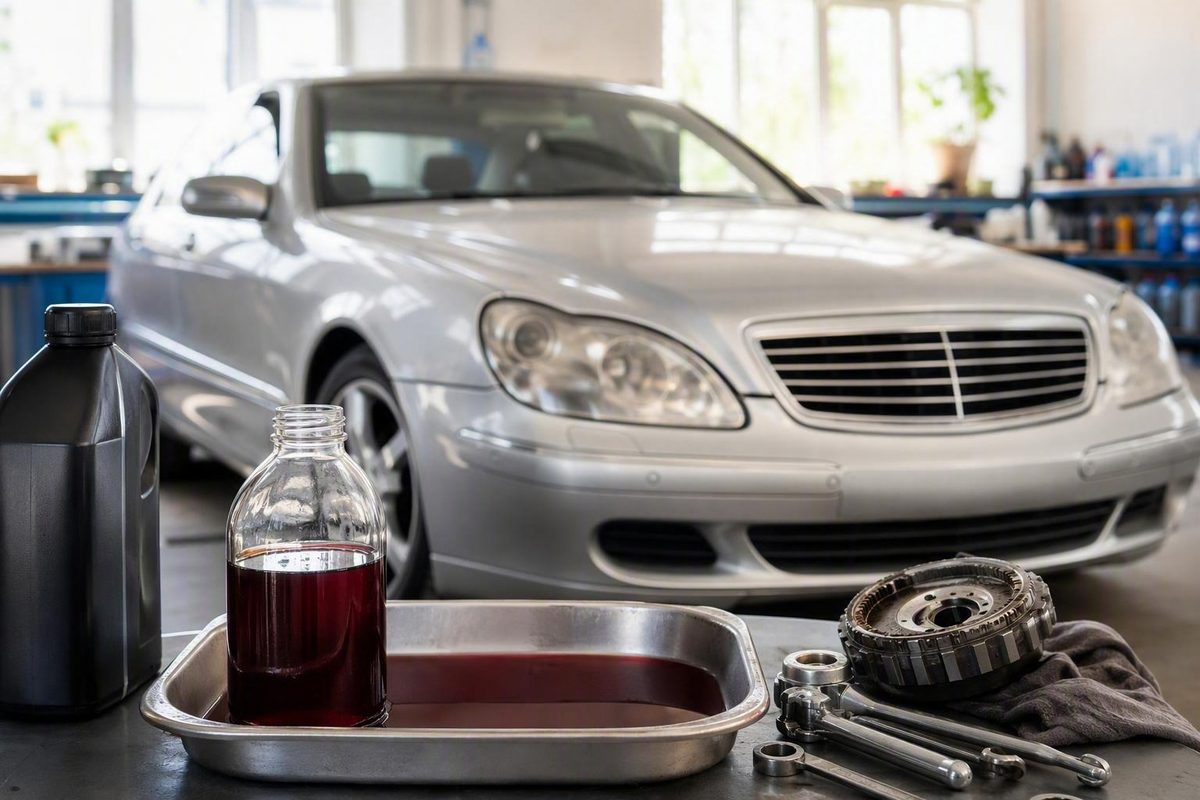
The short answer: transmission fluid can deteriorate
Yes, transmission fluid can go bad. It does not, however, deteriorate on one universal timetable. Fluid life depends on the transmission design, fluid formulation, operating temperature, driving conditions, contamination, maintenance history and—for stored fluid—how the container was sealed and stored.
Transmission fluid has several jobs. It lubricates gears, bearings and other moving parts; carries heat away from working surfaces; and helps protect components against wear and corrosion. In an automatic transmission, it also transmits hydraulic pressure and helps actuate the clutches that produce gear changes. Heat can reduce some of those lubricating, protective and clutch-actuation capabilities, as explained in Cars.com’s overview of automatic-transmission fluid degradation.
The principal in-service threats are:
- Heat and oxidation: Repeated exposure to elevated operating temperatures can accelerate chemical change and reduce useful performance.
- Mechanical stress: The fluid is pumped through passages and worked between moving components.
- Performance loss: Its additives and friction characteristics may no longer perform as intended after prolonged service.
- Contamination: Clutch material, dirt and metallic wear particles can enter the fluid.
- Transmission or cooling problems: A fault may overheat or contaminate fluid that otherwise would have remained serviceable longer.
Degraded or heavily contaminated fluid may become less effective at lubrication, heat management, corrosion protection, hydraulic control or clutch operation. Those effects cannot always be identified by examining a drop of fluid. Service history, operating behavior, level, leaks, odor, debris and the manufacturer’s instructions all matter.
It is also important to distinguish old fluid from low fluid. Automatic-transmission fluid is not normally consumed in the same manner as engine oil. A low level commonly warrants an inspection for leakage. Adding fluid may restore the level temporarily, but it does not repair the source of a leak.
The clearest way to answer “does transmission fluid go bad?” is to divide the question into three cases:
- Fluid installed and operating inside a transmission.
- Fluid left in an opened container.
- Fluid still in an intact, factory-sealed container.
Each case presents different risks.
Installed, opened, and sealed fluid do not age the same way
Fluid inside a working transmission faces heat, mechanical loading, wear debris and repeated operating cycles. An opened bottle is spared those stresses but has more opportunity for contamination. An unopened bottle is better protected, yet its condition still depends on packaging integrity, product-specific instructions and storage history.
| Fluid situation | Main concerns | Best basis for a decision |
|---|---|---|
| Installed in a transmission | Operating heat, oxidation, mechanical stress, wear debris, leakage, severe use and unknown service history | Exact vehicle schedule, normal or severe use, correct fluid specification, condition checks, symptoms and service records |
| Opened and stored | Dirt, moisture, accidental mixing, a loose or damaged cap and uncertain identity or opening date | Clean original container, tight closure, known storage history and product-manufacturer guidance |
| Unopened and stored | Failed packaging, uncertain age or batch information, sunlight, moisture and temperature exposure | Manufacturer instructions, intact packaging, known storage conditions and confirmation from the fluid maker when uncertain |
Installed fluid
Calendar age is only one part of the picture. A vehicle towing in hot, congested conditions can work its fluid much harder than a vehicle accumulating the same mileage under lighter highway use. Conversely, low mileage does not prove that installed fluid remains suitable indefinitely. The vehicle maker may prescribe time-based maintenance or define service according to operating conditions.
An unknown history deserves particular caution. The fluid may be overdue, may have been serviced with an unsuitable product or may be affected by an existing mechanical problem. Before assuming age is the only concern, identify the transmission, inspect for leaks and look for reliable service records.
Opened fluid
Opening a container creates more opportunity for dust, water, shop debris or another lubricant to enter. If opened fluid is retained, it should remain in a clean, tightly closed and clearly labeled original container so its identity is not lost.
There is no defensible universal rule that every opened bottle remains usable for a specific number of years. A bottle opened once in a clean workshop and immediately recapped is not equivalent to an unmarked container with an unknown history. If you cannot verify the product, its required specification or whether it remained clean, do not use it as a questionable top-up in a transmission.
Visual inspection may reveal obvious contamination, but appearance and odor alone cannot certify old stored fluid as suitable. Product-specific guidance from the named fluid manufacturer is the stronger basis for a decision.
Factory-sealed fluid
An intact factory seal reduces contamination risk, but “sealed” does not answer every question. Inspect the bottle for leakage, cracking, swelling, brittleness or distortion. Look for a manufacturing date, expiration date or batch code, then ask the manufacturer how that information should be interpreted.
Storage guidance is product-dependent. Packaging condition, moisture, sunlight, heat and temperature fluctuations are among the considerations discussed in this commercial technical overview of transmission-fluid storage, but its generalized figures should not replace instructions from the manufacturer of the actual product.
A manufacturer’s warranty period and a product’s possible practical usability are not necessarily identical concepts. Even so, that distinction does not establish that every sealed bottle remains usable indefinitely. Different formulations and packages may have different limits.
Calendar age alone therefore cannot certify or condemn every unopened bottle. If the fluid is old, its code is unclear or its storage history is uncertain, contact the named manufacturer with the exact product, code, container condition and known storage details. A generic claim that all transmission fluid expires after a fixed number of years is not an adequate substitute.
Why heat and severe driving shorten fluid life
For installed fluid, operating heat and contamination generally deserve more attention than the calendar alone. Every transmission produces heat, but vehicle load, traffic, terrain, cooling performance and driving style affect how demanding that heat exposure becomes.
Conditions that can increase the burden include:
- Towing a trailer
- Hauling heavy cargo
- Repeated stop-and-go operation
- Steep or mountainous routes
- Hot ambient conditions
- Aggressive acceleration
- Frequent shifting under load
- Commercial, off-road or other sustained heavy use
The causal chain should be understood without overstating it. Greater load or repeated shifting can produce more heat. Greater heat exposure can accelerate fluid deterioration. Clutch surfaces and other internal components also wear during operation and can add debris. A filter may capture part of that material, but it cannot restore fluid whose useful performance has declined.
Overheating can be both a contributor and a warning. It may accelerate fluid breakdown, but it may also point to an underlying problem such as low fluid, an incorrect level, restricted cooling, excessive load or internal transmission wear. Replacing overheated fluid without investigating the cause may allow the condition to recur.
Do not shorten a published service interval by an arbitrary percentage simply because the vehicle occasionally carries passengers or encounters traffic. Instead, look for a manufacturer-defined severe-service schedule. Manufacturers define severe use differently, and the applicable category may depend on how frequently the vehicle tows, operates under heavy load or encounters demanding temperatures and terrain.
AAA identifies towing, heavy loads, hot or mountainous conditions, stop-and-go driving and intensive use as factors that may accelerate fluid wear, while emphasizing that service timing depends on transmission type and manufacturer guidance in its transmission-fluid maintenance guide.
Low-use vehicles also require judgment rather than complacency. Low mileage reduces some mechanical work and wear, but it does not prove that installed fluid remains suitable forever. The available evidence does not establish one universal calendar limit for every transmission, so consult the exact schedule rather than inventing one.
How to assess fluid condition without relying on color alone
A condition check can reveal reasons for further investigation, but it is not a laboratory certification. Interpret appearance alongside level, odor, debris, service history, operating symptoms and the vehicle’s prescribed inspection procedure.
Use this checklist:
- Fluid level: Is it within the specified range under the manufacturer’s required test conditions?
- Leaks: Is there fluid around the transmission, cooler lines or beneath the vehicle?
- Odor: Does the sample have a distinctly burnt or varnish-like smell?
- Clarity: Is it reasonably clear for its formulation, or persistently cloudy?
- Sediment: Has material settled at the bottom of a sample or container?
- Visible particles: Are there fibers, grit, dirt or unidentified contaminants?
- Metallic material: Are there obvious flakes, chips or shavings?
- Operating changes: Has shifting, engagement, noise or temperature behavior changed?
- Fluid identity: Is the product known to meet the required specification?
- Service history: Is there reliable evidence of when and how it was last serviced?
Many descriptions call fresh automatic-transmission fluid red or pink and older fluid brown or darker. That shorthand has limits. Formulations differ, not every product begins with the same color and some darkening may occur during use. Red fluid is not automatically healthy, and dark fluid does not by itself prove that replacement is due.
Odor and suspended material add context. A burnt or varnish-like smell, persistent cloudiness or sediment should prompt further inspection, but none identifies a failed component by itself. Stored fluid with abnormal sediment or contamination should be evaluated under the product manufacturer’s guidance rather than assumed usable after mixing or shaking.
Fine residue and obvious metal fragments should not be treated as equivalent. Depending on transmission design and history, fine residue may accompany normal wear. Distinct flakes, chips or shavings are more concerning because they may indicate internal damage. Fresh fluid cannot repair the source of that metal.
Level-checking procedures also differ substantially. Some transmissions have a conventional dipstick; others require special tools, a specified fluid-temperature range or service-facility access. AutoZone notes that fluid formulations and checking arrangements vary and that some vehicles lack an owner-accessible dipstick in its guide to transmission-fluid level and condition.
There is therefore no safe generic dipstick procedure for every vehicle. Follow current service information for the exact year, engine, transmission and driveline. If the prescribed check requires specialized tools or access beneath the vehicle, have a properly equipped technician perform it.
Symptoms that require inspection, not a fluid-only diagnosis
Transmission symptoms overlap. A delayed shift might involve low, unsuitable or deteriorated fluid, but it may also result from a control problem or internal mechanical wear. Treat symptoms as evidence that inspection is needed—not as proof that the fluid alone is responsible.
Driving symptoms
Possible warning signs include:
- Delayed or irregular shifts
- Hesitant, harsh or jerky shifts
- Slipping or an increase in engine speed without matching acceleration
- Surging
- Delayed engagement after selecting Drive or Reverse
- Delayed acceleration or poor response
- Unusual whining, grinding or clunking
Leak or level clues
Look for:
- Fluid spots or puddles beneath the vehicle
- Visible wetness around the transmission or its fluid lines
- A level below the specified range
- A recent or repeated need to add fluid
- An incorrect reading after prior service
A leak can produce many of the same symptoms people attribute to “bad fluid.” Adding fluid without using the correct level-setting procedure can also leave the underlying problem unresolved.
Urgent findings
Prompt professional inspection is appropriate when there is:
- Severe slipping or loss of drive
- Overheating
- Smoke
- A substantial or rapidly worsening leak
- A transmission or powertrain warning light
- Grinding or severe mechanical noise
- Metallic flakes, chips or shavings
- A strong burning smell accompanied by poor operation
The following matrix illustrates why one observation cannot identify the repair:
| Observation | Possible fluid-related explanation | Plausible alternative causes | Appropriate next step |
|---|---|---|---|
| Delayed engagement | Low level, unsuitable fluid or deteriorated fluid | Control problem or internal wear | Verify the level and specification using the prescribed procedure; diagnose if persistent |
| Harsh or irregular shifts | Incorrect level, unsuitable fluid, contamination or heat-damaged fluid | Electronic, hydraulic or mechanical fault | Check history, leaks and manufacturer diagnostic information |
| Slipping or engine flare | Low fluid, overheating or reduced hydraulic performance | Worn internal components or another pressure-related fault | Limit further demanding use and obtain prompt diagnosis |
| Surging or hesitation | Contaminated or unsuitable fluid may contribute | Engine, driveline or transmission-control problem | Determine which system is producing the symptom |
| Whining, grinding or clunking | Low level or reduced lubrication may contribute | Gear, bearing or other mechanical wear | Inspect level and leakage, then diagnose the noise source |
| Burning odor | Overheated or oxidized fluid | Another automotive fluid or component overheating | Inspect promptly, especially if operation has changed |
| Overheating | Low, unsuitable or deteriorated fluid; excessive load | Cooling problem or internal transmission fault | Reduce the load and diagnose the cause |
| Fluid puddle | Transmission-fluid loss | Another vehicle fluid leaking | Identify the fluid and repair the leak |
| Warning light | A temperature, ratio or control problem involving the transmission | Electrical, sensor, engine or mechanical fault | Retrieve diagnostic information and follow the manufacturer’s procedure |
| Metallic debris | Internal wear contaminating the fluid | Existing component damage | Obtain mechanical diagnosis; do not expect fluid replacement to repair wear |
Adding or changing fluid cannot rebuild worn clutches, restore damaged gears or bearings, reseal failed parts or correct every control fault. Fresh fluid can restore the correct product and condition only when the specification, procedure and final level are right. It is maintenance, not a universal transmission repair.
How to decide when transmission fluid should be serviced
There is no universal mileage or time interval for every automatic, manual, continuously variable or dual-clutch transmission. Published recommendations vary because transmission architecture, fluid formulation, vehicle use, climate and manufacturer policy vary.
Generic ranges illustrate that disagreement rather than resolve it. AAA gives broad examples of 60,000–100,000 miles for automatic and continuously variable transmissions and 30,000–60,000 miles for manual transmissions, while directing owners to vehicle-specific requirements. Those figures are not a replacement schedule for an individual vehicle.
Use this decision sequence:
- Identify the transmission type and code. Do not rely only on the vehicle model or shifter appearance.
- Find the exact approved fluid. Confirm the required specification rather than relying on a broadly similar viscosity or a generic “universal” claim.
- Read the normal and severe-service schedules. Use the schedule matching the vehicle’s actual duty.
- Review the service history. Determine what product and procedure were previously used, if possible.
- Check for leaks and symptoms. Routine maintenance planning changes when the transmission is slipping, overheating or shedding visible metal.
- Select the approved procedure. Confirm whether the manufacturer calls for draining, filter replacement, pan removal, exchange or another method.
- Verify the fill procedure. Obtain the required quantity, tools, temperature conditions and final level-check instructions.
Automatic-transmission fluid, manual-transmission lubricant, CVT fluid and dual-clutch fluid have different formulations and friction requirements. They should not be treated as interchangeable merely because they are packaged similarly. The exact required specification matters; unsuitable fluid can impair operation and may damage the transmission.
The final level matters as well. Too little fluid can compromise lubrication and transmission operation. Follow the vehicle-specific procedure.
Treat “lifetime fluid” as a vehicle-specific maintenance term, not a universal promise. The phrase alone does not establish that every transmission is permanently maintenance-free. Consult the current schedule and service information for the exact vehicle instead of assigning the term a generic meaning.
Manufacturer-specific or professional information is especially important when:
- The transmission is described as sealed.
- There is no conventional dipstick.
- The service history is unknown.
- Fluid temperature affects the level check.
- Special fill equipment or diagnostic tools are required.
- The vehicle is already slipping, overheating or making mechanical noise.
- An unsuitable fluid may previously have been installed.
Drain-and-fill, pan service, exchange, or flush?
Service terminology is inconsistent. Ask what a shop intends to do rather than choosing by name alone.
Drain-and-fill
A drain-and-fill removes the fluid that flows naturally from the transmission’s drain point or during limited pan draining, then replaces that amount with the correct new fluid. Some old fluid normally remains in the torque converter and internal passages.
The proportion replaced varies by transmission design and procedure. A partial replacement is not inherently inadequate; it may be the manufacturer’s intended maintenance method. Repeated drain-and-fill services are sometimes proposed to renew a greater proportion over time, but that approach must also be compatible with the vehicle’s instructions.
Pan-and-filter service
Where the design permits it, a pan service involves draining the fluid, removing or lowering the pan, inspecting and cleaning it, and replacing the serviceable filter and gasket as required. This can provide an opportunity to examine accumulated material instead of simply draining fluid through a plug.
Not every transmission has a conventionally removable pan or a filter intended for routine replacement. Confirm the design and required parts before service.
Fluid exchange
An exchange replaces a greater proportion of the old fluid by circulating or displacing it while new fluid is introduced. Equipment and procedures differ among providers. “Complete exchange” may also be used loosely, so ask whether the pan will be removed, whether the filter will be replaced, whether any cleaning chemicals are involved and how the final level will be verified.
Flush
Some businesses use “flush” as another name for equipment-assisted fluid replacement. Others mean a process involving a cleaning solution. Jiffy Lube, for example, describes its advertised flush as running a solution through the cooler lines, while its conventional change lowers and drains the pan in its comparison of transmission-fluid changes and flushes. That is one provider’s definition, not a universal industry standard.
Flushing cannot responsibly be declared universally safe, universally harmful or always superior. The correct method depends on transmission design, present condition, manufacturer instructions and the actual procedure being offered. Replacing a greater percentage of fluid is not automatically better if the shop uses an unsuitable product, omits a required filter, sets the wrong level or employs a process incompatible with the transmission.
The evidence also does not establish that fresh fluid inherently destroys high-mileage transmissions. A neglected transmission may already contain worn components, leakage or heavy debris. Symptoms appearing near the time of service may reveal or coincide with that existing wear. Conversely, no fluid service can repair worn mechanical parts.
Before authorizing service, confirm:
- Is the proposed procedure approved for this transmission?
- What exact fluid specification and product will be used?
- Is a filter, gasket, washer or pan replacement required?
- Will the pan be inspected where applicable?
- Is the service history known?
- Are there current symptoms, warning lights, leaks or metal debris?
- Does “flush” mean fluid exchange only, or are chemicals involved?
- How will the final level be verified?
- What vehicle position, fluid conditions and tools are required?
Applying the guidance to a Mercedes-Benz W220 with the 722.6
The Mercedes-Benz 722.6 is a vehicle-specific application, not a model for every transmission. A W220 owner should first verify that the car actually has the 722.6 five-speed transmission. Other units may require different fluids and procedures.
W220 Repair recommends servicing the 722.6 fluid and filter at approximately 40,000–60,000 miles, with earlier attention for towing or extensive city driving. The same page reports that the transmission lacks a conventional permanently installed dipstick and instead uses a locked fill tube, a separate measuring tool and temperature-based level checking. These are W220 Repair’s own recommendations and technical account, not a documented Mercedes-Benz factory interval or independently verified workshop procedure in the evidence available here. Owners should confirm the current instructions for the exact vehicle through Mercedes-Benz service information.
The site also identifies MB 236.10- or MB 236.12-approved ATF for the 722.6, while reporting different specifications for later 722.9 transmissions. It recommends attention to the filter, pan gasket and electrical connector sleeve, and estimates that one 722.6 drain-and-fill replaces about 40% of the fluid because some remains elsewhere in the transmission. These claims likewise come from the site’s dedicated 722.6 transmission-fluid article; verify the transmission identity, current fluid approval, required parts and level-setting method against current Mercedes-Benz information before purchasing fluid or beginning work.
A label that merely says a product is “suitable for Mercedes” is less specific than documentation showing the exact approval required for the identified transmission. Do not transfer the W220 Repair interval, fluid specification or estimated drain percentage to another Mercedes-Benz transmission—or to the broader vehicle market.
The bottom line
Transmission fluid does go bad, but there is no single expiration clock for every transmission or bottle.
Start by identifying whether the fluid is installed, opened or factory sealed. Then verify the exact fluid specification and manufacturer guidance. For installed fluid, account for heat, severe use, leaks, service history and operating symptoms. For stored fluid, consider packaging integrity, known storage conditions and product-specific instructions.
Do not rely on color alone. A burnt odor, persistent contamination, metallic debris, overheating, substantial leakage or serious shifting symptoms calls for inspection and diagnosis rather than guesswork. Fresh fluid can be important maintenance, but it cannot repair existing internal wear.
Frequently asked questions
How long does transmission fluid last in a vehicle?
There is no universal lifespan. The applicable interval depends on the transmission, required fluid, vehicle, climate, driving pattern and manufacturer policy. Published generic mileage ranges vary widely and should be treated as examples rather than rules.
Identify the transmission and follow its normal or severe-service schedule. If its history is unknown, inspect for leakage and symptoms, verify the fluid specification and consult vehicle-specific service information. Low mileage reduces some wear but does not prove that the fluid lasts indefinitely.
Does unopened transmission fluid expire?
It may have a manufacturer-defined shelf life, warranty period or storage limit, but no single expiration period applies to every product. Check the label, date or batch code, seal integrity and manufacturer’s storage instructions.
If an old sealed bottle has an unclear code or uncertain storage history, contact the product manufacturer. An intact seal is favorable, but it cannot by itself certify condition or compatibility with the transmission.
Can transmission fluid be bad even if it is still red?
Yes. Color alone cannot verify lubrication performance, friction characteristics, contamination or whether the fluid meets the required specification. Red fluid could be unsuitable for the transmission or contaminated in a way that is not visually obvious.
Likewise, darker fluid is not automatically failed. Consider odor, clarity, debris, level, leaks, service history, symptoms and the product’s normal appearance.
Can changing old transmission fluid damage a high-mileage transmission?
The available evidence does not establish that fresh fluid inherently damages an old transmission. A high-mileage or neglected unit may already have worn components, pressure loss, leakage, contamination or other internal damage. Service can coincide with the discovery of that wear, but fresh fluid cannot create or repair a healthy mechanical component.
Before servicing a symptomatic transmission, diagnose severe slipping, overheating, mechanical noise or metallic debris. Use the approved fluid and procedure, replace required filters and verify the final level correctly.
Is a transmission-fluid change the same as a flush?
Not necessarily. A conventional drain-and-fill replaces the fluid that drains naturally, leaving some old fluid in internal components. A pan-and-filter service also opens the pan where applicable for inspection, cleaning and filter replacement. An exchange replaces a greater proportion of the fluid.
“Flush” has no perfectly consistent definition. It may describe an equipment-assisted exchange or a process that also uses cleaning solution. Ask the provider exactly what will be done, then compare that process with the transmission manufacturer’s instructions.