
A W220 brake-pad wear warning identifies a sensor circuit, not every pad. Inspect all four corners, check the discs and renew a worn sensor.
Understand W220 brake-pad wear sensors, inspect every pad safely, and diagnose a warning that remains after brake service.
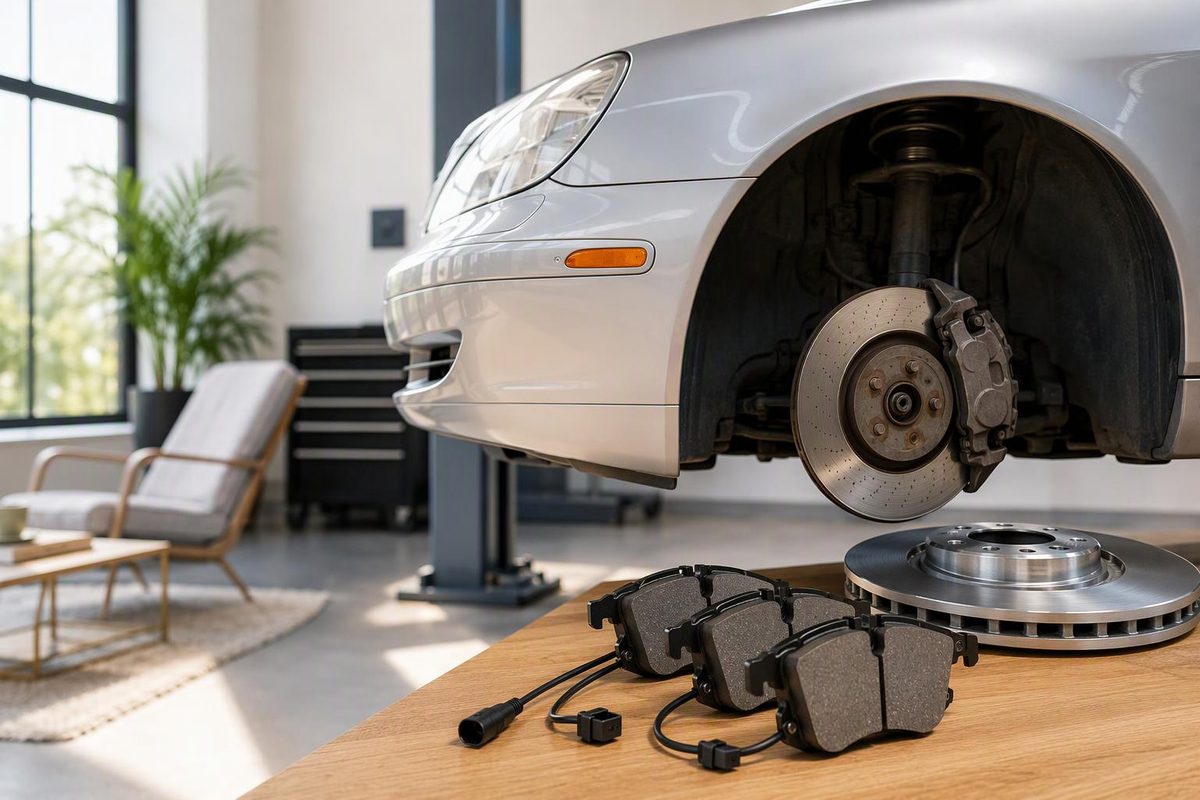
On a Mercedes-Benz W220 S-Class, the brake-pad wear indicator is a sacrificial electrical sensor fitted to selected pads. It is not a thickness gauge for every pad, and the cluster does not show a percentage of pad life.
In the 2004 U.S.-market S-Class manual, BRAKE PAD WEAR — VISIT WORKSHOP! means the pads have reached their wear limit; Mercedes says to have them replaced as soon as possible (2004 S-Class operator’s manual). Treat the message as a prompt for a complete brake inspection—not proof that every pad has worn evenly.
What triggers the warning
The removable sensor fits into a recess in a brake pad. The W220-style two-wire sensor contains a simple circuit. When wear reaches the sensor, contact with the disc damages the sensor element and opens the circuit, triggering the warning. It cannot report the thickness of pads that have no sensor.
This sacrificial principle is also described by Delphi, which recommends replacing wear sensors with the pads because heat, wear and handling can damage the sensor, lead or retaining clip.
A W220 component reference lists pad-contact sensors at the left front, right front and right rear wheels; its brake page places the rear sensor in the right inner pad (component locations, W220 brake reference). That still leaves several pads without direct monitoring.
Brake hardware also differs by engine, AMG version, model year and option package. Confirm the VIN and fitted brake system before ordering pads, sensors or discs rather than relying on a listing that merely says “W220.”
What to inspect when the message appears
-
Check braking behavior first. If there is grinding, a soft or sinking pedal, strong pulling, smoke, an active fluid leak or markedly reduced braking, stop safely and arrange recovery. Those symptoms require more than routine pad replacement.
-
Distinguish the warnings. “Brake pad wear” concerns the pad-sensor system. A brake-fluid warning is different. Mercedes says low reservoir level may result from pad wear or a leak and calls for immediate brake-system inspection; it specifically warns against simply adding fluid before the cause is checked (operator’s manual).
-
Inspect every pad. Securely support the car, remove the wheels and examine the friction material on every inner and outer pad. Do not include the steel backing plate in the measurement. A view through the wheel is only a preliminary check because inner pads can be difficult to see.
-
Compare wear across each caliper and axle. One pad substantially thinner than its partner can indicate a sticking piston, binding pad, damaged guide hardware or another caliper problem. A new sensor will not correct uneven wear.
-
Inspect and measure each disc. Check both faces for heavy scoring, heat cracks, severe corrosion and a pronounced lip. Measure disc thickness with a suitable micrometer and compare it with the limit for the exact brake package. There is no safe universal W220 minimum because the standard and performance variants use different hardware.
-
Check the sensor and lead. Look for a worn sensor head, damaged insulation, broken wire, loose connector or routing that lets the lead contact the disc, wheel or suspension.
Replace brake pads as a complete axle set. If a disc is below its specified limit or otherwise unserviceable, replace both discs on that axle. Renew any sensor that has reached the disc, has damaged insulation, a broken clip or an insecure fit.
If the warning remains after brake service
The pad-wear message should clear after the sensor circuits are restored; it does not use a pad-life service countdown that needs a routine dashboard reset. W220 owners have reported persistent messages caused by an incompletely seated connector or a defective replacement sensor (MBWorld discussion). Use those reports as diagnostic leads, not proof of the fault on a particular car.
Check in this order:
- Confirm that every disturbed connector is fully latched.
- Verify that each sensor is correct for the application and fully seated in its pad.
- Check every lead for pinching, chafing or contact with the disc.
- Inspect the other monitored wheels rather than assuming the serviced axle caused the warning.
- With the ignition off and the sensor disconnected, check the sensor for continuity. A sensor whose internal circuit has worn open must be replaced.
- If the sensors test correctly, use W220-specific wiring information to test the vehicle-side harness rather than repeatedly trying to clear the display.
Do not twist sensor wires together or otherwise bypass the circuit. That may extinguish the message while disabling the warning for future pad wear.