
W220 722.6 Conductor Plate: What It Does and When to Replace It
Understand the W220 722.6 conductor plate, separate it from connector and TCM faults, and plan replacement only when the diagnosis supports it.
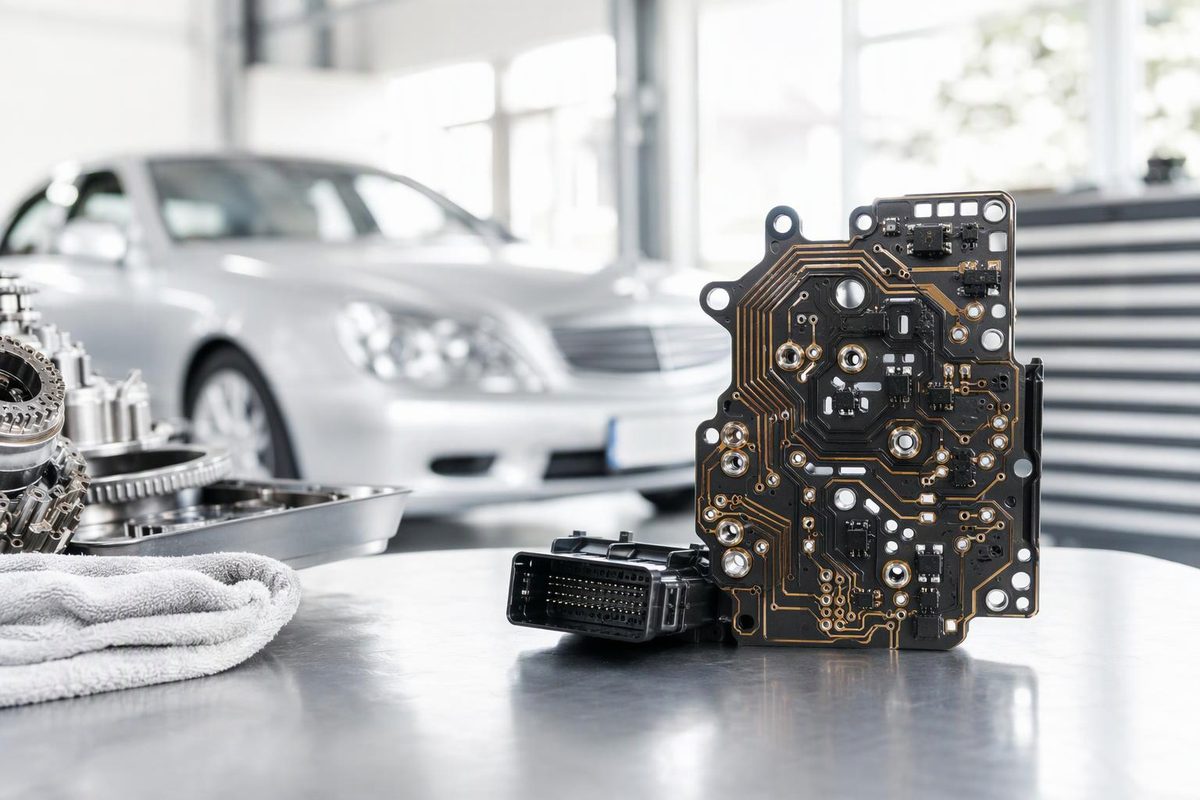
The 722.6 conductor plate is the electrical carrier and sensor assembly mounted on top of the transmission valve body. A failed integrated sensor can justify replacing the plate without replacing the whole transmission. But limp mode, a solenoid code or an oily electrical connector does not, by itself, prove the plate is faulty.
This guide applies to W220 S-Class vehicles with a confirmed 722.6 five-speed transmission. W220s also used the 722.9 seven-speed, so record the model year, variant, VIN and installed gearbox identification before ordering parts or choosing a procedure. Do not select a conductor plate from “W220” alone. The W220 transmission reference distinguishes the two gearbox families.
What the conductor plate does
The plate connects the transmission’s internal electrical components to the external harness. It carries:
- N2 and N3 Hall-effect speed sensors. These monitor different rotating members; neither directly measures turbine-shaft speed in every gear. The control module calculates the relevant speed from their signals.
- The transmission-fluid temperature sensor. Its reading supports transmission control and temperature-dependent fluid-level checking.
- A reed-switch contact associated with Park/Neutral recognition. It shares a circuit with the temperature sensor.
- Electrical connections for six solenoids, which control shifting, pressure and torque-converter lock-up.
The solenoids are separate components fitted through the plate into the valve body. The plate is also not the external transmission control module (TCM/EGS), which evaluates the signals and commands the solenoids. These functions and component locations are described in febi’s 722.6 technical guide.
That distinction matters when buying parts: a bare conductor plate, a complete valve body with solenoids, and a transmission control module are three different repairs.
Separate plate failure from the nearby faults
| Finding | What it means for the repair decision |
|---|---|
| Repeated N2/N3 signal faults | Investigate the integrated sensors and their supply, wiring and connections before condemning the plate. |
| Implausible ATF-temperature reading | Check the operating conditions and sensor circuit before treating the reading as actual overheating or plate failure. |
| ATF inside the transmission harness plug | Investigate the connector sleeve and its seals; this is not automatic evidence of a failed plate. |
| A solenoid electrical fault | Separate the solenoid, plate connection, harness and control-module fault paths. |
A physically damaged integrated sensor is stronger evidence than limp mode alone. In a Mercedes-Benz Club of America repair account, Gary Edwards found a cracked N3 sensor matching persistent N3 fault codes on a C140 with a 722.6. That supports the failure mechanism, not a diagnosis for every W220.
The connector sleeve, often called the pilot bushing, is the sealed passage through the transmission case. Its O-rings can leak ATF into the harness plug. Fluid can then migrate along the harness into the external control module; Beckmann Technologies documents this problem on early 722.6-equipped vehicles, including the 220 chassis. Replacing the plate alone does not repair leaking sleeve seals or an oil-contaminated TCM.
What to establish before authorizing replacement
- Read the transmission module, not just engine codes. Use STAR Diagnosis or a compatible scanner that can access the fitted EGS, its fault descriptions and live data. Save the codes and note whether the fault occurs cold, hot or intermittently.
- Inspect the external connection first. Check for ATF, corrosion, damaged terminals and harness damage. If fluid is present, inspect the control-module end as well; a dry TCM does not rule out a damaged harness near the gearbox.
- Have the affected circuit tested using the vehicle-specific wiring diagram. A speed-sensor fault can originate outside the sensor. A reproduced Mercedes 722.6 electrical test program lists wiring, the conductor plate and the control module as possible causes of a sensor-supply problem. Do not borrow connector pin numbers from another chassis.
- Replace the plate when the fault has been localized to it. Confirmed failure of an integrated sensor, or physical damage matching the electrical diagnosis, supports plate replacement. A solenoid-only fault needs its own diagnosis; see how to test a W220 solenoid.
The harness check is consequential. In a Transmission Digest case study by Jesse Zacarias, a 722.6 continued producing speed-sensor faults after plate replacement because damaged wiring intermittently shorted the signal to voltage. It was an M-Class case, but it demonstrates why a sensor code is not a parts-order instruction.
Stop the plate-only repair plan if the pan contains substantial metal fragments or other evidence of internal damage. Febi’s guide calls for further investigation when fluid and debris inspection indicates serious wear or contamination.
What replacement involves
This is a job-planning overview, not a complete workshop procedure. On the 722.6, the job is performed from underneath with the transmission installed. It requires draining ATF, allowing the transmission to cool before dismantling, removing the pan and filter, disconnecting and removing the connector sleeve, and lowering the valve-body assembly. On a clean bench, the solenoid retainers and solenoids are removed so the conductor plate can be exchanged. The solenoids must return to their correct positions, with their O-rings inspected where fitted. Febi describes this replacement sequence.
Plan for a VIN/gearbox-matched plate, filter, pan gasket, connector sleeve, specified ATF, service dipstick and a transmission-capable diagnostic tool. Use the exact workshop procedure and torque specifications for the installed gearbox—not a generic video’s bolt count. Support the vehicle securely; never work beneath it on a jack alone.
The critical assembly checks are cleanliness, correct selector-plunger engagement, seated solenoid contacts and an aligned connector sleeve. Dirt entering the valve body can interfere with its spool valves. Febi’s assembly instructions cover these checks. This is a valve-body handling job, not simply a pan-gasket change.
After assembly, refill before starting, set the fluid level by the specified temperature-dependent procedure and check for leaks. Measuring the drained ATF helps estimate the initial refill; it does not establish the final level. The W220 transmission reference reproduces the fluid-level procedure.
Clear the repaired transmission faults and verify operation; Edwards’ repair account notes that stored transmission faults had to be cleared to release limp mode after replacement. Clearing codes is not proof of repair: the relevant live data and faults must be checked again after a controlled test drive.