
Bad Transmission Mount Symptoms: Check a W220 Before Blaming the Gearbox
Diagnose W220 transmission-mount vibration and clunks, separate them from engine, driveline and 722.6 faults, and identify unsafe damage.
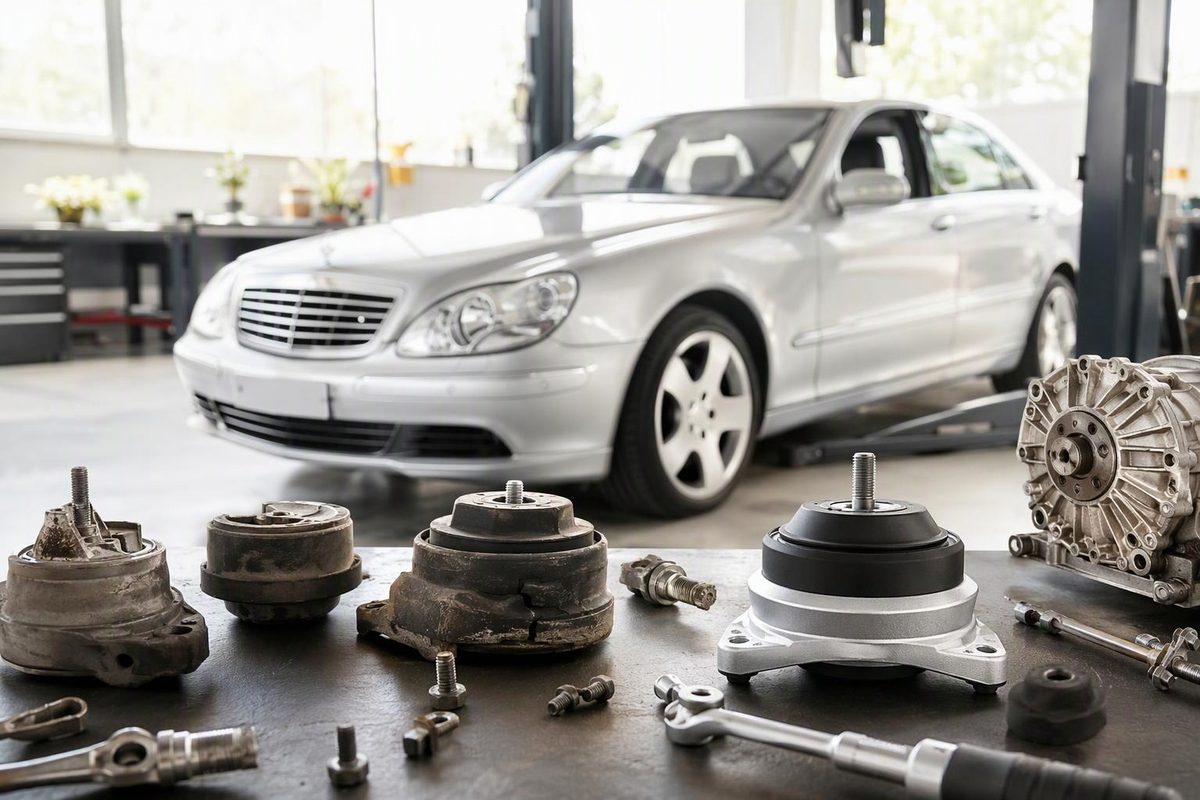
A bad transmission mount on a Mercedes-Benz W220 most often causes vibration, resonance or a thump as drivetrain load changes. It does not normally make engine speed flare between shifts, command transmission limp mode or cause a gear to disappear.
That distinction matters. A collapsed mount can make an otherwise normal shift feel harsh, but replacing it will not repair a hydraulic, electronic or internal gearbox fault.
Before ordering parts, identify the car by VIN, model year, engine, rear-wheel drive or 4MATIC, and transmission. The W220 commonly uses the 722.6 five-speed automatic, but mounts, hardware and access can differ by variant. Confirm the replacement parts by VIN rather than ordering for “W220” alone.
Symptoms that fit a failed transmission mount
Look for a repeatable combination rather than treating one sensation as proof:
- Low-frequency vibration in Drive or Reverse while stationary. It may be felt through the seat, floor or center tunnel more than the steering wheel. Loading the drivetrain in gear can expose a mount that is transmitting vibration into the body.
- A thump when selecting Drive or Reverse. Excess movement may let the transmission or exhaust shift as torque changes direction.
- A clunk when applying or releasing the throttle. It may be strongest when moving away from a stop or transitioning between acceleration and overrun.
- A buzz or drone within a narrow engine-speed range. One forum contributor reported a vibration around 2,000–2,500 rpm that disappeared after the transmission mount was replaced. That is useful community experience, not a diagnostic rule (BenzWorld).
- Visible loss of mount height, torn rubber or unintended contact. A badly collapsed mount can alter the gearbox position enough for the exhaust, a heat shield or the crossmember area to resonate.
A Mercedes specialist’s overview also lists vibration through the seat or console, thumps under changing load, collapsed height and torn rubber as typical evidence. It recommends inspecting the engine mounts, exhaust supports and driveline at the same time (MB Clinic).
Symptoms that point elsewhere
Do not use “it shifts hard” as a transmission-mount test.
Engine speed rises without matching road speed: suspect transmission slip rather than a mount. Follow the checks in How Do I Know If My W220 Transmission Is Slipping?.
The gearbox stays in one gear, will not upshift or stores transmission faults: scan the EGS transmission controller before disturbing parts. The mount has no control circuit and cannot itself command limp mode.
Engagement is delayed and then followed by a bang: check the 722.6 fluid level using the correct temperature-dependent procedure and scan for pressure or ratio faults. The bang may move the drivetrain against a weak mount, but the delay needs its own diagnosis.
Roughness is present in Park or Neutral: check engine smooth-running data, misfire faults, ignition and air/fuel faults. A mount can transmit existing engine vibration; it cannot create an intermittent misfire.
The clunk comes from farther rearward: inspect the flex discs, driveshaft center support, differential mounts and axle joints. Driveline lash can be felt near the center of the car and mistaken for a transmission mount. In one community discussion, contributors considered transmission behavior, differential play and hardened flex discs as separate explanations for shift jolts, illustrating why the symptom alone is inconclusive (BenzWorld).
A useful W220 inspection sequence
1. Establish when it happens
With the car fully stopped and the service brake firmly applied, compare normal idle in:
- Park or Neutral versus Drive;
- Drive versus Reverse;
- cold versus fully warm operation.
During an ordinary road test, compare steady throttle with gentle throttle application and release. Note whether engine rpm remains stable and whether each shift completes normally.
Vibration that appears mainly when the drivetrain is loaded supports a mount or unintended-contact problem, but it does not identify which mount has failed.
2. Scan before blaming the mount
Use a scanner capable of reading the Mercedes EGS module, not only generic powertrain codes. Preserve the codes and available freeze-frame data. If the complaint includes flare, delayed engagement, limp mode or missing ratios, diagnose that path before attributing it to the mount. See Automatic Transmission Problems: Symptoms and Causes for the broader diagnostic branches.
3. Inspect the mount under the car
Work only beneath a properly supported vehicle. Never rely on a hydraulic jack, and never place any part of your body beneath a drivetrain supported only by a jack.
Inspect the transmission support and crossmember area with good lighting. Look for:
- split, cracked or separated rubber;
- a center section sitting unusually low;
- polished witness marks from intermittent contact;
- loose, damaged or displaced hardware;
- oil or ATF contamination around the rubber;
- an exhaust pipe or heat shield touching the body or crossmember.
A photograph may not reveal reduced stiffness or internal separation. In a 2024 discussion, contributors noted that a mount can look acceptable yet still transmit vibration, so combine its appearance with the repeatable symptoms and checks elsewhere in the drivetrain (BenzWorld).
4. Inspect the complete mounting and driveline system
Check both engine mounts, the transmission crossmember, exhaust hangers, flex discs and driveshaft center support. Replacing only the transmission mount may not cure the vibration if an engine mount has also collapsed or another component is contacting the body.
Do not perform a high-rpm “power-brake” test at home. Forum advice sometimes recommends loading the drivetrain in Drive and Reverse to expose movement (MBWorld), but the car can move unexpectedly and already damaged parts may be overloaded. A technician can observe drivetrain movement under controlled conditions from a safe position.
When not to drive
Arrange recovery rather than continuing to drive if there is severe banging, obvious metal-to-metal contact, a loose or hanging transmission or crossmember, a damaged flex disc, contact involving hot or rotating parts, or loss of drive.
Also stop if the car has active ATF leakage together with slipping, delayed engagement or unusual noise; see Transmission Leaks Need a Safety Check Before Repair.
If the only symptom is mild, stable vibration and no loose, contacting or visibly damaged component is found, arrange an inspection promptly. Confirming the fault before replacement prevents an inexpensive rubber mount from becoming an unsuccessful attempt to repair a 722.6 problem.