
How Power Reaches Both Axles in a Four-Wheel-Drive Vehicle
It can drive one axle, both axles or vary how tightly they are coupled. A broken internal torque path may cause partial or complete loss of drive.
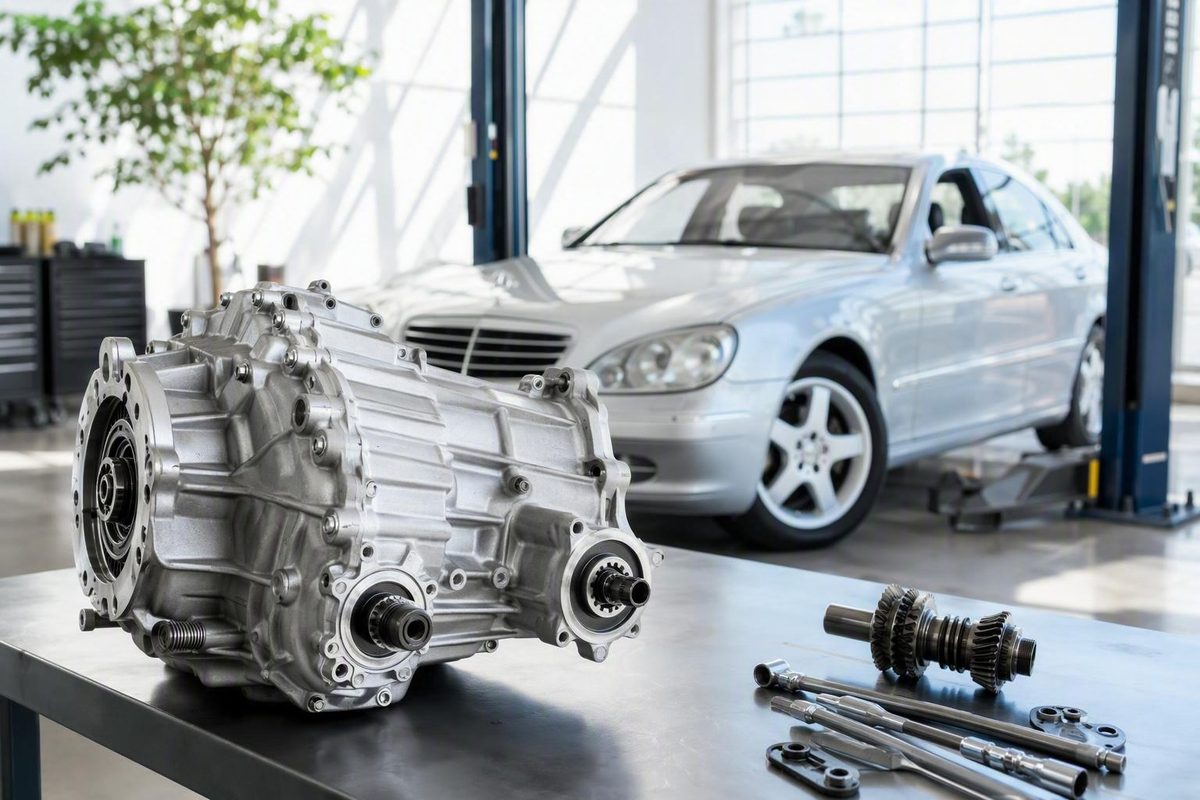
The short answer: a transfer box distributes power between the axles
A transfer box, commonly called a transfer case, is the drivetrain component that receives output from the transmission and routes torque toward the front axle, the rear axle, or both. Supplying both axles is what enables four-wheel-drive or all-wheel-drive operation in drivetrains that use this type of assembly.
The transfer box is commonly mounted behind the transmission, with outputs connected to front and rear driveshafts. That arrangement is not universal: some cases are mounted separately in the driveline, while some AWD systems integrate power-transfer hardware into or alongside a transaxle. AutoZone’s overview of transfer-case construction and placement describes the familiar behind-the-transmission arrangement as well as part-time, full-time, and electronically controlled designs.
It helps to think of the transfer box as an axle-level traffic controller. The engine produces torque, the transmission adjusts the speed-and-torque ratio, and the transfer box determines which axle paths receive that output. Driveshafts, axle differentials, and axle shafts then carry the torque to the wheels.
It makes torque available to more than one axle so the vehicle can use the grip that its tires and the surface provide. Four driven wheels do not remove the physical limits of traction.
The universal function can therefore be summarized simply:
A transfer box routes transmission output between the vehicle’s driven axles.
Everything beyond that depends on the design. A transfer box may also provide:
- Selectable two-wheel drive
- Four-wheel drive in high range
- Reduction-geared low range
- A neutral position
- A locked front-to-rear connection
- A center differential
- An automatically controlled clutch
- A fixed or variable front-to-rear torque distribution
A vehicle need not have all—or even most—of those features. A traditional off-road 4WD truck may offer 2H, 4H, and 4L, while an AWD crossover may control front-to-rear torque automatically and provide no transfer-box selector at all.
“Transfer box” and “transfer case” generally refer to the same type of component. Terminology varies by manufacturer and region. The name alone does not establish whether the system has low range, a locking function, or a particular torque split.
Follow the power: from the engine to all four wheels
A simplified four-wheel-drive power path looks like this:
Engine → transmission → transfer box → front and rear driveshafts → axle differentials → wheels
Each component has a distinct job:
-
The engine produces torque. This turning force begins the mechanical power flow.
-
The transmission changes the overall speed-and-torque ratio. Lower transmission gears provide greater torque multiplication at lower road speeds; higher gears suit faster travel at lower engine speed.
-
The transfer box routes output between the axles. Depending on its design and selected mode, it may drive one axle, drive both axles, or vary how strongly the two axle paths are coupled.
-
The driveshafts carry torque along the vehicle. In a typical longitudinal drivetrain, separate shafts lead toward the front and rear axles.
-
The axle differentials serve the wheels on each axle. The front differential distributes torque between the front wheels, while the rear differential does the same for the rear wheels.
-
Axle shafts or half-shafts complete the path to the wheels.
A basic diagram makes the relationship easier to visualize:
                     ┌── Front driveshaft ── Front differential ── Front wheels
Engine ─ Transmission ─ Transfer box
                     └── Rear driveshaft ─── Rear differential ─── Rear wheels
This is a functional diagram, not a universal packaging drawing. It shows the transfer box behind the transmission because that is a common arrangement. A remotely mounted, or “divorced,” case may be connected to the transmission by another shaft. A transverse AWD vehicle may package its power-transfer hardware beside the transaxle rather than using a conventional case directly behind it.
In a typical arrangement, the transmission output shaft drives the transfer-box input. Internal components then establish the paths to the front and rear outputs. Depending on the system, those components may include:
- Meshing gears
-
A drive chain
-
A center differential
-
A multiplate clutch
-
Shift forks, motors, or actuators
- Electronic sensors and control software
These parts do not all perform the same function. Gears or a chain may carry torque to a second output, while a clutch or center differential determines how the front and rear driveline paths interact.
It is therefore misleading to say that the transfer box sends power “straight to all four wheels.” It sends output toward the axles. Driveshafts, differentials, axle shafts, and—in some designs—wheel-end or axle-engagement hardware remain part of the path. Ralph’s Transmission provides a useful high-level distinction between the transfer case and axle differentials: the transfer case controls power sent toward the differentials, which then serve the wheels.
Transfer box vs. transmission and differential
A transfer box can resemble a compact gearbox because it contains a housing, shafts, bearings, lubricant, and sometimes more than one ratio. Calling it a “secondary gearbox” can be a useful introductory analogy, but ordinary gear selection is not its defining purpose. Its defining job is axle-to-axle power distribution.
| Component | Defining job | What it does not normally decide |
|---|---|---|
| Transmission | Selects the overall gearing between engine speed and driveline speed | Which axle or axles receive output |
| Transfer box | Routes torque toward the front axle, rear axle, or both | How the two wheels on one axle rotate relative to each other |
| Driveshaft | Carries torque between drivetrain assemblies | Gearing or torque distribution |
| Axle differential | Distributes torque between the wheels on one axle and permits wheel-speed differences | Whether the other axle receives power |
| Center differential, where fitted | Distributes torque between the front and rear driveline paths while permitting different rotational speeds | Left-to-right wheel-speed differences within an axle |
Why the axle differential is necessary
When a vehicle turns, the outside wheel follows a longer path than the inside wheel. The wheels on that axle must therefore be able to rotate at different speeds. An open, limited-slip, locking, or electronically controlled axle differential manages this left-to-right relationship, although each type behaves differently when available traction is uneven.
The transfer box works one level higher in the driveline. It determines how transmission output reaches the front and rear axles. It does not replace the differentials within those axles.
What a center differential does
A center differential, where fitted, distributes torque between the front and rear driveline paths while allowing those paths to rotate at different speeds. Its outputs lead toward separate axles rather than toward the left and right wheels of one axle.
The front and rear axles do not always need the same average rotational speed. During a turn, they trace different arcs. A center differential accommodates those differences while both axles remain driven.
Not every transfer assembly contains a center differential. Some use a controlled clutch to permit or regulate relative motion. Traditional part-time 4WD systems may instead lock or closely couple the front and rear outputs whenever 4WD is selected. Central Volkswagen’s transfer-case and differential comparison summarizes the core distinction: transfer cases divide power between axles, while axle differentials manage torque and speed differences between wheels on the same axle.
A note for Mercedes 722.6 readers
The Mercedes 722.6 automatic transmission is not a transfer box. The transmission establishes the main gear ratios; a transfer box or another AWD distribution assembly handles the path toward multiple axles.
Fluid specifications, level-checking procedures, and service recommendations therefore cannot be carried automatically from one assembly to the other. W220 Repair’s 722.6 transmission-fluid article concerns the automatic transmission, so its ATF guidance must not be treated as transfer-box maintenance information.
Part-time 4WD, full-time 4WD, and AWD do not work the same way
Terms such as 4WD and AWD describe broad categories rather than one universal mechanical system. Vehicles carrying similar badges can use substantially different hardware and control strategies.
| System | Normal operation | Typical driver control | How front-to-rear speed differences are handled | Common use | Low range typically available? |
|---|---|---|---|---|---|
| Part-time 4WD | Often drives one axle in 2WD and connects the other when 4WD is selected | Lever, switch, buttons, or rotary selector | Commonly locks or closely couples the front and rear outputs in 4WD | Trucks, utility vehicles, and off-road-focused SUVs | Often, but not always |
| Full-time 4WD | Both axles receive power during normal driving | May provide high, low, lock, or terrain modes | Usually a center differential, controlled clutch, or equivalent mechanism | Mixed road and off-road use | Sometimes |
| Automatic AWD | May power both axles continuously or add torque to a secondary axle as needed | Usually automatic; may offer drive modes or a temporary lock function | Controlled clutch, differential, coupling, or a combined system | Cars, crossovers, and some SUVs | Usually not |
These are typical patterns, not rigid definitions.
Part-time four-wheel drive
A conventional part-time system may drive one axle in 2H. When the driver selects 4H or 4L, the transfer box connects the other axle so both driveline paths receive torque.
In many part-time systems, the front and rear outputs are mechanically locked or closely coupled instead of being separated by a center differential. This arrangement works where the tires can slip enough to relieve front-to-rear speed differences. It can create binding on dry, high-grip pavement.
“Part-time” does not necessarily mean that the driver moves a floor lever. A part-time system can use a dashboard switch and an electric shift motor while retaining the same underlying mechanical behavior. Electronic selection describes the control method, not a separate power-distribution category.
Full-time four-wheel drive
A full-time system continually makes power available to both axles. For normal road use, it generally includes a center differential or an equivalent mechanism that accommodates front-to-rear speed differences.
Some full-time systems let the driver lock the center action for particular low-grip conditions. Others combine a center differential with a controlled clutch to alter torque bias. The permitted use of any locking mode remains vehicle-specific.
Automatic all-wheel drive
Automatic AWD can use sensors, software, clutches, and actuators to vary the relationship between the axles without requiring the driver to select 4WD. Depending on the design, the control system may consider wheel speed, accelerator position, steering input, or vehicle motion when altering clutch pressure or coupling behavior.
This does not mean every automatic system waits for a wheel to spin. Some maintain a contribution from both axles, while others operate mainly through one axle and increase coupling in response to predicted or detected need. Seacoast Mazda’s description of an automatically controlled AWD system illustrates how sensors and clutches can be used to alter distribution rather than maintain one fixed relationship.
An even 50:50 torque split is not universal. Distribution may be nominally equal, biased toward one axle, or continuously variable. Actual axle torque also depends on the center mechanism, axle differentials, available traction, and whether a quoted split refers to normal operation, maximum coupling, or one particular mode. MotorTrend’s overview of transfer-case designs describes the even relationship found in a typical engaged part-time system while cautioning that specific splits depend on the design.
Not every AWD vehicle has a separate conventional transfer case. The system still transfers power between axle paths, but its components may not resemble a traditional truck transfer box.
What 2H, 4H, 4L, Auto, and neutral can mean
Transfer-box labels are not standardized across all manufacturers. These are common meanings rather than universal definitions:
| Mode | General meaning |
|---|---|
| 2H | One axle is powered through high range |
| 4H | Both axles are connected or commanded through high range |
| 4L | Both axles are powered through reduction gearing |
| Auto | The system manages front-to-rear engagement or coupling automatically |
| Neutral (N) | Drive through the transfer case is disconnected, where that function exists |
2H: two-wheel drive, high range
In a typical part-time truck or SUV, 2H powers one axle—often the rear—through the normal high-range path. It is commonly used for ordinary road driving, although the correct default setting depends on the vehicle.
“High” does not refer to a particular transmission gear. It means the transfer box is using its normal ratio rather than its reduction-geared low range.
4H: four-wheel drive, high range
Selecting 4H connects or commands both axles while retaining high range. In a locked part-time system, this may closely couple the front and rear driveshafts. In another vehicle, 4H may identify a less rigid connection or an electronically controlled operating mode.
High range supports higher road speeds than low range, but a 4H label alone does not establish which surfaces are allowed, how fast the vehicle may be driven, or whether engagement is permitted while moving.
4L: four-wheel drive, low range
Low range adds reduction gearing. For a given engine speed and selected transmission gear, the vehicle moves more slowly while greater torque is available at the axles. This supports controlled low-speed progress without requiring high road speed.
Possible uses include travel on steep grades, loose surfaces, deeply rutted routes, or demanding off-road terrain. These are examples, not universal towing, recovery, or hill-descent instructions. The appropriate mode depends on the vehicle and the conditions.
Many AWD cars and crossovers have no low range, selectable two-wheel drive, or transfer-case neutral.
Auto: system-managed engagement
An Auto setting generally allows the vehicle to vary front-to-rear engagement without requiring the driver to make every coupling decision. It should not be assumed to behave like locked 4H or permanent full-time AWD; the control strategy is vehicle-specific.
A dashboard selector also does not mean that the torque transfer itself is entirely electronic. The switch may simply command an actuator that moves mechanical components inside the case.
Transfer-case neutral
Where fitted, transfer-case neutral disconnects drive through the transfer case.
Its intended use and selection sequence are model-specific. Another vehicle’s towing or operating procedure should not be copied without confirming that the same instructions apply.
Never assume the shifting procedure
Some systems permit high-range engagement while moving. Low-range selection can have different requirements from high-range engagement.
Before changing modes, consult the owner’s manual for:
- The meaning of each setting
- Permitted road or terrain surfaces
- Engagement and operating-speed limits
- The required transmission position
- Whether the vehicle must be moving or stationary
- The procedure for entering and leaving low range
- The meaning of flashing or steady mode indicators
Why locked 4WD can bind on dry pavement
When a vehicle turns, the front and rear axles do not follow exactly the same paths. Their tires can therefore require different average rotational speeds. Smaller differences can also result from tire pressure, tread wear, loading, and effective rolling circumference.
A road-capable full-time system accommodates this through a center differential, a controlled clutch, or another mechanism that permits or regulates relative movement between the front and rear driveline paths.
A locked part-time 4WD mode behaves differently. It forces, or very closely couples, the front and rear driveshaft speeds. On loose or yielding terrain, a tire may slip enough to release the difference. On dry, high-grip pavement, the tires may not slip easily enough.
The resulting torsional stress is commonly called driveline windup. The general mechanics of part-time transfer cases and driveline windup explain why non-differentiated operation can be unsuitable for high-grip roads.
Possible observations include:
- A binding or resistant sensation
- Tire scrubbing or hopping in tight turns
- Heavier steering
- Jerking at low speed
- Difficulty releasing the selected mode
These symptoms do not conclusively identify windup or transfer-box damage. Tire faults, steering problems, axle differentials, joints, and an incorrect mode-selection procedure can produce overlapping effects.
The dry-pavement warning applies specifically to modes that lock or do not adequately differentiate the front and rear driveline paths. It does not mean that every AWD or full-time 4WD vehicle is unsuitable for dry roads. Those systems are generally designed to accommodate normal front-to-rear speed differences in their standard road modes.
Mode names are not sufficient by themselves to determine permitted surfaces. The vehicle manufacturer’s instructions control.
Fluid, maintenance, and model-specific rules
Transfer boxes with lubricated mechanical components require the correct fluid at the specified level. Depending on the design, the fluid can lubricate gears, chains, shafts, bearings, clutches, and other working surfaces while also carrying heat away.
There is no universal transfer-box lubricant. Different units may require products with different viscosity, friction, additive, or material-compatibility characteristics. A fluid that looks similar to the specified product may still be unsuitable.
There is also no reliable universal replacement interval. Requirements can vary with:
- The vehicle and transfer-box model
- The required fluid specification
- Internal clutch or differential design
- Normal or severe operating schedules
- Towing or off-road use
- Water or other contamination
- Manufacturer revisions and market-specific schedules
Use the owner’s manual, current manufacturer service information, or a verified specification for the exact unit. Do not import a mileage interval or lubricant recommendation from another vehicle.
Fluid level and condition
Low fluid may result from leakage, but a damp housing does not establish where the fluid originated. The area may need to be cleaned and traced before the source can be identified.
Contaminated, degraded, or insufficient fluid can justify inspection, but it does not by itself prove that internal parts have failed. A Automotive’s transfer-case lubrication explanation notes that fluid lubricates gears, shafts, and bearings and carries heat away from working surfaces.
If the correct procedure or suitable equipment is unavailable, the check should be left to a properly equipped workshop.
An owner can still record useful information without dismantling the drivetrain:
- Where a leak first appears
- The observed fluid color and odor, without assuming its source
- Dashboard warnings or messages
- Whether a sound changes with road speed or engine speed
- The selected drivetrain mode and road conditions
- Whether the symptom followed service, an impact, or water exposure
- Photographs of the affected area
This information can help direct a subsequent inspection without assigning a diagnosis prematurely.
Transmission fluid advice is not transfer-box advice
Even if both assemblies use a product described as automatic transmission fluid, compatibility must be confirmed separately for each unit.
Do not select transmission fluid, gear oil, engine oil, or a “universal” lubricant merely because of appearance or proximity. Confirm the exact transfer-box specification first.
Possible signs of trouble—and why symptoms are not a diagnosis
Possible indicators of a transfer-box or related 4WD/AWD problem include:
- Fluid leakage near the unit
- Grinding, growling, or humming that changes with road speed
- Clunking during acceleration, deceleration, or mode changes
- A new drivetrain vibration
- A 4WD, AWD, or drivetrain warning message
- Failure to engage or disengage a selected mode
- Difficulty changing between high and low ranges
- A mode indicator that flashes or behaves unexpectedly
- Loss of the expected front- or rear-axle contribution
- Partial or complete loss of drive
None of these symptoms uniquely identifies the transfer box. Similar complaints can originate in the transmission, driveshafts, universal or CV joints, axle differentials, shift linkage, front-axle engagement hardware, actuators, wiring, sensors, or electronic controls.
A road-speed-related hum, for example, may come from a bearing elsewhere in the driveline. Failure to engage 4WD may result from an electrical fault or an axle-disconnect mechanism. Difficulty entering low range may simply mean that the required transmission position or vehicle-speed condition has not been met. S&G Gearbox’s transfer-case symptom guide likewise identifies linkage, differential, driveshaft, front-axle shift, and electrical faults as possible alternatives to internal transfer-case failure.
Record the operating context
A clear symptom log can make diagnosis more efficient. Record:
- Vehicle speed
- Engine speed, if relevant
- Selected transfer-box mode
- Whether the vehicle is accelerating, coasting, or braking
- Whether it is travelling straight or turning
- Whether the drivetrain is cold or warm
- Road surface and incline
- Whether the noise follows road speed or engine speed
- Whether the symptom is continuous or occurs only during engagement
Before assuming a mechanical failure, verify the mode-selection procedure in the owner’s manual. The exact meaning varies by vehicle.
Do not assume that a vehicle will remain drivable after a transfer-box problem. The outcome depends on the drivetrain configuration, center differential or clutch arrangement, selected mode, and nature of the fault. One problem may produce only a warning or noise; another may interrupt the torque path.
Removing a driveshaft, bypassing the transfer box, or attempting to operate an AWD or 4WD vehicle as a two-wheel-drive model is not a general roadside solution. Whether the vehicle can operate in that condition depends on its specific drivetrain design.
An active leak, new drivetrain noise, repeated failure to select or release a mode, a relevant warning message, severe binding, or loss of expected drive warrants prompt, model-specific assessment rather than assumptions about which component has failed.
Frequently asked questions
Is a transfer box the same as a transfer case?
Yes. In general automotive usage, transfer box and transfer case are two names for the drivetrain assembly that routes transmission output toward the front axle, rear axle, or both.
The terminology does not guarantee a particular design. One unit may have low range and selectable two-wheel drive, while another may contain a center differential or automatically controlled clutch. Some integrated AWD layouts are instead described as using a power transfer unit or coupling.
Does every AWD or 4WD vehicle have low range?
No. Low range is an optional feature, not a defining requirement for AWD or 4WD.
It is common in off-road-focused trucks and utility vehicles because reduction gearing supports slow travel with increased torque at the axles. Many AWD cars and crossovers have no low range, selectable two-wheel drive, or transfer-case neutral.
Does a transfer box always split power 50:50?
No. A typical locked part-time system may establish an approximately even nominal relationship in an engaged mode, but that is not universal. Specific torque splits depend on the transfer-case and vehicle design, as MotorTrend’s technical overview of 4x4 transfer cases notes.
Other systems may have a fixed axle bias, use a center differential, or vary clutch pressure automatically. Actual torque at each axle also depends on available traction and the behavior of the rest of the drivetrain.
Can I engage four-wheel drive while the vehicle is moving?
It depends on the vehicle, selected range, and operating conditions. Some systems permit high-range engagement while moving within specified limits. Others require the driver to slow down, stop, travel straight, select transmission neutral, or meet another condition. Low range often has a different procedure from high range.
Follow the owner’s manual rather than a generic shift-on-the-fly instruction.
Can a vehicle still drive if the transfer box fails?
Possibly, but it cannot be assumed. The result depends on the drivetrain configuration and the failure itself. A control fault may leave the vehicle in one mode, while a broken internal torque path may cause partial or complete loss of drive.
Removing a driveshaft or bypassing the unit should not be treated as a general way to keep the vehicle moving. The correct response depends on the exact vehicle and diagnosis.
The bottom line
The central distinction is straightforward: the transmission establishes the overall gearing, while the transfer box determines whether that output travels toward one axle or both.
Exactly how the transfer box does that—from automatic AWD clutch control to selectable 4H or reduction-geared 4L—depends on the vehicle. Use these principles to understand the power path, then rely on manufacturer documentation for mode selection, permitted surfaces, lubricant specifications, and service procedures.