
Is Your W220’s Transmission Filter Clogged? Check Level and Codes First
Recognize possible 722.6 filter restriction, separate it from low ATF and limp mode, and decide when a pan service needs deeper diagnosis.
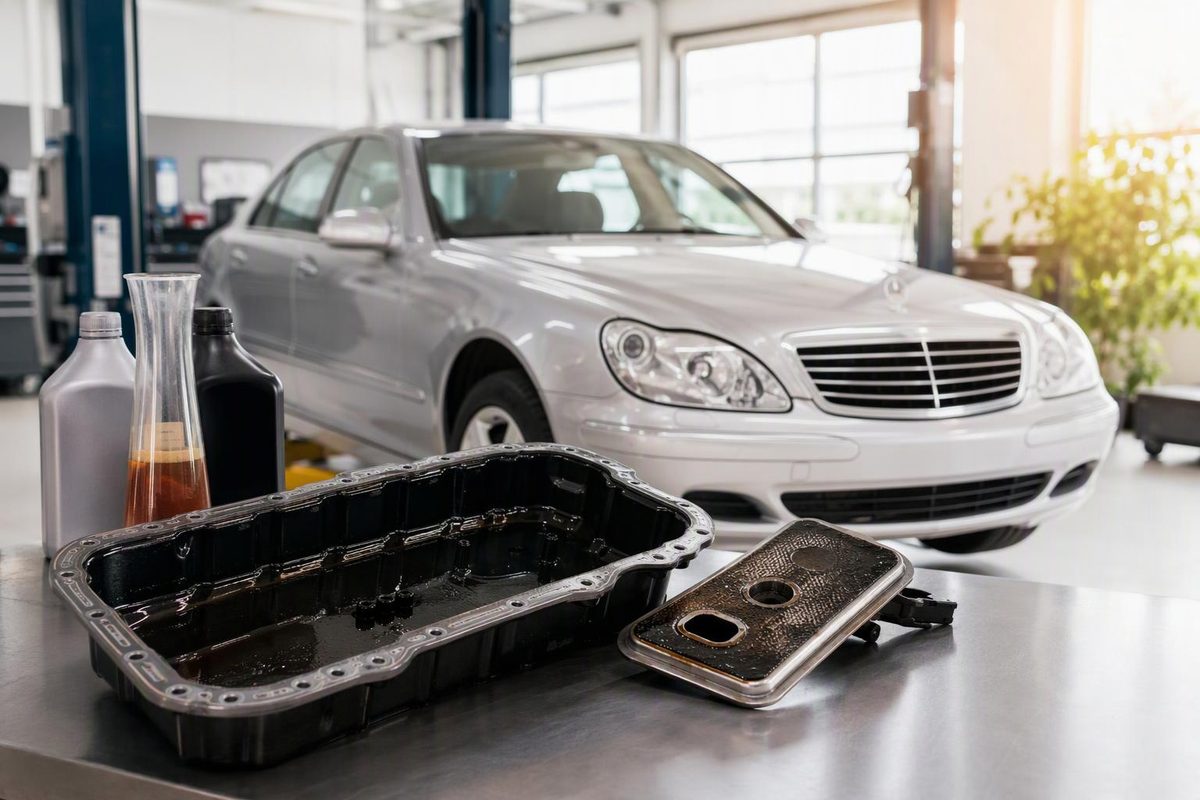
A clogged transmission filter can cause pump howling, delayed Drive or Reverse engagement, and slipping from inadequate hydraulic pressure. None of those symptoms proves the filter is blocked. Low ATF, an incorrectly installed filter, pump trouble and internal faults can overlap.
This guide covers W220s with the five-speed 722.6, including the 2000–2001 S430 and S500 listed in ATSG’s transmission identification tables. Confirm your model year, drivetrain and transmission number before ordering parts. W220s also used the seven-speed 722.9; its level-check and service procedures differ. See 722.6 versus 722.9 dipstick arrangements.
Symptoms that justify checking the filter
The filter removes debris from ATF before it reaches the pump. A sufficiently restricted filter can starve the pump and reduce hydraulic pressure—the pressure needed to apply the transmission’s clutches. This technical explanation of filter restriction describes that mechanism.
| What you observe | What it means diagnostically |
|---|---|
| Howling or whistling across all gears, particularly at high engine speed | The historical Mercedes complaint chart lists filter restriction and pump trouble for this pattern above 4,000 rpm. |
| A pause after selecting D or R, or intermittent failure to engage | Investigate ATF level and pressure supply; the filter is one possibility, not the only one. |
| Engine revs rise without the expected acceleration, or flare during a shift | Suspect slipping. Inadequate pressure may be involved, but worn clutches and control faults remain possible. |
The archived Mercedes 722.6 complaint chart lists a clogged filter and the oil pump as alternatives for howling/whistling above 4,000 rpm in all gears. It also lists ATF level, the filter, selector recognition and internal pressure-build-up faults among causes of intermittent delayed engagement. This is historical guidance for multiple 722.6 applications and production revisions, not a W220-specific repair instruction. Mercedes diagnostic chart
Do not rev a noisy or slipping gearbox to 4,000 rpm to reproduce the chart’s symptom. If the car loses drive, repeatedly flares, or develops pronounced transmission noise, stop driving and arrange recovery rather than forcing it to move.
What does not prove a blockage
- An external ATF leak: trace the leak and measure the level. A wet pan or electrical connector is not evidence that the filter is clogged.
- Dark fluid alone: Mercedes’ historical 722.6 evaluation guidance says brown or black coloration alone does not establish fluid failure. Burnt odor and abnormal debris carry more diagnostic weight.
- Being stuck in one gear: the 722.6 can hold a gear in limp-home mode after an electrical or mechanical-hydraulic fault. Treat that as a reason to scan the transmission, not automatically replace its filter.
These distinctions are described in Mercedes’ ATF evaluation and limp-home guidance. For rev flare versus restricted shifting, use how to identify suspected W220 transmission slip.
Check in this order
1. Preserve fault codes and record the conditions
Read the transmission control module with Mercedes-capable diagnostic equipment before clearing codes or resetting anything. Record whether the problem occurs cold or hot, in D, R or both, and during one shift or across several gears. Mercedes’ diagnostic guidance calls for reading the transmission’s fault memory before repairs. Initial evaluation
A fault code identifies a diagnostic path; it does not confirm filter blockage.
2. Verify ATF level before opening the pan
On the Mercedes 722.6, use the proper service dipstick with the car level and the parking brake applied. With the service brake held and the engine idling, briefly cycle through the gear ranges, then return to Park for the reading. Match the dipstick scale to the actual ATF temperature. For a shifting complaint, use transmission scan data rather than coolant temperature or an assumption that the gearbox is warm because the engine is warm. The W220 level-check instructions describe checking ATF temperature in R or D with the service brake applied, then taking the dipstick reading at idle in P.
ATSG explains that low fluid lets the pump draw air, causing low pressure and slow pressure development. Overfilling can aerate the fluid and produce similar problems. 722.6 level-check procedure and incorrect-level effects
Replacing exactly the quantity drained does not correct a previously wrong level.
3. If symptoms began after service, recheck that work
Verify the correct filter was fitted and properly seated, then recheck the final fluid level and anything disturbed during the repair. Do not assume a newly fitted filter has already clogged: Mercedes lists a missing ATF filter as a cause of delayed engagement and certain shift complaints. 722.6 complaint chart
4. Inspect the pan and old filter when service is justified
Photograph the pan, magnets and deposits before cleaning. Keep the old filter for inspection. Burnt fluid or metal debris may indicate damage rather than an isolated maintenance issue; the FCP Euro 722.6 service walkthrough identifies pan removal as an opportunity to check for both.
Do not condemn the transmission solely for a light film of fine wear particles. Mercedes distinguishes a fine aluminum/brass wear veil from abnormal graphite-like residue or millimeter-size metal shavings. Significant debris warrants internal diagnosis. Mercedes debris evaluation
When a filter service is—and is not—the fix
A correctly performed pan, filter and fluid service may address restriction, but it cannot repair worn clutches or a damaged pump. Use a VIN-matched filter and gasket, and confirm the applicable ATF approval before filling. For example, FUCHS identifies its MB-Approval 236.14 TITAN ATF 4134 as suitable for rear-wheel-drive 722.6 applications, subject to manufacturer filling instructions; that is not permission to use any fluid labelled “universal.” FUCHS application guidance
Brief improvement followed by renewed whining or loss of drive needs deeper investigation. In one owner-reported case involving a 2002 E320 4MATIC—not a W220—successive filters restored drive only temporarily, and the owner later reported metal flakes. The thread illustrates why repeated filter replacement is not proof of a completed repair. BenzWorld owner report
If abnormal debris is present, or symptoms persist after correct level and filter installation are verified, have a transmission specialist determine the source of contamination or pressure loss before further road testing.