
Find the Right Transmission Fill Point on Your W220
Locate the capped ATF tube on a 722.6-equipped W220, distinguish it from the 722.9 layout, and see which service tool and temperature checks apply.
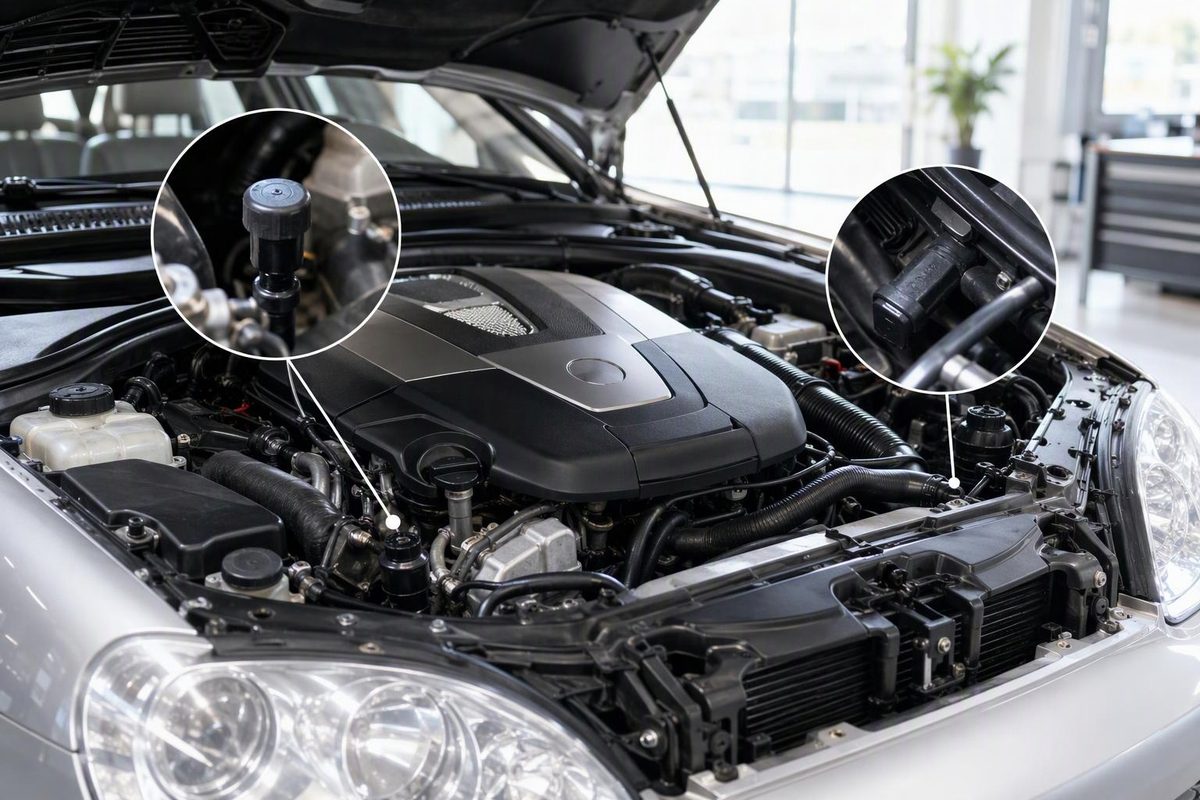
On a 2000 W220 S430 or S500 with the five-speed 722.6, look at the vehicle’s right-rear engine compartment, toward the firewall and almost beneath the air-box assembly. You want a capped transmission filler tube, not a dipstick handle. That location is reported in an MBWorld owner discussion covering these models. If your W220 has the seven-speed 722.9, there is no underhood transmission dipstick or filler tube to find; its fill and level-check arrangement is at the transmission pan.
“Right” means the vehicle’s right when seated facing forward. On a left-hand-drive car, that is the passenger side; when standing in front of the car looking into the engine compartment, it is your left. The owner-reported location above applies to the specified 2000 S430/S500 examples. It is a starting point for those cars, not proof that every W220 engine installation has identical access.
Choose your confirmed transmission code; the tool identifies the fill point and next step.
Find Your ATF Service Point
Use VIN-linked vehicle data or the fitted gearbox identification, not the badge alone.
The fill point is not established until you confirm 722.6 or 722.9. Compare the two layouts below.
| Gearbox | Fill Point | Level Check |
|---|---|---|
| 722.6 | Capped underhood tube | Removable service dipstick |
| 722.9 | Transmission pan opening | Overflow arrangement |
Location and measuring caveats
For a 2000 W220 S430 or S500 with 722.6, the owner-reported location is the vehicle’s right-rear engine compartment, toward the firewall and almost beneath the air box. Vehicle right is your left when facing the car from the front. This report does not establish identical access on every W220.
The 722.6 service dipstick is tool 140 589 15 21 00. Its 25°C and 80°C ranges require the corresponding service-procedure conditions; engine temperature is not ATF temperature. Remove the tool after measuring and refit the cap with a new locking pin.
A confirmed 722.9 has no underhood ATF dipstick or filler tube. An engine-oil tube or transmission vent is not a substitute.
Sources: MBWorld 2000 S430/S500 location report; W220 Wiki gearbox reference; Mercedes 722.6 procedure; febi tool guidance; FCP Euro 722.9 service guide, linked in the article.
Confirm the Gearbox Before Searching for the Tube
The W220 used both the 722.6 five-speed and 722.9 seven-speed transmissions. Later rear-wheel-drive cars can have the 722.9, while W220 4MATIC models retained the 722.6. The W220 transmission reference distinguishes these applications.
Do not select the procedure from the S430 or S500 badge alone. Model year is not enough either. Confirm the transmission code from VIN-linked vehicle data or the identification on the fitted gearbox. You are trying to establish whether the car actually has a 722.6 or a 722.9 before opening anything or buying a level-check tool.
| Confirmed Gearbox | Underhood ATF Tube | Level-Check Arrangement |
|---|---|---|
| 722.6 five-speed | Capped filler tube | Removable service dipstick |
| 722.9 seven-speed | None | Pan opening and overflow |
| Not confirmed | Not established | Identify gearbox first |
If you have not found a tube, that does not by itself establish that the transmission is a 722.9. On a confirmed 722.6, the opening may simply be difficult to see around the engine components. Conversely, finding a capped tube under the bonnet does not establish that it belongs to the transmission. Identification comes before filling.
Look Behind the Air Box on the Specified 722.6 Cars
For the 2000 S430/S500 location described above, start at the vehicle’s right side and look rearward toward the firewall. The useful landmark is the area almost beneath the air-box assembly, rather than an exposed handle at the front of the engine.
Locate the tube with the engine switched off and cool enough to work around safely. Use a flashlight to inspect the rear of the engine compartment. Remove the engine cover only if it is needed for access. This is the locating stage, not the running-engine measurement stage described below.
Expect a cap on the opening. Mercedes did not supply the 722.6 with a permanent transmission dipstick; checking the level requires a separate workshop tool, as explained in febi’s 722.6 technical guidance. The absence of a pull-out dipstick handle is therefore normal for this arrangement.
That distinction changes what you are searching for. Looking only for something shaped like an engine-oil dipstick handle can lead you past the correct tube. Look for the capped filler opening, then positively identify it before removing the cap. If the view is poor or the opening remains uncertain, stop there rather than treating a nearby tube as a likely substitute.
The 722.6 Cap Has a Replaceable Locking Pin
The filler tube has a plastic cap retained by a locking pin. Clean around the cap before opening it so that loose material is not carried into the tube while you work.
Mercedes’ service procedure instructs you to break off the locking pin’s plate, press the remaining pin downward out of the cap, and then remove the cap. Keep the broken plate and pin pieces out of the open tube. These steps appear in the Mercedes 722.6 oil-level procedure reproduced here.
An undamaged cap can be refitted, but use a new locking pin afterward. The cap and locking pin are separate parts of this instruction: opening the lock does not automatically mean the cap must be discarded, and retaining the cap does not mean the old locking pin should be reused.
Have the replacement locking pin available before opening the tube for a level check. Once the measurement is finished, the workshop dipstick comes back out and the cap goes back on. The service tool is not the permanent closure for the filler tube.
Do not pour fluid into an opening you cannot positively identify. The correct cap mechanism is useful confirmation, but it does not replace establishing the gearbox type and the identity of the tube.
A Confirmed 722.9 Has No Underhood ATF Fill Tube
If the gearbox is a 722.9, stop searching beneath the bonnet for a transmission dipstick. Filling and level checking use the transmission pan’s drain opening and overflow arrangement, as described in FCP Euro’s 722.9 service guide.
An engine-oil tube or transmission vent is not a substitute fill point. The 722.6 instructions about a removable service dipstick, capped underhood tube and locking pin do not become a 722.9 procedure simply because both gearboxes were fitted to W220 cars.
The practical decision is straightforward: a confirmed 722.9 sends you to its pan-based service procedure, not to another corner of the engine compartment. Buying the 722.6 dipstick will not create an underhood measuring point on that transmission.
The temperature markings discussed below also belong to the 722.6 dipstick procedure. Do not transfer them to the 722.9 overflow method. Use the procedure for the fitted transmission rather than combining the fill point from one gearbox with the measuring instructions from the other.
Use the 722.6 Service Dipstick, Not the Engine Dipstick
For a confirmed 722.6, use a 722.6-specific service dipstick, referenced by Mercedes tool number 140 589 15 21 00. The engine-oil dipstick is not the specified tool for this measurement.
The workshop dipstick is inserted for the check and removed afterward. Part of it may remain above the filler tube when it reaches its specified measuring end point. Do not force the handle down to make it sit against the tube. febi’s guidance explains why the service tool can protrude.
A protruding handle is not, by itself, evidence that you have failed to insert the tool correctly. Follow the tool’s specified end point rather than using the handle’s position as the target. If you are unsure about that end point, resolve it before relying on the reading.
This is also why finding the filler tube is only the first part of the job. A correctly identified opening, the proper dipstick and the specified measurement conditions are all needed. Opening the cap alone does not tell you whether the transmission needs fluid.
Measure With the Car Level and the Engine Idling
For the 722.6 measurement, the vehicle must be level on its wheels. Secure it against movement. Apply the service brake while cycling through the gear ranges, then return to P with the engine idling.
Keep hands and clothing away from hot or rotating parts. The earlier instruction to locate the tube with the engine switched off applies to finding and identifying it safely; the level measurement itself uses the running-engine conditions in the service procedure.
Do not mix those two stages. A reading obtained while merely inspecting the tube with the engine off is not a substitute for the specified level check. Likewise, confirming that the car is in P does not dispense with the requirements to keep it level, secure it, and establish transmission-fluid temperature.
Insert the correct service dipstick gently to its specified end point, take the reading against the applicable temperature range, and remove the tool after measuring. Refit the cap and a new locking pin when finished. Do not leave the workshop dipstick installed as though it were a factory-fitted permanent dipstick.
Use ATF Temperature to Choose the Dipstick Range
The 722.6 tool has separate 25°C and 80°C ranges. The cold check is at approximately 25°C transmission-fluid temperature—not simply whenever the engine is described as cold.
For the precise hot check when investigating shifting problems, Mercedes’ procedure specifies fluid temperature above 80°C, verified with STAR Diagnosis, and uses the 80°C range. Follow the Mercedes service procedure rather than treating engine temperature as ATF temperature.
| Check | ATF Temperature | Dipstick Range |
|---|---|---|
| Cold check | Approximately 25°C | 25°C |
| Precise hot check | Above 80°C, verified | 80°C |
The wording matters. “Cold” is a temperature condition for the transmission fluid, not a description of how long the car has been parked. “Hot” is not established merely by a warm engine or the position of its temperature gauge. If ATF temperature has not been established, do not treat a mark on the dipstick as a verified basis for adding or draining fluid.
The two ranges are not alternative scales to choose according to which reading looks more plausible. Use the range that belongs to the specified temperature condition. A reading without that context leaves the level unresolved.
Do Not Turn an Unverified Reading Into a Fluid Adjustment
A located filler tube is not evidence of low fluid, and an unexpected dipstick reading is not enough on its own to justify a correction. Before adjusting the level, confirm the gearbox, tool, vehicle position, running conditions and ATF temperature used for the check.
The supplied location and level-check references do not provide a universal top-up quantity for an unknown reading. There is no supported amount to add simply because you have found the tube, nor a figure here that converts an unspecified dipstick difference into a fluid volume.
If the level appears high, work through why one high reading may not mean too much transmission fluid before draining anything. Do not add or remove ATF to compensate for a reading whose measurement conditions have not been verified.
For the specified 2000 S430/S500 with a confirmed 722.6, the search ends at the capped tube near the right-rear firewall area beneath the air box. The next job is a controlled check with the removable service tool. For a confirmed 722.9, the absence of that tube is expected: use the pan-based procedure instead.