
How Much Transmission Fluid Does Your Vehicle Actually Need?
A listed 8L80/MFC fluid change is 7.4 qt with DEXRON HP. Retained converter fluid means the specified level check determines the final amount.
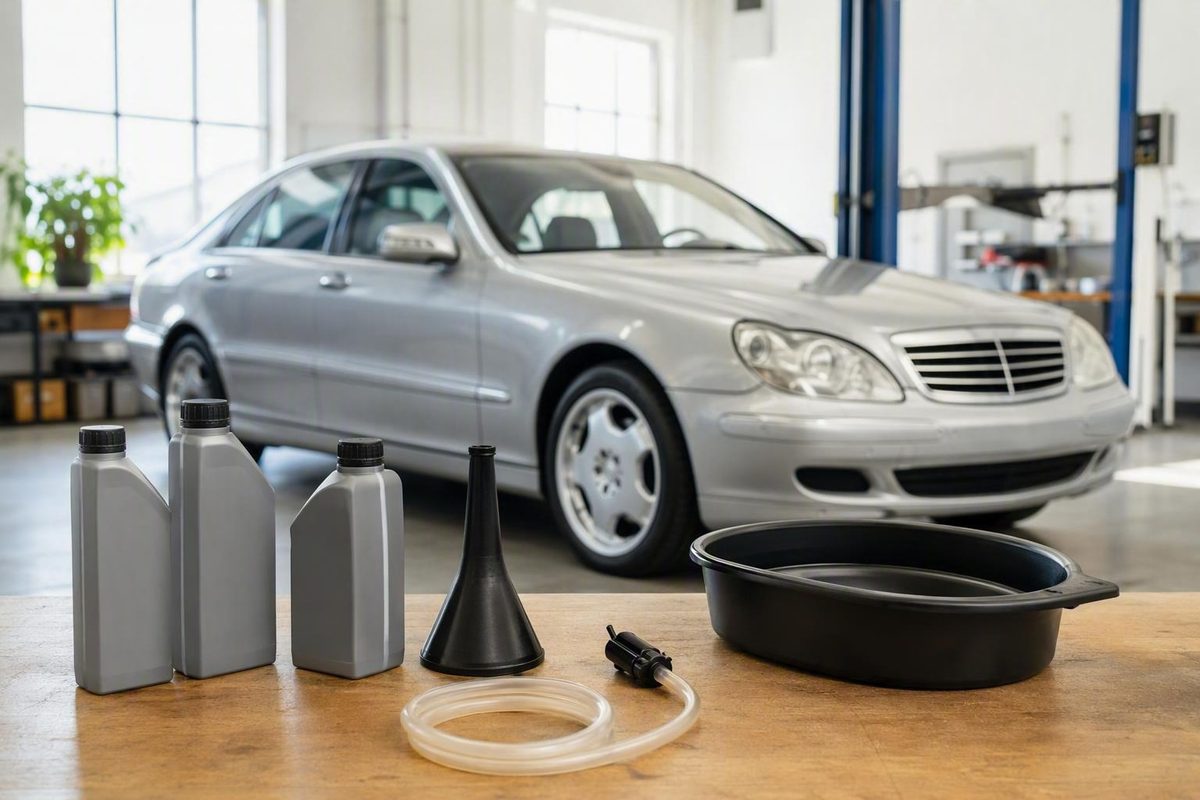
There is no universal transmission-fluid capacity. The correct amount depends on the vehicle’s year, engine, drivetrain, installed transmission, transmission or RPO code, market, pan configuration, and—most importantly—the work being performed.
A routine drain-and-fill may require much less fluid than an overhaul or dry installation because an ordinary drain does not empty the complete transmission system. Even after finding an applicable published quantity, you must use the specified fluid and complete the transmission-specific level-setting procedure.
This guide explains how to interpret and verify transmission-fluid capacity figures. It is not a comprehensive vehicle lookup, and the selected examples should not replace VIN- or transmission-specific service information.
Why There Is No Universal Transmission-Fluid Capacity
You usually cannot determine capacity from the vehicle model or transmission family alone. Before choosing a quantity, identify:
- Model year
- Make and model
- Engine
- Two-wheel drive, four-wheel drive, or all-wheel drive
- Installed transmission model
- Transmission code, option code, or RPO code
- Country or market
- Stock, deep, or aftermarket pan
- Intended service procedure
One vehicle name can cover several engines and transmissions. Those configurations may require different quantities and entirely different fluid specifications.
The Silverado 1500 illustrates the problem. For listed 2025 configurations, the 8L80 with RPO MFC has a fluid-change capacity of 7.0 L (7.4 U.S. qt) and specifies DEXRON HP. Listed 10L80 variants have a fluid-change capacity of 7.7 L (8.1 U.S. qt) and specify DEXRON ULV. For listed Silverado 2500/3500 HD configurations with the 10L1000, the figure is 13.6 L (14.4 U.S. qt). These figures apply only to the configurations in the supplied 2025 U.S. and Canadian transmission capacities and fluids reference.
That comparison reveals three common lookup errors:
- Searching only by model family. “Silverado transmission capacity” is not sufficiently specific.
- Ignoring the transmission code. Two transmissions offered in the same vehicle line may have different capacities.
- Separating quantity from specification. A capacity result is incomplete unless it identifies the required fluid.
Pan type matters because a stock-pan figure should not be assumed to cover a deep or aftermarket pan. Service type matters because draining a pan is not the same operation as filling a substantially empty unit.
Before looking up transmission-fluid capacity, record the complete vehicle and transmission identity. If the transmission has been replaced or the drivetrain modified, do not assume that VIN-based information still describes the unit physically installed.
Drain-and-Fill, Fluid-Change, Overhaul, and Total Capacity Explained
References show more than one capacity because their labels describe different physical conditions and service operations.
Drain-and-fill capacity is the amount associated with a defined routine draining procedure. It does not necessarily represent all the fluid in the transmission system.
Fluid-change capacity is also procedure-dependent. If a chart uses this term, interpret the quantity according to the chart’s stated fluid-change method. Do not treat it automatically as a total or dry-system capacity.
Pan-service capacity generally applies when the pan is removed and refitted, often with filter service. It should not automatically be substituted for a drain-plug quantity or a dry-fill figure.
Overhaul capacity applies to a substantially emptier transmission after disassembly and rebuilding.
Dry-fill capacity usually describes a dry or nearly dry installation.
Total capacity refers to a broader system volume. It is often unsuitable as a routine refill instruction because fluid can remain in the torque converter and internal areas after an ordinary gravity drain.
The Corvette TR9080 examples later in this guide demonstrate why the label must remain attached to the number: those entries are expressly identified as overhaul capacities, not routine drain-and-fill quantities.
An unverified owner-forum discussion illustrates how confusing the terminology can become. Participants interpreted a quoted 2.7 qt “initial fill” figure for an A131L as an ordinary or partial refill and 5.8 qt as total capacity, reasoning that fluid remained in the torque converter. However, the exact vehicle configuration was not established, and no authoritative Toyota documentation was provided. The figures are therefore an example of terminology confusion—not a dependable A131L specification or purchase quantity—as the original forum exchange shows.
Critical rule: Never pour a published total, overhaul, or dry-fill quantity into a transmission after a routine drain unless the service procedure for the exact configuration directs you to do so.
An ordinary gravity drain removes only the fluid released by the defined procedure. It does not establish that the torque converter and all internal areas are empty. The prescribed final level check—not an assumed total capacity—must determine whether more fluid is required.
How to Identify the Capacity That Applies to Your Vehicle
Use a structured identification process instead of searching for a model name followed by “transmission capacity” and selecting the first result.
1. Establish the complete vehicle identity
Record the:
- Model year
- Make and model
- Engine
- Drivetrain
- Country or market
Avoid relying on a broad sales description such as “half-ton truck,” “S-Class,” or “V8 model.” The same vehicle name may cover several transmissions or may retain its name across a production change.
2. Confirm the installed transmission
Find the transmission model and its associated build, option, or RPO code. Useful identification sources can include:
- The owner’s manual
- Vehicle data or option labels
- VIN-specific parts information
- Identification markings on the transmission
- Exact service information
- A qualified technician or parts specialist
Do not infer the transmission solely from the engine if multiple combinations were available. If a previous owner completed a drivetrain swap, VIN-based information may identify the original transmission rather than the installed one.
3. Identify the pan configuration
Determine whether the transmission has:
- Its original stock-depth pan
- A factory alternative
- A deep aftermarket pan
- Another modified pan configuration
A stock-pan capacity should not be applied automatically to a deep pan. Likewise, an aftermarket figure should not be assumed to describe a factory configuration.
4. Define the service precisely
State whether the job is a:
- Drain-plug drain-and-fill
- Pan removal
- Pan and filter service
- Converter drain, where the applicable procedure permits one
- Fluid exchange
- Transmission replacement
- Overhaul
- Dry transmission or converter installation
“Changing the transmission fluid” is too ambiguous for an accurate capacity lookup. Two people can use that phrase while performing very different procedures.
5. Match the fluid specification
Record the exact fluid specification alongside the capacity. Brand, color, or a general label such as “ATF” is not enough. Similar quantities do not establish fluid compatibility.
6. Preserve every qualifier
A reliable capacity record should include:
| Required field | Why it matters |
|---|---|
| Vehicle | Defines the application |
| Transmission | Identifies the installed unit |
| Code or RPO | Distinguishes variants |
| Service type | Separates routine service from overhaul or dry fill |
| Liters | Preserves the metric quantity where supplied |
| U.S. quarts | Prevents unit ambiguity where supplied |
| Fluid specification | Identifies what may be added |
| Market | Accounts for regional configurations |
| Source | Allows the figure to be checked |
| Qualifiers | Preserves restrictions such as “stock pan” or “overhaul only” |
These fields should remain attached whenever a capacity entry is copied, stored, or shared. A bare number can become misleading when separated from its application and service label.
Capacity ranges also require careful interpretation. A listing of 5.0–6.0 L does not mean that 6.0 L should automatically be poured in. The final quantity must be established with the prescribed level-setting procedure.
If the installed transmission cannot be confirmed, resolve that identification question before purchasing or adding fluid. An uncertain transmission code can lead to both the wrong quantity and the wrong specification.
Selected Capacity Examples and Their Limits
The following examples demonstrate how properly qualified capacity entries should be presented. They are not comprehensive, and a figure for one listed configuration does not apply automatically to another year, market, transmission, or pan.
Confirm the application against exact vehicle service information before acting on any figure in the 2025 U.S. and Canadian capacity table.
Selected 2025 GM fluid-change entries
| Vehicle | Transmission / RPO | Service type | Liters | U.S. quarts | Specified fluid | Market | Source | Qualifiers |
|---|---|---|---|---|---|---|---|---|
| Chevrolet Blazer | 9T60 / M3T | Fluid change | 5.0–6.0 L | 5.3–6.3 qt | DEXRON-VI | U.S. and Canada | 2025 capacity table | Listed 2025 configuration; range is not an automatic fill target |
| Chevrolet Blazer | 9T65 / M3V | Fluid change | 5.0–6.0 L | 5.3–6.3 qt | DEXRON-VI | U.S. and Canada | 2025 capacity table | Listed 2025 configuration; range is not an automatic fill target |
| Chevrolet Colorado | 8L80 / MFC | Fluid change | 7.0 L | 7.4 qt | DEXRON HP | U.S. and Canada | 2025 capacity table | Listed 2025 configuration only |
| Chevrolet Silverado 1500 | 10L80 / MQB, MQC, MHT, MI2, or MHS | Fluid change | 7.7 L | 8.1 qt | DEXRON ULV | U.S. and Canada | 2025 capacity table | RPO must match |
| Chevrolet Silverado 2500/3500 HD | 10L1000 / MKM, MGM, or MGU | Fluid change | 13.6 L | 14.4 qt | DEXRON ULV | U.S. and Canada | 2025 capacity table | RPO must match |
| Chevrolet Trax | 6T40 / MNH | Fluid change | 4.0–6.0 L | 4.2–6.3 qt | DEXRON VI | U.S. and Canada | 2025 capacity table | Listed 2025 configuration; range is not an automatic fill target |
The Blazer and Trax ranges are not instructions to add the upper endpoint. The vehicle-specific level-setting procedure remains decisive.
The Silverado rows also show why “truck transmission capacity” is not a usable specification. The listed 10L80 configuration has a different fluid-change quantity from the listed 10L1000 heavy-duty configuration, even though both are in the Silverado line and both specify DEXRON ULV.
Overhaul-only examples
These figures are deliberately separated from routine fluid-change entries. Every row is expressly labeled as an overhaul capacity.
| Vehicle | Transmission / RPO | Service type | Liters | U.S. quarts | Specified fluid | Market | Source | Qualifiers |
|---|---|---|---|---|---|---|---|---|
| Chevrolet Corvette | DCT TR9080 / M1L | Overhaul only | 11.4 L | 12.1 qt | TITAN EG FLL-4 | U.S. and Canada | 2025 capacity table | Not a routine drain-and-fill target |
| Chevrolet Corvette | DCT TR9080 / M1M | Overhaul only | 11.9 L | 12.6 qt | TITAN EG FLL-4 | U.S. and Canada | 2025 capacity table | Not a routine drain-and-fill target |
| Chevrolet Corvette E-Ray | DCT TR9080 / MLH | Overhaul only | 11.4 L | 12.1 qt | TITAN EG FLL-4 | U.S. and Canada | 2025 capacity table | Not a routine drain-and-fill target |
| Chevrolet Low Cab Forward | LCT1000 / MW7 | Overhaul only | 14.5 L | 15.3 qt | CASTROL TRANSYND | U.S. and Canada | 2025 capacity table | Not a routine drain-and-fill target |
| Chevrolet Low Cab Forward | 2550RDS / MPQ | Overhaul only | 14.5 L | 15.3 qt | CASTROL TRANSYND | U.S. and Canada | 2025 capacity table | Not a routine drain-and-fill target |
Removing “overhaul only” from one of these entries would materially change its meaning. The service label must remain attached whenever the figure is repeated.
Selected classic domestic stock-pan figures
TCI publishes the following figures for selected popular domestic automatic transmissions with stock pans. These are aftermarket-source stock-pan capacities, not complete vehicle dry-fill specifications or comprehensive manufacturer service data. The source labels its quantities in quarts but does not state a quart system on the supplied page, so the table preserves them simply as published quarts in TCI’s fluid-capacity chart.
| Vehicle | Transmission / code | Service type | Liters | Published quarts | Fluid specification | Market | Source | Qualifiers |
|---|---|---|---|---|---|---|---|---|
| Not vehicle-specific | GM TH350 | Stock-pan capacity | Not supplied | 4 qt | Not supplied | Not stated | TCI chart | Selected transmission; stock pan only |
| Not vehicle-specific | GM TH400 | Stock-pan capacity | Not supplied | 6 qt | Not supplied | Not stated | TCI chart | Selected transmission; stock pan only |
| Not vehicle-specific | GM Powerglide | Stock-pan capacity | Not supplied | 4 qt | Not supplied | Not stated | TCI chart | Selected transmission; stock pan only |
| Not vehicle-specific | GM 700R4/4L60E | Stock-pan capacity | Not supplied | 6 qt | Not supplied | Not stated | TCI chart | Selected transmission; stock pan only |
| Not vehicle-specific | GM 2004R | Stock-pan capacity | Not supplied | 6 qt | Not supplied | Not stated | TCI chart | Selected transmission; stock pan only |
| Not vehicle-specific | GM 4L80E | Stock-pan capacity | Not supplied | 7.7 qt | Not supplied | Not stated | TCI chart | Selected transmission; stock pan only |
| Not vehicle-specific | Chrysler Torqueflite 727 | Stock-pan capacity | Not supplied | 5 qt | Not supplied | Not stated | TCI chart | Selected transmission; stock pan only |
| Not vehicle-specific | Chrysler Torqueflite 904 | Stock-pan capacity | Not supplied | 5 qt | Not supplied | Not stated | TCI chart | Selected transmission; stock pan only |
| Not vehicle-specific | Ford C4 | Stock-pan capacity | Not supplied | 5.5 qt | Not supplied | Not stated | TCI chart | Selected transmission; stock pan only |
| Not vehicle-specific | Ford C6 | Stock-pan capacity | Not supplied | 7 qt | Not supplied | Not stated | TCI chart | Selected transmission; stock pan only |
| Not vehicle-specific | Ford AOD/AODE | Stock-pan capacity | Not supplied | 6.5 qt | Not supplied | Not stated | TCI chart | Selected transmission; stock pan only |
Use these figures only within their stated limits. They do not identify a vehicle, fluid specification, market, or complete dry-system condition. A deep pan falls outside the chart’s stock-pan qualification.
Torque-Converter Capacity and Retained Fluid
Do not add a separately published transmission capacity to a torque-converter capacity and assume the result is the correct complete fill. The available evidence does not support that calculation.
A torque converter can retain fluid after the transmission has been drained. That retained fluid is one reason a routine service may release less than a total-capacity figure suggests.
TCI lists converter quantities separately and identifies them as capacities for new converters. It also says that previously operated converters generally retain some fluid and advises filling a new converter before installation in its new-converter capacity guidance.
| Converter condition | Diameter | Published capacity | Source | Qualifiers |
|---|---|---|---|---|
| New converter | 13 inch | 5 qt | TCI chart | New-converter figure |
| New converter | 12 inch | 4 qt | TCI chart | New-converter figure |
| New converter | 11 inch | 3.5 qt | TCI chart | New-converter figure |
| New converter | 10 inch | 3 qt | TCI chart | New-converter figure |
| New converter | 9 inch | 2.5 qt | TCI chart | New-converter figure |
| New converter | 8 inch | 2 qt | TCI chart | New-converter figure |
| New converter | 7 inch | 2 qt | TCI chart | New-converter figure |
Those qualifiers are essential. A previously operated 12-inch converter is not necessarily empty and should not automatically receive the listed new-converter quantity. Nor should that quantity simply be added to a stock-pan figure to create an assumed total system capacity.
For a converter installation, obtain instructions for the exact converter and transmission pairing. Confirm:
- Whether pre-filling is required
- What pre-fill quantity is specified
- Whether the converter can or should be drained separately
- How fluid is circulated after installation
- How the final system level must be established
Converter retention may explain why a routine drain releases less fluid than a total-capacity figure suggests. It does not, by itself, establish the correct refill amount.
Fluid Specification Matters as Much as Quantity
Capacity and fluid specification must always be looked up together.
The selected 2025 applications include several different specified fluids:
- DEXRON VI
- DEXRON-VI
- DEXRON HP
- DEXRON ULV
- HP CVTF
- TITAN EG FLL-4
- CASTROL TRANSYND
The supplied table includes applications with equal listed quantities but different specified fluids. The quantity therefore cannot be used to infer what product belongs in the transmission.
Do not select fluid solely because it is labeled “automatic transmission fluid,” “universal,” or “multi-vehicle.” Verify that the stated specification applies to the installed transmission and vehicle variant.
For the Mercedes-Benz 722.6, W220 Repair recommends ATF approved to MB 236.10 or MB 236.12 and says that the later specifications it discusses for the 722.9 are not interchangeable. The same article says an ordinary drain-and-fill exchanges approximately 40% of the fluid, but it provides no total or refill capacity in liters or quarts. Its percentage therefore cannot be converted into a defensible purchase or fill quantity without an independently verified base volume, as the W220 Repair 722.6 article itself demonstrates.
That guidance is attributable to W220 Repair; it is not proof that one specification or procedure applies to every 722.6 installation. Mercedes W220 owners still need to confirm:
- Exact model year and market
- Engine and drivetrain
- Installed 722.6 variant
- Required approved fluid
- Pan configuration
- Whether the job is a routine drain, pan service, converter drain, overhaul, or replacement
- Applicable initial quantity
- Required temperature and level-setting procedure
Do not derive a W220 capacity from an exchange percentage. A percentage without a verified total volume does not produce a reliable refill amount.
Refill and Verify the Level Without Overfilling
Treat a published capacity as a planning figure and initial-refill guide. It is not a substitute for the prescribed final level check.
Checking conditions vary by transmission. The applicable procedure may specify:
- Engine running or engine off
- A defined fluid-temperature window
- Park or neutral
- A particular gear-selection sequence
- A conventional dipstick or special measuring dipstick
- An overflow or level plug
- A level vehicle
- Temperature data from a scan tool
- A waiting or drain-back period
Generic instructions must yield to the owner’s manual or exact service information.
A bounded general workflow is:
- Confirm the vehicle and transmission identity. Resolve uncertainty before opening the transmission.
- Confirm the service type. Determine whether the capacity applies to a drain-and-fill, pan service, overhaul, replacement, or dry installation.
- Obtain the specified fluid. Do not substitute based on color, a broad “ATF” label, or a similar capacity.
- Review the complete level-setting procedure. Know the required temperature, engine state, gear sequence, tools, and checking method before beginning.
- Place the vehicle on a level surface. Apply the parking brake and follow the vehicle-specific instructions for securing or lifting it.
- Start below the maximum applicable quantity. Preserve room for adjustment instead of assuming that every published unit must be added immediately.
- Follow the specified circulation or warm-up steps. Do not assume every transmission is checked warm or with the engine running.
- Use the designated level-check method. Follow the instructions for the fitted dipstick, measuring tool, overflow plug, or level plug.
- Add only the specified fluid in small increments. Recheck after each addition.
- Inspect the serviced areas for leaks. A low level should not be addressed indefinitely without investigating its cause.
- Complete any required final recheck. Follow the exact procedure rather than relying on a generic warm-engine rule.
Where a conventional dipstick is fitted, general guidance is to wipe it clean, insert it fully, remove it again, and read the applicable marking. Some transmissions have no dipstick or require a professional, temperature-dependent inspection. Automatic transmission fluid may be hot, and an unexpectedly low level may indicate a leak; Quaker State presents these points as general level-check guidance, subordinate to the vehicle’s own instructions.
If a chart gives a range, do not begin by assuming the upper boundary is required. If it gives a fixed quantity, do not treat that number as permission to bypass the final check. The correct reading depends on following the prescribed checking conditions.
For the Mercedes 722.6, W220 Repair recommends checking the level at approximately 45°C with a measuring dipstick. It also recommends replacing the internal filter, pan gasket, and electrical connector sleeve during service. These are the article author’s recommendations, not independently verified Mercedes-Benz instructions for every variant, and should be used only after comparison with authoritative vehicle-specific documentation in the 722.6 service article.
Before considering the job complete, use this checklist:
- Verify identity: year, vehicle, engine, drivetrain, transmission, and code.
- Verify service type: routine drain, pan service, exchange, overhaul, or dry installation.
- Verify fluid specification: never select fluid by quantity alone.
- Begin below the maximum: preserve room for level adjustment.
- Follow the exact temperature procedure: do not rely on a universal warm or cold rule.
- Set the final level: use the specified dipstick, measuring tool, overflow plug, or level plug.
- Inspect for leaks: topping up is not a substitute for diagnosis.
Frequently Asked Questions
How much transmission fluid should I buy for a drain-and-fill?
First find the drain-and-fill or fluid-change figure for the exact year, model, engine, drivetrain, transmission code, market, pan, and service procedure. Do not use a total, overhaul, or dry-fill quantity as a purchasing figure for routine service.
The published routine-service figure can inform planning, but the amount purchased is not an instruction to pour all of it into the transmission. Add the specified fluid incrementally and establish the final level through the prescribed procedure.
If the capacity is shown as a range, the upper endpoint is not an automatic fill target.
Is transmission-fluid change capacity the same as total capacity?
Usually not. Fluid-change capacity describes the amount associated with a specified maintenance procedure. Total capacity describes a more completely filled system.
A routine refill may therefore require less than a total, overhaul, or dry-fill quantity.
Should transmission and torque-converter capacities be added together?
Not unless configuration-specific instructions explicitly direct that calculation.
Separate converter charts may describe a new, empty converter, while a previously operated converter can retain fluid. A transmission capacity may also carry stock-pan or service-state assumptions. Adding two unrelated chart entries can produce a number that does not describe the actual system condition.
Do all automatic transmissions have a dipstick?
No. Certain procedures may also require temperature data or professional equipment.
Consult the owner’s manual or exact service information before checking the level. Do not assume that a dipstick-free transmission can be checked with a generic warm-engine procedure.
What is the transmission-fluid capacity of a Mercedes W220 with a 722.6 transmission?
The supplied W220 Repair guidance does not state an absolute capacity in liters or quarts, so it cannot support one universal W220 or 722.6 quantity. Its approximate exchange percentage is not enough to calculate a refill volume.
Obtain the correct figure for the exact W220 year, engine, drivetrain, market, 722.6 variant, pan configuration, and service operation. Confirm whether the number applies to a routine drain, pan service, converter drain, overhaul, replacement, or dry installation, then pair it with the applicable approved fluid and temperature-based level procedure.
The safest answer to any transmission-fluid capacity question is a configuration-specific, procedure-labeled figure paired with the correct fluid specification. Identify the installed transmission, distinguish routine service from overhaul or dry fill, add fluid incrementally, and complete the prescribed final level check.