
Find the Cause Behind a Hot W220 Transmission Reading
Trace a high W220 transmission-fluid reading through scan-data checks, correct fluid-level testing, cooling diagnosis and converter-slip evidence.
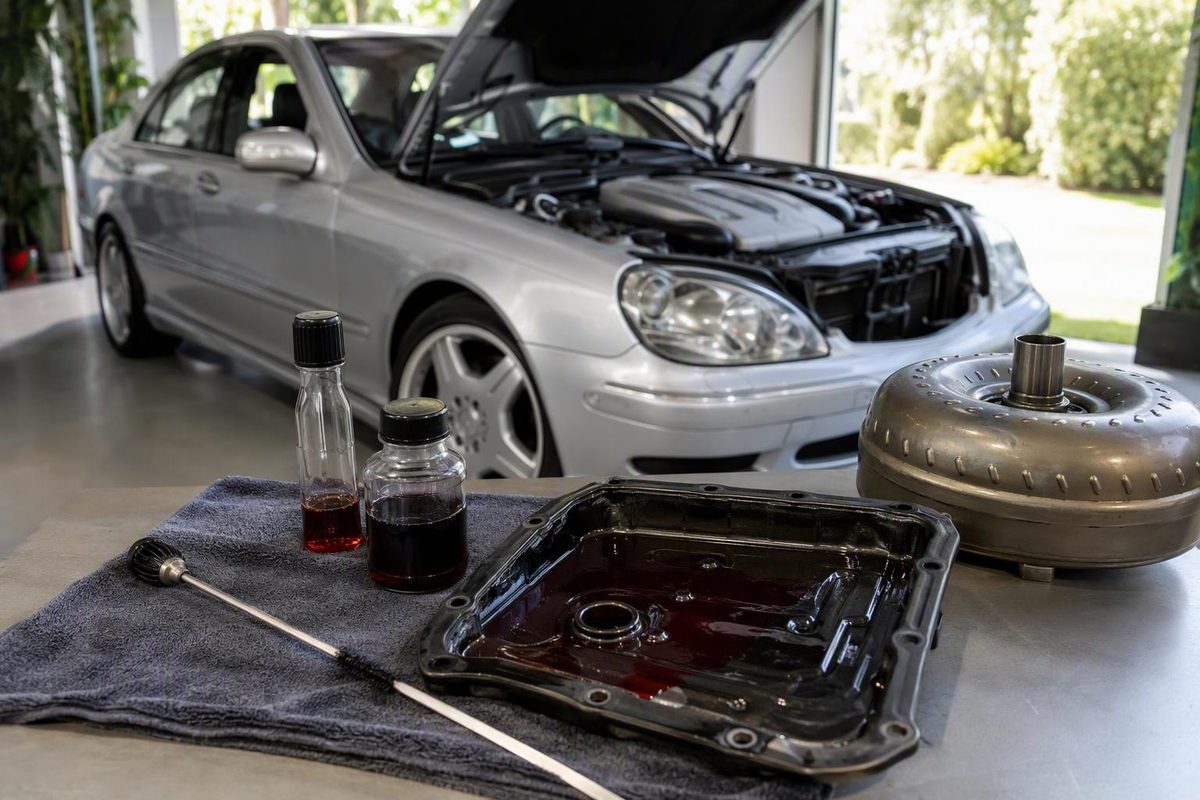
A high transmission-fluid temperature on a Mercedes-Benz W220 can mean genuine overheating, but the reading alone does not identify the fault. Stop driving if it comes with slipping, loss of drive, active leakage, smoke, severe vibration or coolant overheating; otherwise verify the scan data, identify the transmission and diagnose the conditions under which the temperature rises before replacing parts.
Select the observed pattern to see which checks should come first.
Sort the Overheating Pattern
Use observed scan data and driving symptoms, not a dipstick calibration mark or pan temperature.
Check Cooler Flow and Internal Heat Generation
Inspect the cooler lines and heat exchanger, then test actual cooler flow with suitable workshop equipment. Compare the rise with converter command and measured slip.
Temperature alone cannot distinguish restricted cooling from heat generated inside the transmission.
Source basis: the 722.6 sensor and fault guidance and the diagnostic patterns cited in the article. This sorter supplies priorities, not an overheating threshold.
Identify the Transmission Before Checking Fluid
A W220 may have the five-speed 722.6 or, on some later rear-wheel-drive variants, the seven-speed 722.9. Their fluid specifications and level-setting procedures differ. Check the vehicle data card, decode the VIN or read the number on the transmission case before ordering fluid or parts.
On a 722.6, the stamped designation begins with 722.6 and identifies the engine-specific version (ATSG 722.6 technical manual). Do not assume that a procedure or fluid approval for one W220 transmission applies to the other.
Stop When Heat Comes With Loss of Drive
Move to a safe place and shut the car down if the high reading is accompanied by:
- slipping or engine-speed flare during a shift;
- delayed or failed engagement of Drive or Reverse;
- a burning odor, smoke or ATF reaching the exhaust;
- active fluid loss;
- grinding or severe vibration; or
- engine-coolant overheating.
Continuing under load can turn a level, cooling or control fault into clutch or torque-converter damage. An active leak with slipping or overheating calls for recovery rather than a drive to the workshop. Follow the W220 transmission-leak safety checks.
Verify the Temperature Reading Before Diagnosing Overheating
Do not treat the calibration temperature printed on a service dipstick as an overheating limit. That temperature is used to interpret the fluid level because ATF expands as it warms; it is not a published maximum operating temperature.
Read temperature from the transmission control module with a Mercedes-capable scan tool. Do not substitute the engine-coolant gauge or an infrared reading from the pan.
Selector position matters on the 722.6. Its fluid-temperature sensor is part of the electrical conductor plate, but the sensor signal reaches the controller only in Reverse or a forward range. In Park or Neutral, the controller substitutes engine temperature, according to the ATSG description of the 722.6 sensor circuit. A stationary reading in Park can therefore be misinterpreted.
After an overnight cold soak, ATF, coolant and ambient readings should be reasonably consistent. A transmission value that begins implausibly hot, jumps suddenly or changes unexpectedly with selector position points toward scan-data interpretation, the sensor, conductor plate, connector or wiring—not necessarily hot fluid.
Retrieve transmission-module faults before clearing anything. Published 722.6 fault tables include temperature-sensor circuit faults, gear-ratio errors, torque-converter clutch faults and a torque-converter-temperature fault (ATSG fault-code tables). A generic engine-code reader may not show the transmission data needed here.
Match the Temperature Rise to the Driving Condition
During a controlled road test, record ATF temperature, coolant temperature, selected and actual gear, engine speed, input speed, output speed, torque-converter clutch command and converter slip. Stop the test if the car slips, loses engagement or the temperature continues rising abnormally.
| Observed Pattern | Checks to Prioritize |
|---|---|
| Implausible or erratic after a cold start | Sensor, conductor plate, 13-pin connector, harness and selector-position interpretation |
| ATF and coolant rise together in traffic | Fans, radiator airflow, debris between heat exchangers and the engine-cooling system |
| ATF rises under steady load with excessive converter slip | Converter-clutch command, TCC solenoid, valve hydraulics and converter condition |
| Temperature rises while one gear ratio slips | Fluid level, hydraulic pressure, valve body and clutch elements used in that gear |
| Fault starts immediately after service | Fluid approval, level, filter installation, leaks and disturbed or kinked cooler lines |
| Temperature rises but does not stabilize | Cooler flow, restricted lines or heat exchanger, and heat generated internally |
A torque converter produces heat through torque transfer and oil shear. A continuing temperature rise can indicate excessive converter slip or inadequate cooler flow, although temperature alone cannot distinguish between them (Sonnax cooler-flow diagnostic guidance). The 722.6 controller modulates its converter clutch, so commanded state and measured slip are more useful than guessing from a hot pan.
If coolant and ATF rise together, correct the engine-cooling fault first. If coolant remains controlled while ATF rises rapidly, focus on cooler flow and transmission-generated heat.
Inspect cooler lines for leaks, impact damage, kinks and incorrect routing. Actual flow should be tested with suitable workshop equipment. Touching the lines or measuring pan temperature does not prove adequate circulation. Do not disconnect a hot cooler line for an improvised flow test.
Check 722.6 Fluid Level With the Engine Idling
Both low and excessive fill can cause malfunctions. Do not add or drain ATF based on a cold, sloping or engine-off reading.
For a 722.6:
- Put the car level, apply the parking brake and inspect the pan, cooler lines and 13-pin connector area for leaks.
- Insert the correct service dipstick fully. It bottoms inside the transmission, so part of the tool may remain above the filler tube.
- With the engine idling and the service brake applied, move briefly through the ranges, then return to Park.
- Read actual ATF temperature with a suitable scan tool and compare the level with the corresponding dipstick scale.
- Correct the level in small amounts, repeat the check, remove the service dipstick and secure the cap with a new locking pin.
Replacement-tool instructions likewise specify a level vehicle, engine-idle range cycling, full insertion and removal of the dipstick after measurement (febi 722.6 level instructions). Do not drain fluid because of one apparently high reading; follow the W220 level-check cautions.
Do not apply this procedure to a 722.9. That transmission has no dipstick and uses an overflow-based procedure at a specified fluid temperature. The pan and overflow-pipe version also affect the applicable procedure (W220 transmission reference).
Fluid Condition Supports the Diagnosis but Does Not Prove It
Check for a burnt odor, opaque dark fluid, friction debris, metal or milky contamination. Mild discoloration alone does not prove overheating. Compare fluid condition with fault codes, operation and material found in the pan; see what W220 fluid condition can—and cannot—show.
Burnt fluid indicates thermal stress, not a complete repair plan. If the transmission is slipping, new fluid cannot restore worn friction elements or a damaged converter.
Use only ATF carrying the required Mercedes approval for the exact transmission. Mercedes publishes products by approval sheet, such as its MB 236.14 approved-fluid list, but that does not mean 236.14 is automatically correct for every W220. Identify the gearbox and required sheet first. The W220 ATF specification guide explains the 722.6 and 722.9 distinction.
Require Evidence Before Authorizing Major Parts
Before authorizing a cooler, conductor plate, torque converter or complete transmission, ask for:
- the exact transmission number;
- stored and current transmission-module faults;
- cold-soak and road-test temperature data;
- converter command and slip data when the temperature rises;
- a temperature-correct fluid-level result;
- leak, pan-fluid and cooler-flow findings; and
- engine-cooling-system status.
These findings separate a false signal, incorrect fill, inadequate heat rejection and heat generated by internal slip. An auxiliary cooler or fluid change should not be used to mask a fault that remains inside the transmission.