
Find the Cause of W220 Transmission Slip
Find what causes a W220 transmission to slip, from fluid and pressure loss to speed sensors, torque-converter lockup and worn internal clutches.
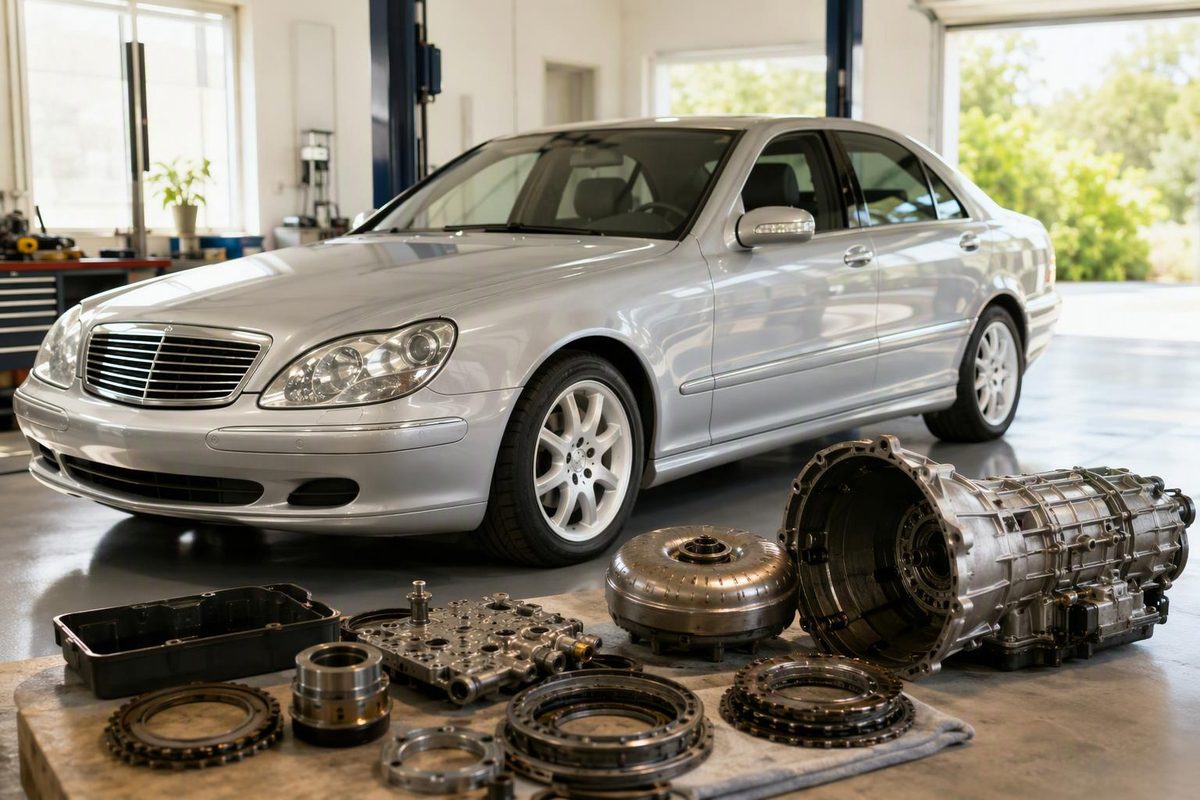
A Mercedes-Benz W220 transmission slips when engine speed rises without the expected increase in road speed because the gearbox is not holding the commanded ratio. On the 722.6 five-speed automatic, the main causes are an incorrect fluid level, hydraulic pressure loss, torque-converter clutch trouble and worn internal friction elements. Bad speed-sensor data and limp-home operation can feel similar without proving that a clutch is physically slipping.
Confirm the transmission designation from the VIN and the number stamped on the left side of the case before ordering parts or choosing fluid. The 722.6 came in versions with different internal ratios and torque capacities; an incompatible transmission or rear axle can produce ratio errors that the controller interprets as slip (ATSG 722.6 service manual). Some late W220 variants use the seven-speed 722.9, which requires different fluid-level and diagnostic procedures.
Select the symptom and strongest evidence; the checker shows the first diagnostic branch.
722.6 Slip Diagnostic Branch
Save ETC codes, verify the fluid level and record the exact shift. With plausible speed data, investigate that shift’s hydraulic circuit, adaptation values and friction element.
Loss of engagement, grinding, overheating, a burning smell or heavy debris means stop driving and arrange recovery.
Basis: ATSG 722.6 service information, Mercedes-Benz adaptation training, and febi and Sonnax 722.6 technical guides cited in the article.
Incorrect Fluid Level Can Reduce Apply Pressure
Low fluid can let the pump draw air, causing low pressure and slow pressure buildup. Overfilling can let rotating parts churn the fluid into foam, producing similar symptoms. ATSG documents both conditions on the 722.6 (ATSG).
Low level normally means fluid has escaped. Inspect the pan, cooler lines and 13-pin electrical connector sleeve. The sleeve seals are a documented leak point (febi 722.6 conductor-plate guide).
Do not add or drain fluid based on an unverified cold reading. Follow the 722.6 fluid-level procedure using the correct dipstick, measured ATF temperature, level ground and an idling engine. Repair the leak rather than repeatedly topping up the transmission.
Incorrect or Contaminated ATF Changes Shift Behavior
The wrong fluid can alter clutch friction behavior and shift quality. Overheated fluid may accompany clutch damage, but color alone does not establish a fault. Burnt odor, opaque fluid, substantial friction debris or metal in the pan carries more diagnostic weight than mild darkening.
Pink, frothy fluid may indicate coolant contamination, including possible leakage through a transmission heat exchanger. Confirm that finding with an appropriate glycol test rather than relying on color alone (febi).
Use fluid approved for the exact gearbox specification. The W220 transmission-fluid guide explains why 722.6 and 722.9 fluid requirements must not be confused.
Hydraulic Pressure Loss Can Affect One Shift
The 722.6 needs hydraulic pressure to apply its K-series clutches and B-series brakes. A restricted filter, pump fault, leaking piston seal, worn sealing ring, sticking valve or worn valve-body bore can reduce clamping force. The result may be delayed engagement, a flare during one shift or slip under load.
Hydraulic wear does not necessarily affect every shift. Sonnax associates different 722.6 circuits with 1–2, 2–3, 3–4 and 4–5 flare complaints, as well as delayed engagement and low line-pressure rise (Sonnax vacuum-test guide). Record the exact shift and driving condition rather than reporting only that the transmission slips.
A repeatable flare on one change, with plausible speed-sensor data and a correctly set fluid level, points the diagnosis toward the hydraulic circuit and friction element used for that shift. It does not identify the failed component by itself.
Electrical Faults Can Imitate Mechanical Slip
The conductor plate carries the N2 and N3 speed sensors and connections for six solenoids. A failed sensor, solenoid or circuit can disrupt shift control and trigger limp-home mode. Oil entering the 13-pin connector through failed sleeve seals can also contaminate the electrical connection (febi).
A conductor-plate fault is not automatically proof of worn clutches. It may supply implausible speed information or prevent normal control. Read the ETC transmission module—not only generic engine codes—and compare the selected or commanded gear with N2 and N3 speed data before replacing parts.
When a circuit fault identifies a specific component, follow the electrical checks in how to test a W220 solenoid. A scan tool that accesses only the engine module may miss the evidence needed for transmission diagnosis.
Torque-Converter Slip Usually Appears at Steady Speed
The torque-converter lockup clutch is separate from the transmission’s shift clutches. Excess lockup-clutch slip is more likely to appear as RPM oscillation, shudder or failure to hold lockup at steady road speed than as a flare confined to one gear change.
Possible causes include worn converter friction material, a torque-converter clutch solenoid fault or leakage in the apply circuit. Sonnax identifies possible leakage at the converter piston seals, turbine-shaft sealing rings and several valve-body bores, including the pressure-regulator, TCC damper and TCC-control circuits (Sonnax 722.6 TCC analysis).
The checks in torque-converter warning signs help separate lockup trouble from a shift-specific flare.
Worn Clutches, Brakes or Seals Cause Repeatable Slip
If an applying clutch or brake has worn friction plates, a leaking piston seal or mechanical damage, it cannot hold engine torque. Slip may then occur consistently in one gear or during one particular shift. Continued driving creates additional heat and can turn a hydraulic fault into extensive friction-element damage.
Mercedes training material explains that the 722.6 adapts shift time, filling time and filling pressure to compensate for tolerances and wear. With a reproducible complaint, the specified combination of values at their adaptation limits can indicate a hydraulic shift-element fault or internal damage—not merely a need to reset the controller (Mercedes-Benz USA 722.6 training material).
Mercedes also says adaptation data should be reset only after repair. Resetting it is not expected to improve shift quality by itself, and erasing the values before diagnosis removes useful evidence.
Check a Slipping 722.6 in This Order
- Stop driving if engagement is being lost. Active slipping with a burning smell, an overheating warning, grinding, heavy debris or loss of Drive or Reverse warrants recovery rather than repeated road tests.
- Define the event. Record whether it occurs cold or hot, under load or at steady cruise, in one shift or in every gear. Confirm that the symptom matches actual transmission slip, not limp mode, weak engine output or dragging brakes.
- Scan the ETC before clearing faults. Save transmission codes and available event data. Review actual and commanded gear, N2 and N3 speeds, ATF temperature and torque-converter slip values.
- Inspect for leaks and verify the fluid level. Use the procedure for the identified transmission and measured ATF temperature. Do not diagnose from an unverified cold level.
- Inspect the fluid and pan when justified. Burnt fluid and friction debris increase suspicion of internal damage. Metal pieces require mechanical investigation. A fine dark-gray film on the magnet can be normal, according to febi’s service guide.
- Review adaptation values without resetting them. Interpret them only alongside the reproducible shift complaint and Mercedes’ required combinations of values. A single adaptation number is not a complete diagnosis.
- Separate electrical, hydraulic and internal faults. Circuit codes and implausible speed signals support connector, wiring, solenoid or conductor-plate testing. A repeatable shift-specific flare with plausible sensor data directs attention to that shift’s hydraulic circuit and friction element. Broad slip with low or aerated fluid requires leak, level, filter, pump and pressure-control checks first.
The decisive evidence comes from the identified gearbox, a correctly measured fluid level, stored ETC faults and believable speed data. Those checks should come before condemning the conductor plate, valve body, torque converter or complete transmission.