
How to Read Shudder, RPM Flare, Heat, and Delayed Engagement
Severe slip, a temperature warning, burning smell, grinding, repeated stalling or loss of Drive or Reverse means stop safely and consider a tow.
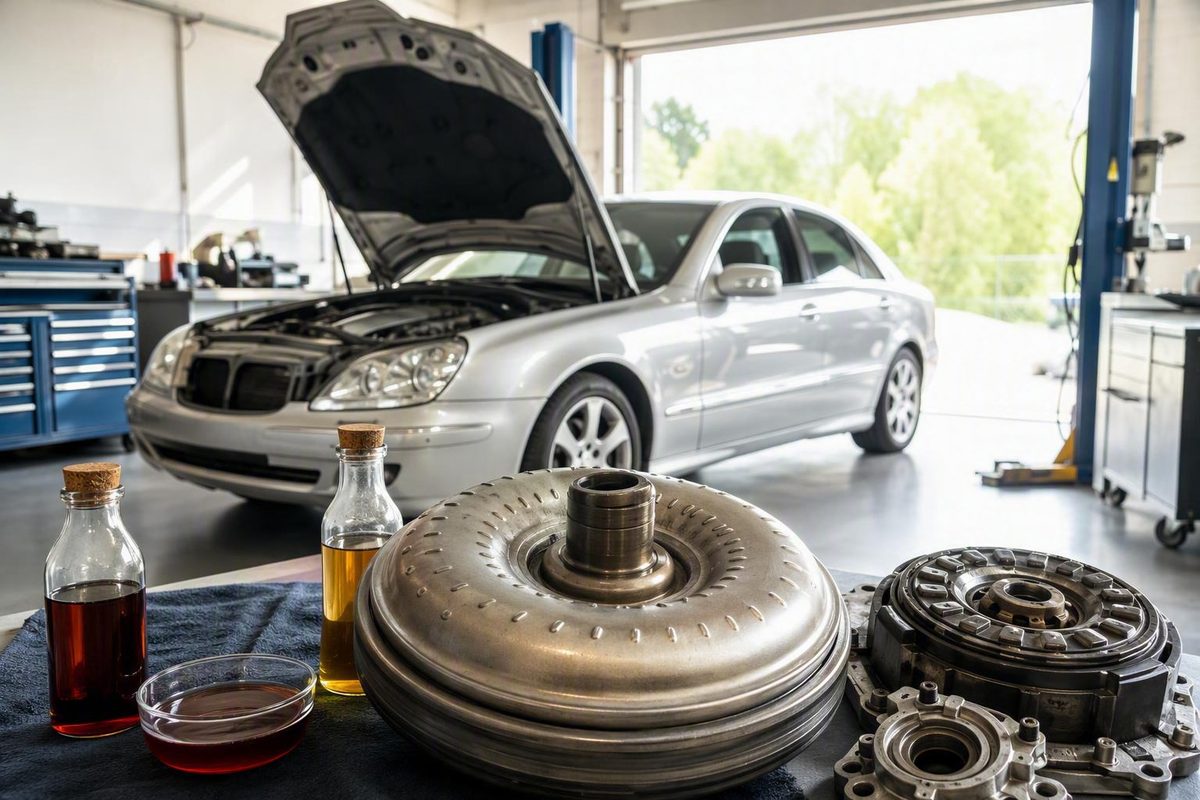
Slipping under load, delayed engagement, overheating, abnormal fluid, transmission-area noises, and occasional low-speed stalling increase concern about the converter or the wider transmission.
None of these symptoms proves that the converter itself has failed. Low, degraded, excessive, or incorrect fluid; a torque-converter-clutch solenoid or wiring fault; valve-body or pressure trouble; internal transmission wear; an engine misfire; damaged mounts; and driveline faults can produce similar behavior.
The practical goal is not to diagnose the part by feel. Record exactly when the fault occurs, avoid adding unnecessary heat or load, and give a technician enough information to distinguish among the converter, its controls, the hydraulic system, the engine, the driveline, and the rest of the transmission.
The strongest warning signs at a glance
A torque converter is the fluid coupling between the engine and an automatic transmission. It transfers engine power, multiplies torque primarily during launch or other high-slip conditions, allows the engine to continue running while the vehicle is stopped, and commonly contains a lock-up clutch that creates a more direct connection while cruising.
Possible warning signs, ranked roughly from more informative to less specific, include:
- Light-throttle cruising shudder. A brief vibration resembling a rumble strip—especially when it appears and disappears as accelerator position changes—is a characteristic torque-converter-clutch complaint. It is suggestive, not conclusive.
- Observable RPM flare or slip. The tachometer rises, but road speed does not increase proportionally. This shows inefficient power transfer somewhere in the converter or transmission.
- Slipping under load. The symptom becomes more obvious while accelerating, climbing a hill, towing, or asking for more torque.
- Delayed engagement into Drive or Reverse. The transmission pauses before taking up drive, sometimes followed by a bump or clunk.
- Excess heat or degraded fluid. A transmission-temperature warning, dark fluid, or a burnt odor suggests overheating or fluid deterioration.
- Unusual transmission-area noise. Whining, rattling, clicking, whirring, clunking, grinding, or a noise that changes with engine or vehicle speed can accompany internal damage.
- Low-speed stalling. If a lock-up clutch remains applied as the vehicle slows, the engine may be dragged down and stall.
- Reduced fuel economy. Extra lock-up-clutch slip can waste energy, but fuel consumption has too many other influences to serve as a useful diagnosis by itself.
These symptoms overlap substantially with fluid, control, hydraulic, engine, driveline, and wider transmission faults. Commercial transmission guidance therefore recommends inspection and diagnostic testing rather than attributing the complaint to the converter from symptoms alone. Mister Transmission describes that broader diagnostic approach.
Fluid can escape from several locations. Shift quality depends on pressure, valves, solenoids, electronics, and internal clutches. A warning light can identify a monitored circuit or performance problem without naming the failed mechanical part.
Treat the symptoms as locating a problem area, not identifying the replacement part. Depending on severity, the appropriate response will fall into one of three levels:
- Document the symptom and arrange an inspection
- Seek prompt diagnosis and limit driving
- Stop driving when safe and consider towing
What the symptoms feel like in different driving situations
The conditions under which a fault appears are often more useful than the driver’s choice of words. “It vibrates” is vague; “it shudders for two seconds at steady light throttle after warming up, then stops when I add throttle” gives a technician a reproducible test condition.
| Driving condition | What the driver may notice | Possible converter-related explanation | Important competing causes | Typical urgency |
|---|---|---|---|---|
| From a stop | Hesitation, weak launch, sluggish response, or RPM rising faster than road speed | Inefficient fluid coupling, internal converter trouble, or excessive slip | Engine power loss, incorrect fluid level or type, pressure loss, internal clutch slip, brake drag | Prompt diagnosis if recurring; stop if movement is severely limited |
| Moderate or hard acceleration | Engine revs increase but acceleration feels delayed or disconnected | Converter or lock-up clutch is not transferring torque efficiently | Internal clutch or band slip, valve-body fault, solenoid problem, engine-management issue | Prompt diagnosis |
| Hill climbing or heavy load | Pronounced RPM flare, weak pull, heat, or a burning smell | Converter-clutch slip becomes more apparent as torque demand rises | Internal transmission slip, insufficient line pressure, engine power loss | Reduce load and seek prompt diagnosis; stop for overheating or severe slip |
| Light-throttle cruise | Brief rumble-strip vibration that changes with throttle or operating conditions | Uneven lock-up-clutch engagement or clutch slip | Engine misfire, tire or wheel vibration, mounts, axle, driveshaft, CV-joint, or U-joint fault | Inspect soon if mild; prompt diagnosis if recurring or worsening |
| Selecting Drive or Reverse | A pause before engagement, sometimes followed by a bump | Internal leakage or failure to build or transmit pressure promptly | Low or degraded fluid, valve-body wear, pump or line-pressure trouble, seal leakage, wider transmission wear | Prompt diagnosis; stop if Drive or Reverse is lost |
| Slowing to a stop | Engine drags down, shakes, or stalls | Lock-up clutch may be failing to release | Idle-control, fueling, ignition, sensor, electrical, or other transmission-control fault | Prompt diagnosis; consider towing if stalling recurs in traffic |
| During a gear change | Hard, late, flared, or erratic shift | Converter or its controls may affect the event, but it is not converter-specific | Solenoids, valve body, pressure regulation, fluid, conductor plate, internal clutch wear | Evaluate the entire transmission |
| At idle in gear | Vibration or roughness that diminishes in Park or Neutral | Converter load or an internal rotating problem may contribute | Engine misfire, worn mounts, exhaust contact, idle-control issue | Inspect; escalate if accompanied by stalling, noise, or loss of drive |
During launch, focus on whether the engine is producing power but the vehicle is failing to use it. A weak engine and a slipping transmission can both feel sluggish, but the tachometer may help: a slipping power-transfer component often allows RPM to rise while acceleration remains poor.
Under load, make the same distinction carefully. A converter clutch that cannot hold can produce flare and heat, but so can an internal transmission clutch. A hill-induced flare does not isolate the converter.
The exact strategy nevertheless depends on the vehicle, gear, load, temperature, and software calibration. Road speed alone cannot diagnose the fault.
Delayed Drive or Reverse engagement points toward a hydraulic or mechanical problem, but not necessarily one inside the converter.
Hard, delayed, or erratic shifts should broaden the investigation rather than narrow it. Those events involve coordinated pressure control and clutch application within the transmission. The converter may be involved, but shift quality alone is weak evidence for replacing it.
Torque-converter shudder: the hallmark clue that still is not proof
Torque-converter shudder is commonly described as briefly driving over a rumble strip even though the pavement is smooth. It may feel like a rapid vibration through the seat, floor, or steering wheel. Some drivers describe it as a slight engine misfire because it can appear abruptly and disappear just as quickly.
Automotive repair sources commonly place the complaint at approximately 30–50 mph, often during gentle acceleration or steady cruising. That is a broad observation, not a universal test range. Actual lock-up speed varies with transmission design, selected gear, throttle position, load, temperature, and calibration. AutoZone reports this approximate range while emphasizing the overlap between converter and transmission symptoms.
One possible mechanism is uneven engagement or repeated slipping of the lock-up clutch. Instead of making a smooth, controlled connection, the clutch may alternately grab and release. That explanation fits the sensation, but the driver cannot confirm the mechanism by feel.
Compare the pattern with common alternatives:
- Engine misfire: May produce hesitation, uneven exhaust sound, a flashing or steady engine warning light, or roughness under load. A misfire can closely resemble lock-up shudder.
- Tire or wheel problem: Usually tracks vehicle speed more consistently and may remain present while coasting, although road surface and load can change its intensity.
- Worn engine or transmission mounts: Often cause vibration at idle, when selecting a gear, or during torque reversals rather than only during lock-up operation.
- Axle, driveshaft, CV-joint, or U-joint fault: May change with vehicle speed, acceleration, deceleration, or driveline angle.
- Vibration during a gear change: If the event occurs exactly as the transmission shifts rather than during steady cruising, pressure control or internal clutch application may be more relevant.
- Brake-related vibration: Generally appears while the brakes are applied, not during stable light-throttle cruising.
If the shudder occurs during ordinary driving, record:
- Road speed
- Engine RPM
- Throttle position or how steadily the pedal was held
- Selected or indicated gear
- Whether the transmission was cold, warming, or fully hot
- Transmission-fluid temperature, if displayed
- Whether the road was level or uphill
- Whether the symptom stopped when throttle input changed
- Whether it happened during a shift, after a shift, or during steady operation
- Whether the engine sound changed at the same time
Do not repeatedly provoke the symptom through hard acceleration or heavy loading. Converter-clutch slip can create heat, and unresolved heat or pressure problems may affect other transmission components. Commercial transmission guidance similarly associates load-related slip with RPM flare and heat buildup.
There is no conclusive driveway test based solely on lifting or adding throttle. A change in vibration can help define the operating condition, but a technician still needs to compare the event with commanded lock-up status, actual or calculated clutch slip, gear selection, engine behavior, and vehicle-specific operating logic.
Slipping, heat, fluid changes, noises, and stalling
RPM flare means engine speed rises while vehicle speed barely changes or increases much more slowly than expected. For example, the tachometer may jump during a hill climb without a corresponding surge in road speed. The observation indicates that power is not being transferred efficiently somewhere between the engine and driven wheels. It does not distinguish converter slip from internal transmission clutch slip by itself.
Persistent slip can create a damaging feedback loop:
- A clutch or hydraulic component fails to transfer torque efficiently.
- Some of the lost energy becomes heat.
- Heat degrades the fluid and can affect seals, friction materials, and lubrication.
- Degraded fluid or damaged parts can make slip and pressure control worse.
- Continued operation creates still more heat and wear.
Possible overheating clues include a transmission-temperature warning, darkened fluid, or a burnt odor. These findings indicate heat exposure or degradation; they do not identify which component started the problem. A slipping converter may overheat otherwise serviceable fluid, but low fluid, cooling trouble, pressure loss, or internal transmission slip can produce the same result. Bud’s Auto Repair likewise associates converter slip with heat and dark or burnt-smelling fluid while cautioning that symptoms overlap.
Fluid appearance requires context. Some fluids are naturally darker than others, and age changes color. A burnt odor, suspended friction material, or visible metallic debris is more concerning than color alone, but even those observations cannot identify the originating part without inspection.
Possible noises include:
- Whining
- Rattling
- Clicking
- Clunking
- Whirring
- Grinding
- A speed-dependent hum or growl
Worn bearings or internal converter damage can create noise, but sound travels through the bellhousing, transmission case, engine, mounts, exhaust, and body. A noise that seems to come from the converter can originate in an accessory drive, flexplate, transmission pump, internal geartrain, driveshaft support, axle, wheel bearing, or mount. Grinding accompanied by poor engagement or contaminated fluid warrants urgent diagnosis.
A transmission-fluid leak is equally nonspecific. A leak can lower the fluid level enough to cause delayed engagement, aeration, pressure loss, slipping, and heat even when the converter was initially sound. Locating the source matters more than assuming the visible drip identifies the failed component.
Low-speed stalling also requires a broad diagnosis. A lock-up clutch that remains applied as the vehicle stops can drag the engine down, but ignition, fueling, idle control, air metering, sensors, wiring, and other transmission-control faults can produce similar behavior. Note whether the engine restarts immediately, whether the stall happens only in gear, and whether it recurs as the vehicle slows.
Reduced fuel economy may accompany increased converter-clutch slip because a less direct connection wastes energy. It is only a secondary clue.
Bad torque converter or another transmission, engine, or driveline fault?
The best way to avoid an unnecessary converter replacement is to treat the complaint as a differential diagnosis. Start with the symptom, then test the plausible alternatives rather than selecting the most familiar part name.
| Symptom | Converter-related possibility | Alternatives that must be considered |
|---|---|---|
| Light-throttle cruising shudder | Lock-up clutch slipping or applying unevenly | Engine misfire, incorrect or degraded fluid, TCC solenoid or wiring fault, valve-body problem, mounts, tires, wheels, axle, driveshaft, CV joint, or U-joint |
| RPM rises without matching acceleration | Converter or lock-up-clutch slip | Internal transmission clutch wear, low pressure, low or aerated fluid, valve-body fault, control problem |
| Delayed Drive or Reverse | Internal converter leakage or delayed torque transfer | Low, excessive, old, contaminated, or incorrect fluid; pump or line-pressure loss; valve-body wear; seal leakage; internal wear |
| Harsh or erratic shifts | Converter-control interaction | Solenoid, wiring, valve body, pressure regulation, fluid condition, internal clutch wear, adaptation or control fault |
| Dark or burnt-smelling fluid | Heat generated by converter slip | Wider transmission overheating, internal clutch slip, low fluid, cooling fault, severe operating conditions |
| Whining, rattling, or grinding | Converter bearing or internal damage | Pump, flexplate, engine accessory, geartrain, differential, wheel bearing, mount, driveshaft, axle, or exhaust contact |
| Stalling while slowing | Lock-up clutch fails to release | Engine misfire, idle-control fault, fueling or air-metering problem, sensor or electrical fault, other transmission-control problem |
| Fluid leak | Converter-area or input seal leak | Pan, cooler line, electrical connector, case seal, output seal, or another transmission location |
| No warning light or code | Mechanical or intermittent fault remains possible | The fault may fall outside monitored conditions or may not have crossed a code-setting threshold |
Fluid can be a cause, contributor, or consequence. Low or incorrect fluid can disrupt pressure and clutch control. Old or contaminated fluid can impair operation. Converter or internal transmission slip can then overheat and further degrade that same fluid. Dark fluid therefore does not establish the direction of causation.
The torque-converter-clutch solenoid and its wiring also matter.
A lack of codes does not clear the converter or transmission.
Mercedes W220 and 722.6 caution: W220 Repair’s 722.6 transmission-fluid guidance associates harsh 2–3 shifts, cold-start flare, and limp-home operation with neglected fluid and possible valve-body or conductor-plate concerns. It does not present those symptoms as proof of converter failure. Fluid history and specification are relevant diagnostic context, but they cannot diagnose the converter.
For a W220 or another 722.6-equipped vehicle, do not import generic lock-up speeds, acceptable slip figures, or fault trees from a different transmission. The available evidence does not establish a universal 722.6 converter-failure pattern. Diagnosis still needs the exact model, transmission variant, control software, fluid specification, and appropriate vehicle-level procedure.
Safe checks an owner can make before booking diagnosis
The most useful owner check is careful documentation. Create a worksheet or phone note with the following fields:
| Item to record | Useful detail |
|---|---|
| Vehicle speed | Approximate speed when the symptom begins and ends |
| Engine RPM | Before, during, and immediately after the event |
| Throttle input | Steady, gently increasing, lifting, or heavy acceleration |
| Gear | Indicated or selected gear, if available |
| Temperature | Cold start, warming up, fully hot, or displayed fluid temperature |
| Load | Level road, hill, towing, passengers, or cargo |
| Engagement | Delay after selecting Drive or Reverse |
| Warning indicators | Engine, transmission, temperature, or other lights |
| Sound | Type of noise and whether it changes with RPM, road speed, or gear selection |
| Smell | Normal, hot-oil, or burnt odor |
| Fluid observations | Level, color, odor, visible contamination, or debris |
| Repeatability | Every trip, intermittent, only hot, only cold, or only under load |
For a preliminary leak check, note fresh spots where the vehicle is normally parked and any wetness visible from an ordinary standing or under-hood inspection. Leave inaccessible areas and source confirmation to a properly equipped shop.
Check transmission-fluid level and condition only by the procedure specified for the exact vehicle. Generic checks can produce an incorrect reading, and both underfilling and overfilling can impair operation. Mister Transmission likewise limits preliminary fluid checks to vehicles and procedures where access is provided.
Record the fluid’s color and odor and note visible contamination or metallic material. Appearance can establish that fluid is degraded or contaminated, but it cannot prove whether the converter, an internal clutch, a bearing, or another component produced the debris.
Retrieve and record diagnostic trouble codes before clearing them. Include pending and history codes if the scanner can access them, along with freeze-frame or transmission-module information where available.
P0740 and P0741 are associated with torque-converter-clutch circuit or performance trouble, but neither code independently orders a converter replacement. Depending on the vehicle, diagnosis may need to consider:
- Wiring and connectors
- Fluid level, condition, and specification
- TCC solenoid operation
- Valve-body leakage or wear
- Hydraulic pressure
- Commanded versus actual lock-up behavior
- Internal transmission condition
- The converter clutch itself
AutoZone places P0740 and P0741 within a broader diagnostic process rather than treating either code as proof of mechanical converter failure.
Do not conduct a casual DIY stall-speed test. The test loads the drivetrain and can create heat rapidly; the supplied guidance limits or qualifies its use and requires comparison with vehicle-specific specifications. Gearstar’s discussion explicitly calls for caution and limits its stall-test guidance.
Do not treat an indiscriminate transmission flush as either a diagnosis or a universal cure. Correct service can help when fluid level, condition, filtration, leakage, or specification is the cause. It cannot restore worn clutch lining, damaged bearings, failed seals, or other internal parts. The appropriate service method depends on the transmission and its condition.
When to keep monitoring, schedule diagnosis, or stop driving
There is no universal safe mileage for a suspected torque-converter problem. A mild intermittent vibration and severe uncontrolled slip are not equivalent, and vehicle condition can change quickly. Use the symptom’s severity and accompanying signs to choose among three urgency levels.
Level 1: Document and schedule an inspection
This level may be reasonable when:
- The shudder is mild and intermittent
- The vehicle still accelerates and engages normally
- There is no temperature warning
- There is no burning odor
- There is no severe RPM flare
- There is no grinding or substantial leakage
- The engine does not stall
Record the conditions and arrange an inspection if the symptom persists. Do not normalize a recurring shudder simply because the vehicle remains driveable.
Level 2: Arrange prompt diagnosis and limit avoidable driving
Move to this level for:
- Recurring or worsening cruising shudder
- Noticeable RPM flare
- Slipping under moderate load
- Delayed engagement into Drive or Reverse
- New or worsening noises
- A stored torque-converter-clutch code
- Fluid that appears degraded
- A stalling or near-stalling event
- Deteriorating shift quality
Until the cause is known, avoid towing, steep climbs, hard acceleration, and unnecessary trips. Those conditions add load and heat to a system that may already be slipping or losing pressure. Continued driving with worsening slip or overheating may extend damage beyond the original fault. Gearstar warns that ongoing slip and heat can affect transmission gears, clutches, and bearings.
Level 3: Stop when safe and consider towing
Stop normal driving when there is:
- Severe or continuous slipping
- A transmission-temperature warning
- A strong burning odor
- Grinding
- Repeated stalling in traffic
- Substantial fluid leakage
- Loss of Drive or Reverse
- Weak, erratic, or unpredictable movement
Significant slipping and overheating can contribute to damage involving friction clutches, seals, bearings, gears, and other transmission components. These symptoms justify stopping when safe and arranging recovery rather than trying to establish how many additional miles the vehicle might cover. Commercial transmission guidance similarly connects converter-related heat and unresolved pressure or clutch damage with wider transmission harm.
If a temperature warning appears, engagement is lost, or the vehicle begins stalling in moving traffic, prioritize reaching a safe stopping location. No generic mileage promise is responsible because the immediate environment, symptom severity, and vehicle response all differ.
How a technician narrows down the cause
A professional diagnosis should proceed as a sequence rather than jumping from symptom to replacement.
1. Verify the complaint
The technician begins with the driver’s notes and attempts to reproduce the event during a controlled road test. Speed, RPM, throttle input, gear, temperature, load, and shift or lock-up status may be recorded. A vague complaint of “vibration” becomes useful only when tied to operating conditions.
2. Retrieve codes and scan data
The scan should include relevant transmission and engine modules, not only generic powertrain codes.
A code identifies the circuit or performance area detected by the control module. It does not reveal by itself whether the cause is wiring, a solenoid, the valve body, pressure loss, worn friction material, or the converter.
3. Inspect fluid, leakage, and debris
Fluid level and condition must be checked through the appropriate temperature-dependent procedure. The technician should inspect for leaks and determine their source rather than merely topping up the unit. Burnt fluid or debris changes the repair discussion because it can indicate wider heat exposure or internal wear.
4. Test the converter-clutch control path
Depending on the transmission, diagnosis may evaluate:
- Electrical supply, grounds, connectors, and wiring
- TCC solenoid command and response
- Valve-body operation and leakage
- Hydraulic pressure and pressure regulation
- Commanded versus actual lock-up behavior
- Whether slip changes with temperature and load
- Whether the symptom occurs during lock-up, during a gear shift, or neither
Line-pressure and related hydraulic tests are technician work. The correct ports, gauges, operating temperatures, commands, and pressure specifications are vehicle- and transmission-specific.
5. Rule out engine and driveline faults
If the complaint resembles a misfire, the engine should be evaluated under the same load and speed at which the vibration occurs. Mounts, wheels, tires, axles, driveshafts, CV joints, U-joints, wheel bearings, and related rotating components may also require inspection.
Converter-clutch shudder tends to correlate with lock-up operation. These patterns guide testing, but none is an infallible rule.
6. Assess the wider transmission
Delayed engagement, harsh shifts, pressure faults, severe slipping, or debris justify examining the entire hydraulic and mechanical system. The converter should not be condemned while an unresolved valve-body, pressure, control, or internal clutch problem remains.
No single road sensation, code, noise, or fluid color is sufficient. Confidence comes from agreement among the road-test pattern, scan data, fluid findings, electrical or hydraulic tests, and exclusion of competing causes.
Confirmation matters because replacing a torque converter normally requires removing the transmission, making the job labor-intensive even when the converter is the only defective part. Bud’s Auto Repair notes that converter replacement requires transmission removal, reinforcing the value of diagnosis before authorizing the work.
Fluid service, converter replacement, or wider transmission repair
The correct repair depends on what testing finds. There are three broad scenarios.
Scenario one: Correct a verified fluid, filter, leak, or specification problem
This can include:
- Correcting an underfilled or overfilled condition
- Repairing a confirmed leak
- Using the specified fluid
- Replacing a restricted or overdue filter where applicable
- Performing the appropriate drain, fill, or service procedure
- Addressing a cooling or temperature-control problem
Fluid service may improve delayed engagement, erratic operation, or shudder when fluid level, condition, aeration, filtration, leakage, or specification is the underlying cause. It cannot repair worn lock-up-clutch lining, a damaged bearing, failed internal seals, or other mechanical damage.
Improvement after service is useful evidence, but it does not necessarily prove that every internal component is healthy. Continued slip, debris, a recurring code, or rapidly deteriorating fluid warrants further investigation.
Scenario two: Replace the converter alone
Converter-only replacement can be reasonable when testing confirms the fault and the rest of the transmission appears serviceable. Supporting findings may include:
- Clean fluid
- No significant metallic or friction debris
- Acceptable hydraulic operation
- Normal engagement and shifting outside the converter complaint
- No evidence of heat-damaged internal clutches
- No unresolved solenoid, valve-body, wiring, or pressure fault
The repair plan should account for the correct fluid and any associated seals or required installation parts. A converter should not be installed while leaving a known control or pressure defect unresolved.
Scenario three: Repair the converter and wider transmission system
A broader repair may be appropriate when diagnosis finds:
- Metal or substantial friction debris
- Severe internal slipping
- Heat-damaged fluid and clutches
- Valve-body wear or hydraulic leakage
- Pressure-regulation trouble
- Damaged bearings, seals, or gears
- Contamination requiring attention beyond the converter
- Multiple engagement or shifting faults
This does not mean every converter symptom requires a rebuild. It means the repair scope should match the verified damage. Replacing one component while leaving debris, pressure loss, or heat-damaged parts in service can undermine the repair.
Commercial sources quote broad installed converter-replacement estimates around $600–$1,200, but this is a general reference rather than a current quote or Mercedes W220 price. AutoZone publishes that approximate range while noting variation by vehicle, labor, and the specific failure. See its general cost discussion.
The actual total can change substantially with:
- Vehicle make, model, and transmission
- Front-, rear-, or all-wheel-drive layout
- Access and transmission-removal labor
- Local labor rates
- New, rebuilt, or remanufactured converter choice
- Diagnostic time
- Fluid and filter requirements
- Seals, fasteners, cooler work, and related parts
- Taxes and shop fees
- Valve-body or solenoid repairs
- Internal transmission damage
- Warranty terms
For a W220 or 722.6 application, use vehicle-specific fluid and level-setting guidance. Maintenance history and fluid specification can help explain symptoms or identify a service problem, but neither establishes that the converter has mechanically failed.
What does a failing torque converter sound and feel like?
It may feel like a brief rumble-strip vibration during light-throttle cruising, hesitation from a stop, weak acceleration, or engine RPM rising without matching road speed. It may also produce or accompany whining, rattling, clicking, whirring, clunking, or grinding.
The pattern matters more than the sound label. A shudder that correlates with lock-up operation is more suggestive than a constant vibration, while a speed-dependent noise can come from many rotating components. A technician should correlate the complaint with temperature, gear, load, scan data, and vehicle-specific converter-clutch operation.
Do P0740 or P0741 confirm that the torque converter must be replaced?
No. P0740 and P0741 are associated with torque-converter-clutch circuit or performance trouble, but possible causes include wiring, connectors, fluid condition, a solenoid, valve-body leakage, hydraulic pressure, internal transmission faults, and the converter clutch itself. AutoZone discusses both codes as part of a wider diagnostic process.
Record the codes and associated data before clearing them. Replacement should follow testing that identifies the failed part, not the code description alone.
Can low or contaminated transmission fluid mimic torque-converter failure?
Yes. Low, excessive, aerated, old, contaminated, or incorrect fluid can contribute to delayed engagement, shudder, erratic shifting, pressure problems, slipping, and overheating. Those symptoms can closely resemble converter failure.
Check the level only through the exact vehicle’s prescribed procedure. Fluid condition can reveal a maintenance or heat problem, but appearance alone cannot identify which internal component is defective.
Can a transmission-fluid service fix torque-converter shudder?
It can help when incorrect level, degraded fluid, the wrong specification, leakage, or a filter problem is causing the shudder. It cannot restore worn converter-clutch material, bearings, seals, or other damaged internal parts.
Use the vehicle-appropriate service method rather than assuming a pressure flush is universally suitable. For Mercedes 722.6 readers, fluid specification and temperature-dependent level setting require particular attention, but correct service is still not a substitute for diagnosis.
Can I keep driving with a shuddering or slipping torque converter?
A mild, intermittent shudder without overheating, burning odor, severe slip, noise, leakage, stalling, or lost engagement may permit cautious operation while an inspection is arranged. Recurring shudder, delayed engagement, RPM flare, or a TCC code calls for prompt attention and reduced load.
Stop when safe and consider towing if there is severe slipping, a transmission-temperature warning, a burning smell, grinding, repeated stalling, substantial leakage, or loss of Drive or Reverse. Continued significant slip can generate heat and contribute to broader transmission damage.
Light-throttle shudder and RPM flare are useful clues, but a torque converter cannot be diagnosed from feel alone. Document the exact conditions, inspect fluid and leaks only through safe vehicle-specific procedures, and preserve any codes. Severe slipping, overheating, burning odor, grinding, repeated stalling, or loss of engagement warrants stopping when safe and considering a tow. The eventual repair should address the verified cause—whether that is a fluid issue, the converter, or damage elsewhere in the transmission.