
Diagnose a W220 Transmission Cooler Line Leak Before Replacing Parts
Trace a W220 cooler-line leak, separate it from nearby 722.6 leaks, choose the right repair and restore the ATF level correctly.
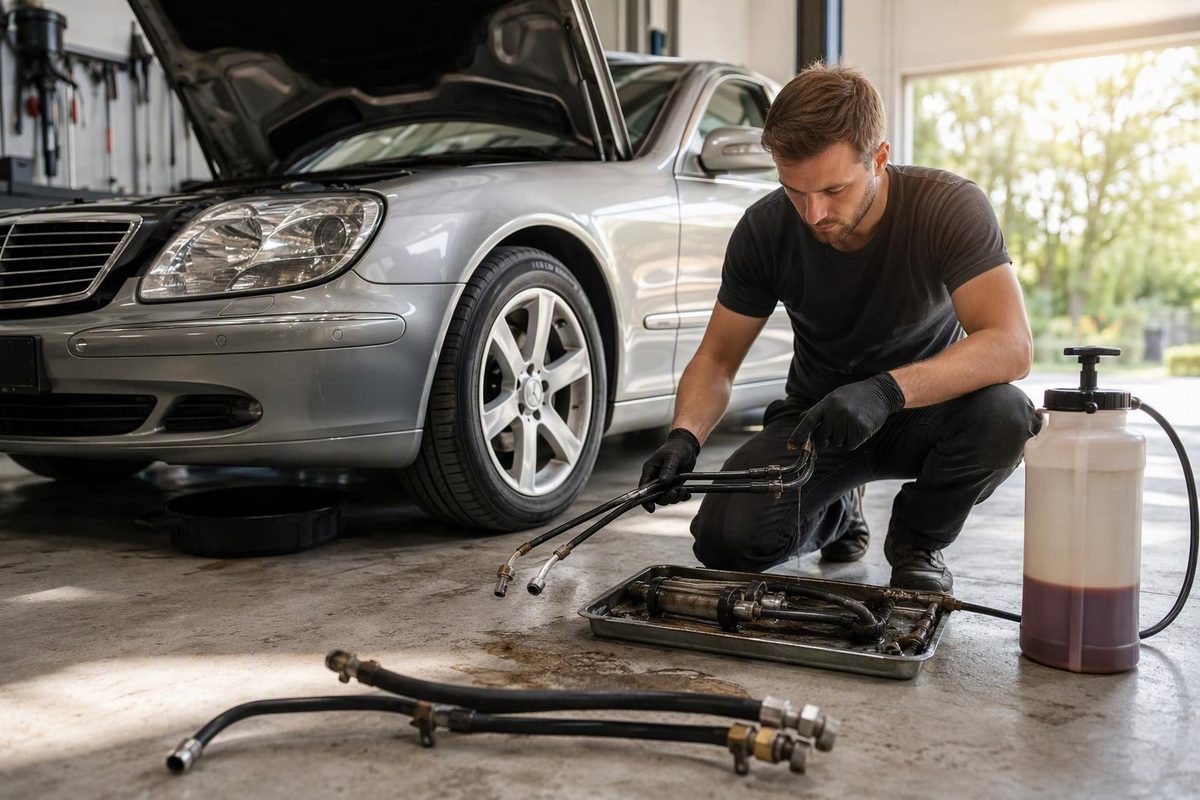
A transmission cooler line leak can wet a pipe between the transmission and radiator, a line connection or the front undertray. Do not order a line from the model name alone: routing and fittings vary by year, engine, rear-wheel drive or 4MATIC, and transmission.
Most W220s have the five-speed 722.6, but select non-4MATIC 2004-model-year S430 and S500 cars received the seven-speed 722.9. Mercedes-Benz technical training identifies those early 722.9 applications and confirms that 722.6 remained in other applications (Mercedes-Benz USA training material). Confirm the transmission and full vehicle identity from the data card or VIN before buying parts.
This matters even within one model. Mercedes lists line 220-270-26-96-64 as a right-side transmission-to-cooler line specifically for the 2003–2006 S430 4MATIC, not as a universal W220 part (Mercedes-Benz USA).
Decide whether the car should move
Shut the engine off and arrange a tow if:
- fluid is actively dripping or reaching a hot exhaust component;
- Drive or Reverse engages slowly or not at all;
- engine speed rises without matching acceleration;
- the transmission makes a new abnormal noise; or
- a transmission-temperature warning appears.
Low ATF can reduce the hydraulic pressure and lubrication on which the transmission depends. A damp line without operating symptoms is less immediate, but it still needs prompt diagnosis because the undertrays can retain fluid and disguise the amount lost. Use the broader transmission-leak safety checks before deciding whether to drive.
Prove that the cooler line is the source
A wet line is not necessarily a failed line. Fluid can run along pipes, wiring and underbody panels before dripping elsewhere.
On a 722.6, inspect the 13-pin electrical connector area as well as the pan and cooler lines. In one documented W220 case, the owner found ATF on the wiring and then confirmed drops at the passenger-side electrical connector (PeachParts). That is a useful diagnostic lead, not proof that every wet 722.6 has a connector leak.
Start with the car cold:
- Identify the fluid. ATF is oily, but its color alone is not conclusive because specification, age and contamination affect its appearance. Coolant is more watery and may leave dried residue. Engine oil, power-steering fluid and ABC hydraulic fluid can also migrate into this area on a W220.
- Remove the lower panels. Note where fluid has collected before cleaning the cooler lines, support clips, radiator connections, transmission connections, pan rail and 13-pin connector area.
- Inspect the whole route. Look for corrosion pitting, a polished rub-through point, a split flexible section, wetness at a hose-to-pipe crimp, a missing support clip or damage around a connection.
- Recheck for the first wet point. With the parking brake applied, wheels chocked and selector in Park, start the engine only if the fluid loss is not severe. Observe from above or beside the vehicle with a light, mirror or camera. Do not put any part of your body beneath a running car supported only by a jack or stands.
- Stop as soon as the source appears. If residue starts above the line, continue tracing upward after shutting the engine off. If a cleaned crimp, corroded pipe or connection becomes wet first, the cooler circuit is implicated.
If the source remains unclear, a workshop can clean the area and inspect it on a lift. Repeatedly adding ATF while guessing risks both overfilling and continued fluid loss.
Match the repair to the failure
Connection or seal leak
Identify the connection design for the exact VIN before taking it apart. Some joints use an O-ring and retaining hardware; others may use a different line or union arrangement. Mercedes training for the 722.9, for example, describes push-in cooler lines sealed by rubber O-rings and secured by retaining bolts (Mercedes-Benz USA training material). Do not assume that description applies unchanged to a 722.6 connection.
Replace the specified seal and any one-time or damaged retaining hardware. A genuine Mercedes O-ring listing describes part 0199975745 as a seal for transmission-to-radiator cooling lines and calls for replacement whenever the applicable line is disconnected, but its fitment must still be checked against the VIN (FCP Euro).
Inspect the pipe end, sealing bore, seat and retainer. A new O-ring will not correct a bent pipe, corroded sealing surface, distorted port or damaged retaining feature. Do not use plumbing tape, RTV or epoxy: the engineered seal or seat must make the joint, and loose sealant must not enter the transmission circuit.
Crimp, flexible section or hard-pipe leak
Replace the affected line assembly where practical. Also inspect its brackets and the neighboring line; a missing clip or incorrect routing can let a replacement rub through.
Mercedes parts documentation shows why a visual match is insufficient. One W220-family line, 220-270-03-96, is described as running from the cooler to the right side of the torque-converter housing and is listed for selected rear-wheel-drive S430 and S55 applications among other vehicles (MB Parts Center). The visually similar 220-270-26-96-64 has much narrower S430 4MATIC fitment.
Do not substitute ordinary fuel hose. If a properly engineered repair section is used instead of an original line assembly, every hose, fitting and clamp must be expressly rated for hot automatic-transmission fluid and transmission-cooler service. It must also be routed away from exhaust heat and moving parts and supported against abrasion.
Access can be difficult on 4MATIC cars. An S430 4MATIC owner reported that the front differential and engine-mount brackets obstructed removal of the rigid lines (MBWorld). Treat that as owner experience, not a universal removal procedure. If the correct line cannot be removed without shifting major components, obtain the VIN-specific Mercedes workshop instructions rather than cutting first and improvising a route.
Radiator or cooler leak
Establish whether the removable line joint is leaking or the radiator/cooler port or body is damaged. Overtightening a connection will not repair a cracked or distorted port.
Milky ATF or oily contamination in the coolant reservoir raises a different concern: an internal breach between the cooling circuits. Stop running the vehicle and have both fluids and the cooler or radiator tested before treating it as a simple external line leak.
Refill and set the level correctly
Measure any fluid captured during disconnection as a rough starting point, not as the final refill specification. After fitting the correct parts, clean the area and perform a stationary leak check before reinstalling the undertrays.
For a 722.6, the car must be horizontal and the engine running when the final level is measured at the procedure’s specified fluid temperature. Insert the service dipstick fully into the capped fill tube, even if part of the tool remains above the tube, then remove the dipstick after measuring. The sequence includes briefly selecting the ranges with the brake applied and returning to Park (febi). Perform that range-cycling step only with the car safely on the ground or on equipment intended for a running vehicle.
The 722.9 has no dipstick tube; Mercedes specifies a temperature-dependent overflow method through the pan, so 722.6 dipstick instructions do not apply (Mercedes-Benz USA training material). If the transmission cannot be identified or its temperature cannot be read correctly, stop and have the level set with suitable diagnostic equipment.
Use ATF carrying the approval required by the installed gearbox. Mercedes says approved products are identified on their containers by the applicable “MB-Approval” and publishes its current approval sheets on the Mercedes-Benz Operating Fluids site. The W220 ATF specification guide explains the 722.6 and 722.9 distinction.
Recheck the repaired area with the engine running. Road-test only if engagement is normal and no leak remains, then inspect again after the test. Do not add or drain ATF from one poorly controlled reading; vehicle angle and fluid temperature can change the result, as explained in why a high reading may be misleading.