
When a W220 Transmission Repair Beats Another Car Loan
Compare your transmission quote with Experian's 2026 used-car rates and calculate 36-, 48-, and 60-month interest before replacing a W220.
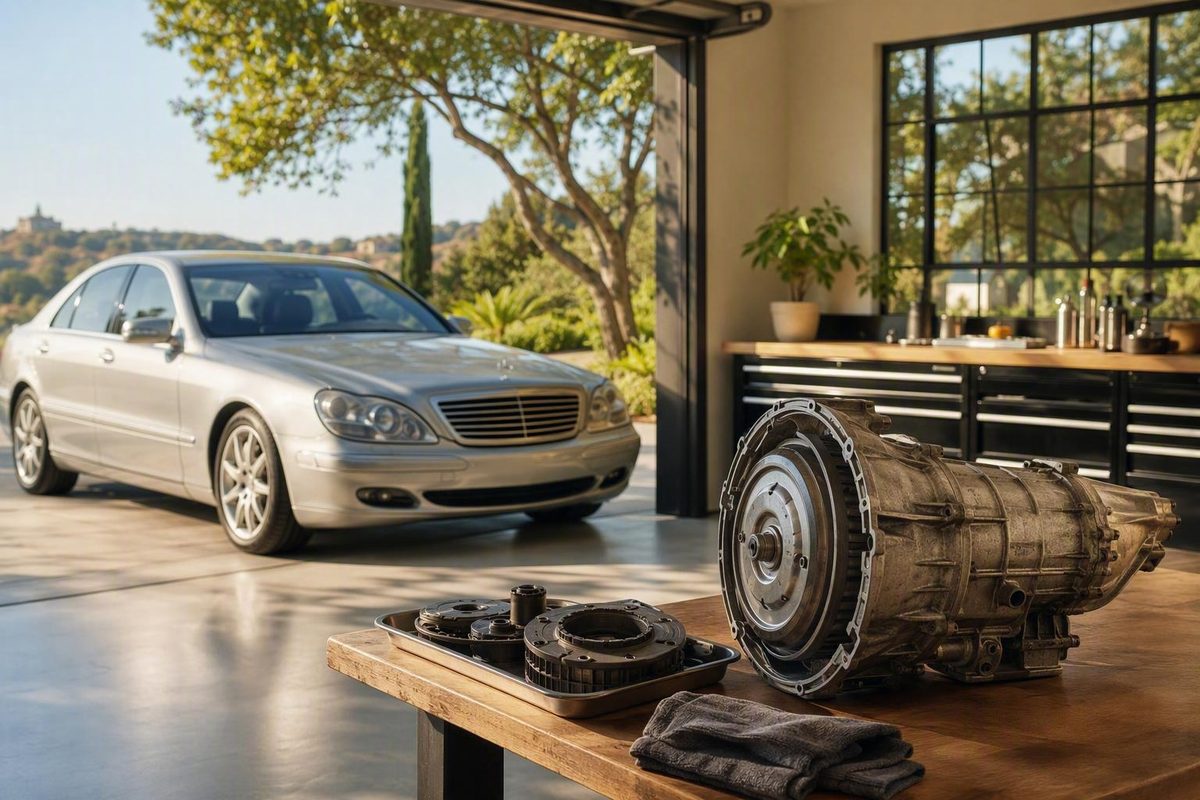
For a paid-off, otherwise sound W220, repairing a diagnosed transmission fault is usually cheaper than financing a same-class used replacement. Experian’s Q2 2026 data put the average used-vehicle interest rate at 11.19%, while its Q1 tier data put even prime borrowers at 8.77% APR. At that prime rate, a $15,000 loan over 60 months generates roughly $3,600 in interest alone—enough to rival a substantial transmission repair before depreciation, taxes, insurance changes, or repairs to the replacement are counted (Q1 rates reported by AOL; Q2 data reported by Auto Remarketing).
That verdict is limited to a car with an isolated, correctly diagnosed fault and credible useful life after repair. Replacement becomes reasonable when the transmission is one item in a larger list of engine, cooling-system, rust, suspension, electrical, or safety problems. Immediate affordability also remains separate from total cost: a repair can be cheaper overall while still requiring more cash today.
Choose your credit tier, replacement price, transmission quote, and loan term; the calculator shows which side wins the interest-only test.
This tests whether the transmission quote costs less than the replacement loan’s interest alone. It also shows the payment and total repayment.
How Term Changes A Prime-Tier $15,000 Loan
| Term | Payment | Total Interest | Repair Test |
|---|---|---|---|
| 36 months | ~$475 | ~$2,111 | Loan interest lower |
| 48 months | ~$372 | ~$2,846 | Loan interest lower |
| 60 months | ~$310 | ~$3,579 | Repair lower |
The break-even repair quote in this narrow test equals total loan interest. Replacement principal, down payment, taxes, fees, depreciation, insurance, and repairs are not included.
Credit Tier Changes 60-Month Interest
| Used-Car Tier | Rate | Interest On $15,000 | $3,500 Repair |
|---|---|---|---|
| Super Prime | 6.30% | ~$2,526 | Above interest |
| Prime | 8.77% | ~$3,579 | Below interest |
| Nonprime | 14.03% | ~$5,970 | Below interest |
| Subprime | 19.42% | ~$8,562 | Below interest |
| Deep Subprime | 21.77% | ~$9,732 | Below interest |
Use your lender’s actual offer for the decision. Experian’s tiers are aggregate averages, not guaranteed rates. Reject repair regardless of this result if the vehicle cannot be made safe or lacks credible useful life.
Source: Experian Q1 2026 used-vehicle tier rates as reported Aug. 6, 2026 by AOL. Values marked ~ are standard amortization estimates; unknown taxes, fees, insurance, depreciation, and vehicle values are —.
The Case For Replacing An Old W220
The usual advice is understandable. A W220 with high mileage and a transmission quote in the thousands has limited resale value, while a newer used car appears to offer better dependability and a manageable monthly payment. A successful transmission rebuild does not renew the engine, cooling system, AIRMATIC suspension, brakes, body, electronics, or interior.
That view is right when the transmission failure is part of a wider decline. Replacement may justify its higher cost if the car has structural rust, unresolved safety defects, repeated overheating, major engine trouble, extensive deferred maintenance, poor parts or specialist availability, or transportation needs it no longer meets. It is also difficult to defend a repair when the car is unlikely to provide enough safe, useful service to recover the expense.
The consensus becomes unreliable when it compares the complete repair bill with one replacement-car payment. The repair is generally a one-time expense. The payment represents only one month of a loan that can continue for three to five years, and it does not disclose the down payment, total interest, financed fees, negative equity, insurance, or remaining balance.
Used-Car Interest Changes The Comparison
Experian’s Q1 2026 credit-tier figures show why a generic monthly-payment comparison is inadequate. Average used-vehicle APRs were 6.30% for super-prime, 8.77% for prime, 14.03% for nonprime, 19.42% for subprime, and 21.77% for deep-subprime borrowers. The overall reported averages were 6.39% for new vehicles and 11.43% for used vehicles. These are market averages, not offers guaranteed to an individual borrower (Q1 rates reported by AOL).
Experian’s Q2 2026 used-vehicle data reported an average $27,852 amount financed, $542 monthly payment, and 11.19% interest rate, down from 11.57% a year earlier. The report calls 11.19% an interest rate, so it should not automatically be relabeled as an APR. It also reported average refinancing savings of $83 per month among represented borrowers, but refinancing eligibility and lifetime savings were not guaranteed (Auto Remarketing’s Experian report).
For the smaller $15,000 replacement used in the calculator, a prime borrower at 8.77% pays roughly $2,100 in interest over 36 months, $2,850 over 48 months, or $3,600 over 60 months. The exact result changes with the amount financed, term, and actual lender offer.
The $3,600 is total interest over 60 months, not interest accumulated within the first 12 to 18 months. The evidence supports comparing a transmission quote with the loan’s full borrowing cost; it does not support claiming that all of that interest arrives during the opening year.
A repair below the loan’s total interest is a particularly strong case for keeping the W220: the owner avoids more in borrowing cost than the repair itself, while also avoiding the replacement principal. A repair above the interest figure can still be cheaper than replacement because the loan principal, taxes, fees, depreciation, and ownership-cost changes remain outside that narrow test.
Diagnose The 722.6 Before Pricing A Replacement
Slipping, delayed engagement, limp mode, leaks, vibration, burning fluid, and poor gear selection do not by themselves prove that the complete transmission needs replacement. Depending on the test results, the fault may involve a seal, electrical connector, conductor plate, solenoid, wiring, valve body, torque converter, pump, or internal mechanical damage.
Do not continue driving a car that engages unpredictably, overheats, has a substantial fluid leak, or cannot be operated safely. Have it towed when safe operation is in doubt.
A major quote should identify the fault codes and test results, failed components, proposed repair method, labor, fluid, filter, seals, coding or adaptation work, taxes, fees, and warranty terms. It should also say whether the supplied unit is used, locally rebuilt, or remanufactured. A line reading only “replace transmission” is not enough to compare against a multiyear car loan.
Kelley Blue Book gives a broad average transmission-replacement range of approximately $2,900 to $7,100. Vehicle design, damage, location, shop, labor, and the type of replacement unit can materially change the actual quote (Kelley Blue Book’s transmission cost guide). Smaller component repairs may cost much less, which is why a second model-knowledgeable diagnosis is worthwhile before authorizing complete replacement.
For a W220, confirm the installed transmission from the VIN, data card, model year, or transmission code before ordering parts. The site’s 722.6 transmission-fluid guidance recommends service roughly every 40,000–60,000 miles, MB 236.10- or 236.12-approved fluid, replacement of the electrical connector sleeve, and level setting at the specified temperature. That service guidance is not a cure for confirmed internal damage, nor does it replace fault-code analysis.
Compare Equal Ownership Periods
Use the same 12-, 36-, or 60-month period for both choices. On the repair side, include the all-in transmission work, repair-financing charges, existing loan payments, other work identified during inspection, downtime, and the car’s estimated value at the end.
On the replacement side, include the down payment, amount financed, all loan payments, taxes, dealer charges, registration, insurance changes, expected maintenance and repairs, and any negative equity rolled into the loan. At the end of the comparison period, subtract only net equity: estimated vehicle value minus the remaining loan balance.
The net cash cost over the period equals upfront costs plus payments and operating expenses, minus sale proceeds and ending net equity.
The Automatic Transmission Rebuilders Association uses a similar comparison structure incorporating payments, repairs, insurance, registration, fuel, financing, mileage, and trade value. Its example has replacement costing more over five years, but the useful point is the method rather than its result for any particular W220 (ATRA’s fix-or-trade calculator).
Cost per useful month is also more revealing than the payment. A $4,000 repair expected to preserve 36 months of service represents about $111 per useful month. That allocation does not make the shop bill monthly; it shows what the repair buys if the car lasts as expected.
If a $4,000 repair avoids an estimated $450 of incremental net replacement cost per month, its rough break-even period is about nine reliable months. The $450 must represent the replacement’s additional net ownership cost, not merely its payment, because part of every payment reduces principal and may create equity.
Whole-Car Condition Sets The Real Break-Even Point
A transmission repair becomes persuasive when the engine and cooling system are sound, structural rust is absent, suspension and brakes are serviceable, electrical faults are bounded, maintenance records are credible, and no other major work appears imminent. Ask the inspecting shop for a written list of immediate and near-term needs rather than a promise that an older car will be trouble-free.
Estimate the W220’s value in three conditions: broken as it sits, successfully repaired, and sold for salvage or parts. A repair does not have to increase resale value dollar for dollar. Its purpose may be to buy several more years of transportation without assuming another loan.
The calculation differs if the plan is to sell immediately. If a car is worth $1,500 broken and $4,000 repaired, a $4,000 repair creates only $2,500 of additional market value before towing, time, or selling costs. Repairing solely for resale would be weak under those assumptions.
This is why a fixed rule based on repair cost as a percentage of vehicle value is incomplete. Market value does not measure the full transportation value of a paid-off car, and it ignores the financing cost required to replace it.
Run at least an expected case and a failure case. The expected case uses the transmission quote plus work actually identified during the inspection. The failure case adds another major repair, extra downtime, and a lower ending value. Apply comparable uncertainty to the replacement: a used car can arrive with worn tires, brakes, suspension, or deferred service.
Negative Equity Makes Trading More Expensive
If the W220 still has a loan, calculate negative equity as the current payoff minus its as-is trade value. A $9,000 payoff and $4,000 trade offer leave $5,000 of negative equity.
That $5,000 does not disappear at the dealership. If rolled into a $27,852 replacement loan, it raises the amount financed to $32,852, so interest accrues on old debt as well as the replacement purchase. It can also leave the borrower owing more than the replacement is worth.
Repairing before sale does not automatically recover the repair bill, either. Obtain an as-is offer and a realistic repaired-value estimate before deciding. Compare the financed repair’s total repayment with the replacement down payment, total loan payments, fees, ending balance, and ownership costs—not whichever option displays the smaller monthly figure.
When Financing A Replacement Is Defensible
Replacement is defensible when an independent inspection shows that a transmission repair would preserve too little useful service. A $5,500 transmission job combined with approximately $7,000 of probable engine, suspension, rust, or safety work is not an isolated transmission decision. If the repaired car is expected to provide only 18,000 miles, a sound replacement capable of covering the full comparison period may offer lower cost per useful mile even with financing.
Safety overrides the financial comparison. Structural damage, unreliable engagement, serious braking defects, or a history of unresolved overheating should not be rationalized because repair looks cheaper on a spreadsheet. Suitability matters as well: a replacement can justify its premium when the W220 no longer meets accessibility, passenger, cargo, weather, or commuting requirements.
For an isolated 722.6 fault, however, the financing figures set a high bar. Start with a documented diagnosis and itemized repair quote. Then obtain a real out-the-door replacement price, lender preapproval, insurance quote, trade offer, and payoff statement. If the W220 remains safe and otherwise sound, compare the repair with the replacement loan over equal terms. At August 2026’s used-car rates, “put the repair money toward another car” is often the more expensive choice rather than the cautious one.