
Diagnose W220 AIRMATIC Faults Before Replacing Parts
Diagnose a low, leaning or hard-riding W220 AIRMATIC system by separating air leaks, compressor faults, valve-block trouble and faulty sensor data.
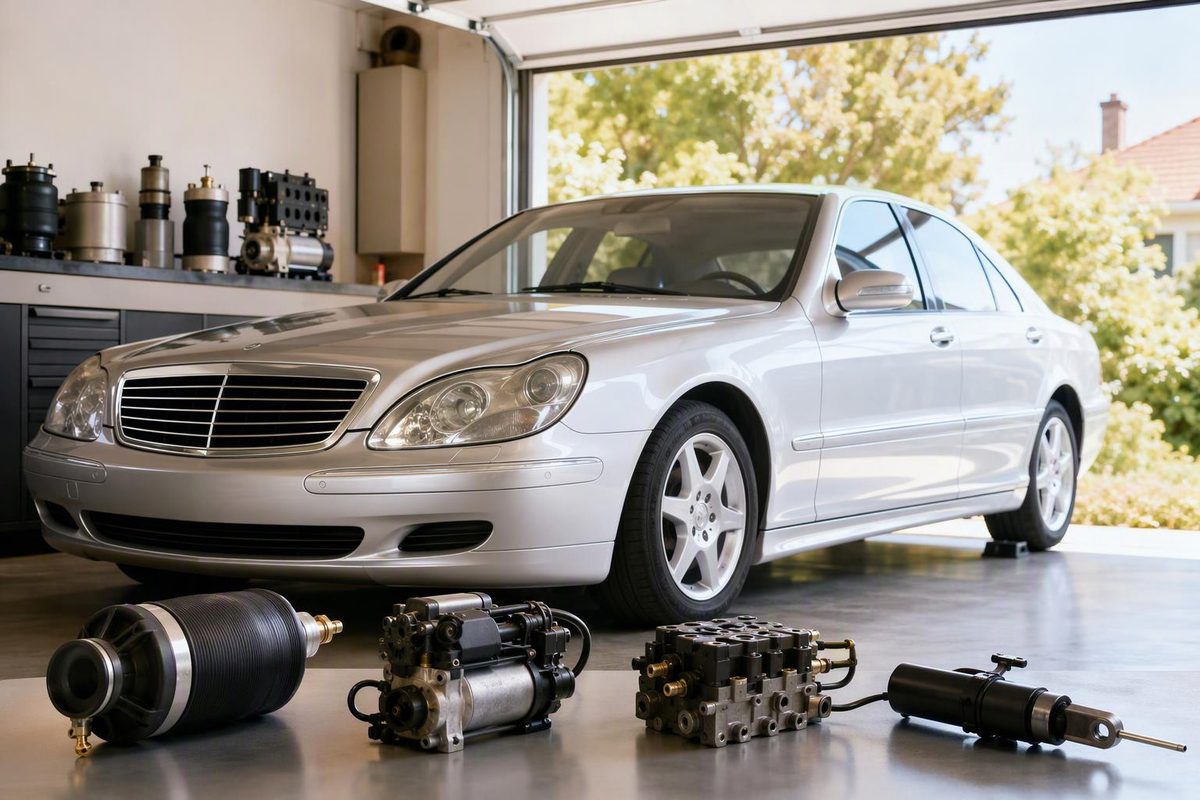
A low Mercedes W220 does not automatically need an air strut, and a silent compressor does not automatically need replacing. The same visible fault can come from an air leak, valve block, compressor supply circuit, level sensor or incorrect ride-height calibration.
First identify the suspension fitted, record how the car fails and scan the AIRMATIC control module. Replace a component only after testing has separated pneumatic leakage, pressure supply, electrical control and incorrect height data.
Select the car’s main symptom to see what to test first and what that symptom cannot prove.
W220 AIRMATIC Fault Sorter
Choose the behavior that best matches the car.
Start With Local Leak Isolation
Source: W220 AIRMATIC workshop, system-description and operator’s-manual references cited in the guide. This sorter identifies a test path, not a confirmed failed part.
Confirm That the W220 Has AIRMATIC
This guide applies to the W220 S-Class with AIRMATIC and Adaptive Damping System (ADS). It does not apply to a car fitted with hydraulic Active Body Control (ABC).
Check the vehicle data card, VIN-specific parts catalog, instrument messages and suspension hardware. Mercedes workshop documentation describes W220 AIRMATIC as applying to model 220 except vehicles with option code 487, Active Body Control. The systems have separate components and require different diagnosis (W220 AIRMATIC workshop documentation).
AIRMATIC combines four air spring or strut units with a compressor, pressure reservoir and valve block. Two front level sensors and one rear-axle sensor report body height to the N51 control module, which also controls adaptive damping. The system therefore has pneumatic, mechanical and electrical failure paths—not one universal “bad air suspension” fault (W220 AIRMATIC system description).
Treat “STOP, CAR TOO LOW!” as a Stop Warning
If the red message says AIRMATIC STOP, CAR TOO LOW!, stop somewhere safe and inspect tire-to-body clearance. Do not continue if a tire is touching the body, the car is severely tilted or you hear scraping.
Mercedes’ 2004 W220 operator’s manual says to select the raised level, avoid turning the steering wheel too far, listen for scraping and not exceed 50 mph (80 km/h) while seeking service. That speed is an upper limit, not permission to drive a collapsed car. If the car will not rise enough for safe clearance, arrange a flatbed tow (2004 S-Class operator’s manual, pp. 318–319).
Keep clear of the wheel housings while the system is operating. Never work beneath a W220 supported only by its air suspension or a jack; use the specified lift points and properly rated stands or a lift. The body can change height when the system wakes or a valve opens. The operator’s manual specifically warns occupants to keep hands and feet away from the wheel housings and stay out from under the car while the chassis is lowering.
Match the Failure Pattern Before Testing Parts
| Observed Behavior | Leading Possibilities | What It Does Not Prove |
|---|---|---|
| One corner drops while parked | Strut, fitting or line leak; internal valve-block leakage | The strut itself is bad |
| Front, rear or all four settle | Multiple leaks, valve block or supply-side leak | All affected struts failed together |
| Car rises, then sinks later | Pneumatic leak; note which corner moves first | The compressor is healthy under load |
| Car stays low and compressor is silent | Fuse, relay, wiring, control inhibition, compressor or sensor data | A new compressor will fix it |
| Compressor runs long or car rises slowly | Leak, restricted intake or drier, or weak compressor output | The valve block is good |
| Normal height but very hard ride | ADS failsafe, damper-valve fault or wiring fault | An air spring is leaking |
| One end rises too far | Sensor linkage, signal, crossed lines, valve or calibration fault | More air should be added manually |
The N51 module monitors compressor running and cooling time because the compressor is not designed for continuous operation. It also sets the ADS dampers to a hard safety setting for certain detected faults. Repeatedly cycling the ignition or height switch to keep a leaking car raised can turn one fault into a leak plus an overheated compressor (W220 AIRMATIC system description).
Use a Diagnostic Sequence That Avoids Parts Swapping
1. Record the Parked Height
Park on a level surface, select normal suspension height and remove unusual cargo. Measure vertically from the center of each wheel hub to a repeatable point on the wheel arch. Record all four measurements, the time and ambient temperature.
Recheck without repeatedly opening doors or operating the remote. The W220 can wake the suspension and correct its level before the engine starts. A consistent drop at one corner is evidence of a local pneumatic loss, but it does not distinguish the strut from its line or the valve block.
2. Inspect Before Commanding Movement
With the car safely supported wherever access requires it, check for:
- Cracked or folded air-spring rubber and damage around the strut top
- Chafed, kinked or poorly seated nylon air lines
- Corrosion, damaged wiring or disturbed lines at the right-front compressor and valve-block assembly
- Broken, bent or disconnected level-sensor links
- Damaged ADS wiring at each strut
- Evidence of recent suspension work or incorrectly routed air lines
A knocking or squeaking suspension may instead be a ball joint, bushing or mount fault. Use the separate W220 suspension squeak diagnosis rather than assuming every chassis noise is pneumatic.
3. Scan the AIRMATIC Module
A basic emissions-code reader may report no faults because AIRMATIC has its own N51 control module. Use Mercedes STAR/Xentry or a chassis-aware scan tool that explicitly supports W220 AIRMATIC.
Before clearing anything, save:
- Current and stored fault codes, including occurrence status
- Left-front, right-front and rear level-sensor values
- System pressure
- Compressor command and response
- Valve and pressure-release-valve faults
- Battery voltage seen by the module
Compare scan-tool height data with the car’s physical position. If a visibly low corner is reported as normal or high, inspect that sensor and linkage before blaming the air spring. If a commanded corner does not move, establish whether pressure was available and whether the appropriate valve was actuated.
4. Test the Compressor Circuit Without Bypassing Safeguards
On the W220, the compressor relay and high-current fuse are in the right-front fuse and relay module. Confirm their exact assignment from the fuse chart for the individual car. Check the fuse, relay control and output, compressor power feed, ground and connector condition.
A blown fuse is diagnostic evidence, not a repair by itself. W220 repair reports include a shorted compressor blowing its fuse and relays failing either open or closed; a relay stuck closed can damage the pump (PeachParts W220 AIRMATIC discussion). Do not repeatedly install fuses or bridge the relay to force extended compressor operation.
If power and ground reach the compressor when it is commanded, use the applicable STAR/DAS test to check pressure rise against the W220 test specification. A motor that can be heard running may still be too weak to build pressure quickly enough.
5. Isolate the Pneumatic Leak
Apply a non-corrosive leak-detection solution intended for pneumatic systems to accessible suspected fittings and seams, following the product directions. Watch for foam that continues to grow; a small leak may not create a large bubble immediately. Never loosen a pressurized line merely to check whether air comes out.
STAR/DAS pneumatic tests can separately check the compressor-to-valve-block line, individual strut circuits and reservoir circuit. That distinction matters because an internal valve-block leak can let a corner settle while the air spring remains sealed. The W220 diagnostic reference also cautions that a very small connector O-ring leak may pass an automated pneumatic test, so scan results should be checked against physical leak testing and the recorded settling pattern (W220 leak-test procedures).
Repair the Cause and Its Consequence
A leaking spring can overwork an otherwise serviceable compressor. A sticking relay can overheat a new compressor. A weak compressor can make a sound valve block appear slow, while false level data can cause the module to command the wrong height.
After the repair:
- Verify that every air line and electrical connector is in its correct position.
- Clear faults only after recording them.
- Run the applicable pneumatic and actuation tests.
- Perform the specified ride-height calibration when the repair affects a level sensor, its linkage, the control module or another component covered by the calibration procedure.
- Recheck all four parked-height measurements after the car has been allowed to sleep.
- Confirm normal and raised modes without extended compressor operation.
Do not use calibration to disguise a leak or bent linkage. Calibration corrects the relationship between measured and specified height; it cannot restore lost pressure or repair worn suspension hardware.