
A Rotten-Egg Battery Smell Is a Stop-Driving Warning
A sulfur smell near a Mercedes W220 battery can indicate hazardous off-gassing. Stop safely, avoid sparks, and have the battery and charging system tested.
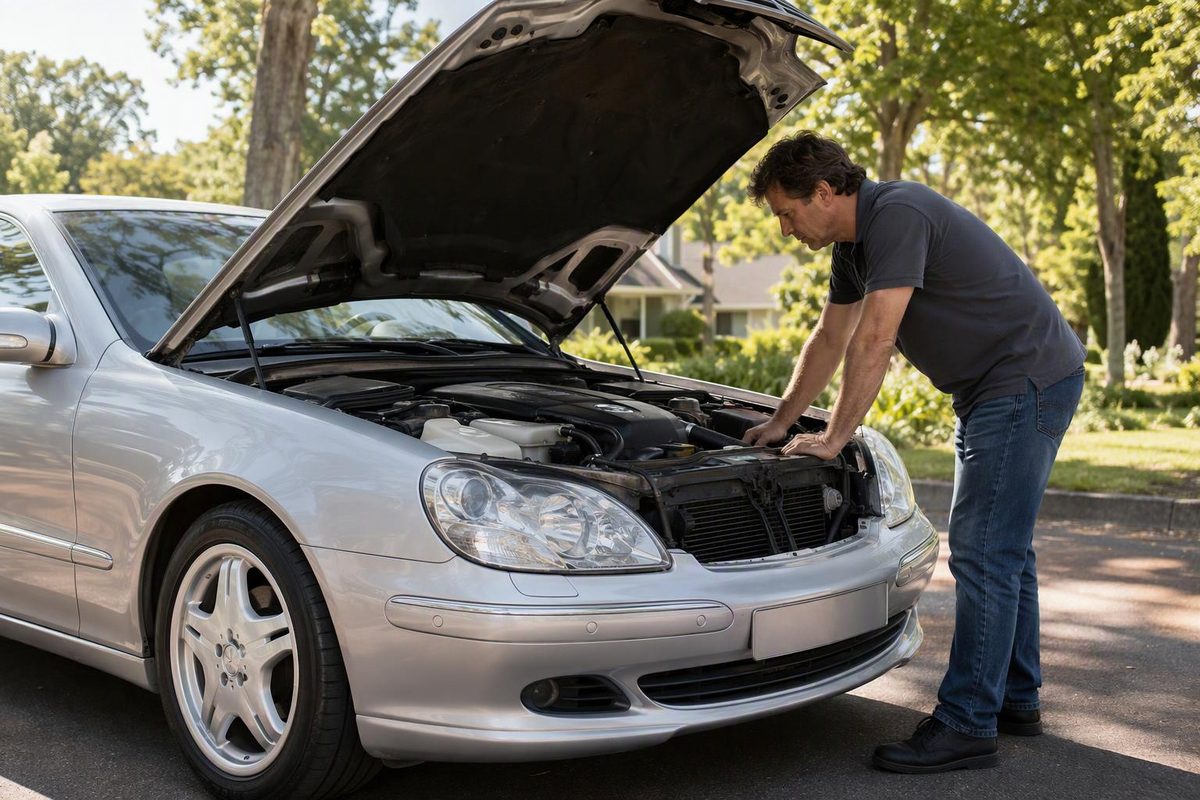
A rotten-egg smell from the battery area is not normal. On a Mercedes-Benz W220 S-Class, stop driving or charging the car, keep people away from the battery and arrange recovery for a battery and charging-system inspection.
The W220’s 12-volt battery is on the right side of the trunk under a cover. The S 430 operator’s manual identifies that location and warns that the electrolyte contains sulfuric acid and that the battery produces flammable, explosive hydrogen gas (Mercedes-Benz S 430 operator’s manual, p. 410). Check the manual for your exact year and variant before any later service work.
What the smell indicates
A battery-area rotten-egg odor is consistent with hydrogen sulfide, a toxic and flammable gas. Battery manufacturer Interstate identifies the smell as a sign of an overcharging battery and advises people not to approach it (Interstate Batteries). The immediate task is therefore safety—not opening the trunk trim for a closer sniff or connecting a meter.
Hydrogen sulfide is different from the hydrogen that lead-acid batteries normally can release while charging. Hydrogen has no odor, but it adds an ignition and explosion risk. A lead-acid battery safety data sheet says charging generates hydrogen, requires ventilation and calls for keeping sparks, flames and smoking materials away (U.S. Battery Manufacturing).
Possible underlying faults include:
- an alternator or voltage-regulator fault that is overcharging the battery;
- an unsuitable, incorrectly set or faulty external charger;
- internal battery damage or deterioration;
- severe battery overheating;
- a disconnected, blocked or incorrectly fitted vent path that allows battery gases into the trunk.
A vent fault may explain why fumes reach the cabin or trunk. It does not explain why the battery is producing a strong sulfur odor; the battery and its charging source still require diagnosis.
Stop safely—do not test it at the roadside
If the odor appears while driving:
- Pull over in a safe outdoor location and switch off the engine. Do not keep driving to see whether the smell clears.
- Get everyone out and move away from the car. Keep cigarettes, flames, jump packs, chargers and other possible ignition sources away.
- Do not lean over the battery, remove its cover to investigate, disconnect the terminals or attempt a jump-start. A tool or terminal connection can produce a spark. Mercedes also warns against detaching the battery clamps while the engine is running or the SmartKey is in the starter switch because that can damage the alternator and other electronics (operator’s manual).
- Arrange recovery rather than driving the W220. Tell the operator that the trunk-mounted lead-acid battery may be hot or off-gassing.
If an external charger is connected, shut off its power at a remote outlet only if that can be done without approaching the battery or creating a spark nearby. Do not resume charging. The W220 manual warns not to charge the battery while it remains in the vehicle unless using a Mercedes-Benz-approved accessory charging unit, because escaping gases may cause an explosion (operator’s manual, p. 411).
Treat a swollen case, hissing, visible vapor, smoke, heat discoloration or acid leakage as a no-touch condition. Keep clear and call emergency services if there is smoke or fire.
Hydrogen sulfide can cause eye and airway irritation, headache, dizziness and nausea. At sufficient exposure, the sense of smell can become unreliable, so a fading odor does not establish that the area is safe (OSHA). Anyone with breathing difficulty, confusion, faintness, persistent eye irritation or other significant symptoms should move to fresh air and seek urgent medical help.
What the workshop should test
Replacing the battery alone is not a complete repair. If the charging system caused the fault, it can damage the replacement. Diagnosis should cover:
- The battery, once the immediate hazard has passed. Inspect for swelling, cracks, leakage, heat damage and incorrect fitment. Verify the battery’s type, rating, age, hold-down and terminals. Do not load-test a hot, swollen or leaking battery in the trunk.
- The trunk vent path. Confirm that the fitted battery’s external vent provision is connected and routed outside as its installation instructions require, without a kink or blockage.
- Battery condition. Use the test specified for that battery—such as conductance, capacity or a controlled load test. Resting voltage alone cannot establish battery health.
- Charging-system operation. Measure voltage at the battery with the engine cold and warm, at idle and raised speed, and with electrical loads applied. Compare sustained readings with the specification for the exact alternator, regulator, battery and W220 variant. Check alternator ripple as part of the charging-system diagnosis.
- Any external charger involved. Verify that it supports the fitted battery chemistry and that the correct battery mode was selected; flooded and AGM batteries do not necessarily use the same charging program (Interstate Batteries).
If the battery also repeatedly goes flat, investigate that only after the odor fault is safe. A parasitic load is a separate diagnosis; use the W220 module-sleep procedure instead of repeatedly jump-starting the car. See checking parasitic draw on a W220 with a multimeter.
The repair verdict should answer two questions: Has the battery been damaged, and why was it gassing? Do not return the car to service until the battery, charging system and trunk vent path have all been checked.